
Azure Kubernetes Service (AKS): Powering the Future of Scalable Cloud-Native Applications
In the cloud-native era, speed, scalability, and reliability are the currencies of innovation. Enterprises can no longer afford to spend weeks provisioning infrastructure or manually scaling applications. As microservices and containerization dominate modern architectures, Azure Kubernetes Service (AKS) stands tall as Microsoft’s answer to seamless orchestration in the cloud.
At its essence, AKS is a fully managed Kubernetes service that abstracts away the operational complexity of deploying, managing, and scaling containerized applications. It enables teams to deploy production-grade workloads quickly and efficiently—whether in the cloud, on-premises, or in hybrid environments.
Kubernetes itself is a powerful yet intricate system. Managing clusters, networking, secrets, and updates manually can be daunting. That’s where AKS comes in—it automates core tasks like node provisioning, auto-scaling, upgrades, monitoring, and security patching, freeing developers and data engineers to focus on innovation, not infrastructure.
For organizations developing AI-driven, IoT, or data-intensive systems, AKS provides the orchestration backbone needed for resilience, elasticity, and continuous delivery.
Azure Kubernetes Service (AKS) Architecture
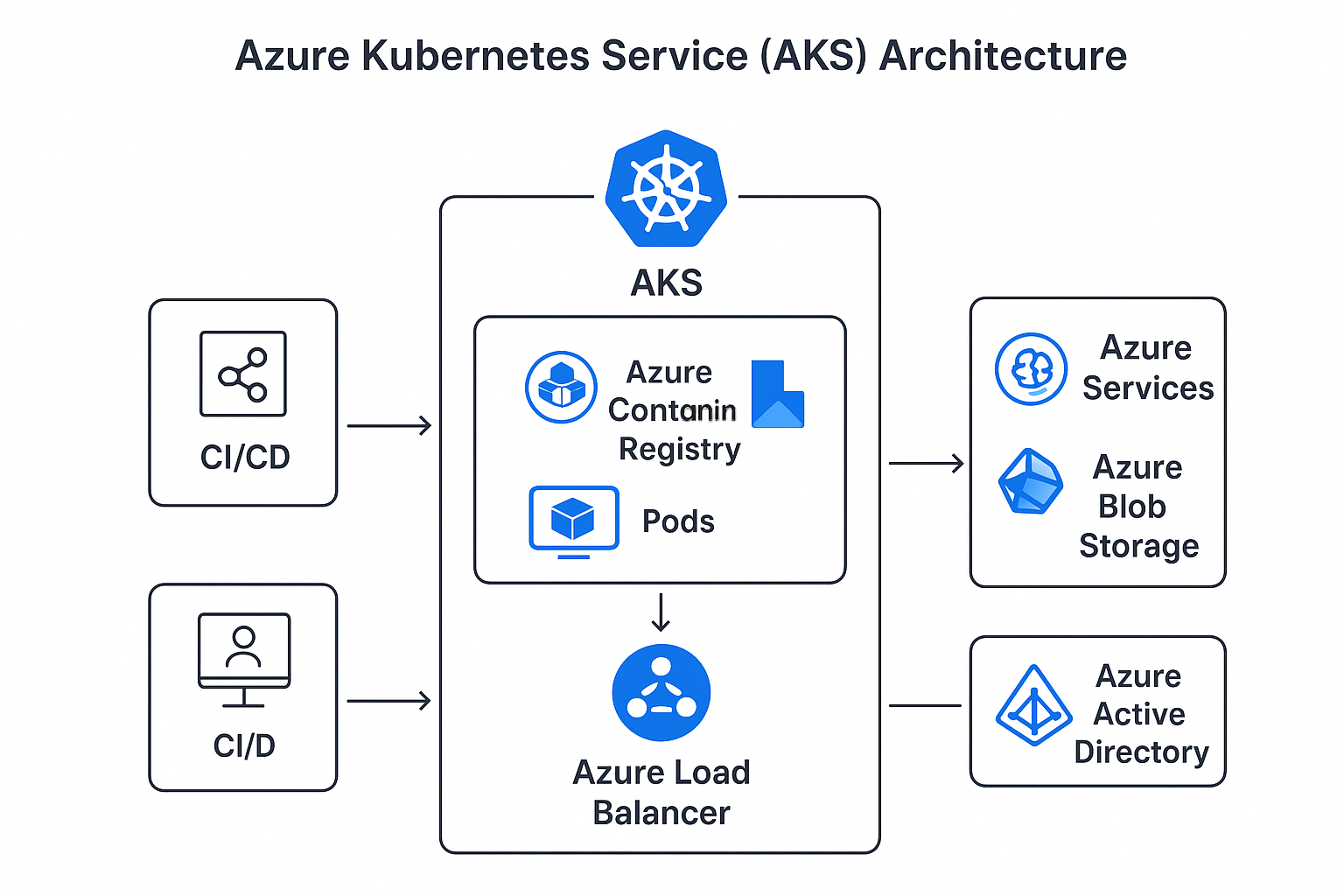
How It Works
- Developerspush code to a repository (GitHub, Azure DevOps).
- CI/CD pipeline(Azure DevOps Pipelines) builds Docker images and pushes them to Azure Container Registry (ACR).
- AKSpulls the images and deploys them as Pods inside clusters.
- Azure Load Balancer / Application Gatewayroutes user traffic to appropriate services.
- Azure Monitor + Log Analyticscapture cluster health and performance data.
- Azure Active Directory (AAD)ensures secure access management and role-based permissions.
- Optional integrations with Azure Machine Learning, Azure Arc, or Azure Cognitive Servicesextend AI and hybrid capabilities.
This setup transforms AKS into a self-healing, intelligent, and scalable foundation for cloud-native application development.
Problem Statements Solved by AKS
- The Scaling Challenge in Modern Applications
Modern web applications experience unpredictable traffic spikes—think of flash sales, live sports streams, or viral campaigns. Traditional VM-based systems struggle to scale dynamically.
Solution:
AKS enables horizontal pod autoscaling (HPA)and cluster autoscaling, ensuring workloads expand or contract automatically based on demand.
Example:
A retail platform built on AKS automatically spins up new pods during peak traffic and scales down when idle—saving up to 40% in cloud costs.
Code Snippet:
apiVersion: autoscaling/v2
kind: HorizontalPodAutoscaler
metadata:
name: web-app-hpa
spec:
scaleTargetRef:
apiVersion: apps/v1
kind: Deployment
name: web-app
minReplicas: 3
maxReplicas: 15
metrics:
– type: Resource
resource:
name: cpu
target:
type: Utilization
averageUtilization: 70
- Complexity in Multi-Environment Deployments
Development, staging, and production often behave differently due to configuration drift. AKS standardizes the deployment pipeline using Infrastructure as Code (IaC)with Bicepor Terraformand integrates easily with Azure DevOpsor GitHub Actions.
Result:
Consistent environments, fewer bugs, and faster release cycles.
Terraform Example:
resource “azurerm_kubernetes_cluster” “aks_cluster” {
name = “myAKSCluster”
location = “East US”
resource_group_name = azurerm_resource_group.rg.name
dns_prefix = “myakscluster”default_node_pool {
name = “default”
node_count = 3
vm_size = “Standard_DS2_v2”
}identity {
type = “SystemAssigned”
}
}
- Cost and Resource Optimization
AKS offers spot instances, multiple node pools, and autoscaling policies, letting teams optimize workloads for performance and cost. Integration with Azure Cost Managementprovides granular insights into utilization.
Example:
A data analytics firm used mixed node pools—GPU nodes for ML inference, CPU nodes for general workloads—reducing cost by 30% while maintaining peak performance.
- AI & ML Workload Orchestration (MLOps)
Deploying and managing machine learning models in production can be complex. AKS simplifies MLOps pipelinesby integrating with Azure Machine Learning (Azure ML)for model versioning, retraining, and serving.
Flow:
- Train model in Azure ML.
- Package as a Docker image.
- Push to ACR.
- Deploy to AKS using Azure ML endpoint.
#Python Deployment Example:
from azureml.core import Workspace, Model
from azureml.core.webservice import AksWebservice, Webservicews = Workspace.from_config()
model = Model(ws, ‘fraud_detection_model’)deployment_config = AksWebservice.deploy_configuration(cpu_cores=2, memory_gb=4)
service = Model.deploy(ws, ‘fraud-detect-service’, [model], deployment_config)
service.wait_for_deployment(show_output=True)
- Security and Compliance
Security is a first-class citizen in AKS. Features like Azure Active Directory (AAD)integration, Managed Identities, and Role-Based Access Control (RBAC)ensure robust governance.
Example:
- Integrate AKS with Azure Key Vault to manage secrets securely.
- Enforce network policies for pod communication isolation.
- Enable Azure Policy for AKSto maintain compliance with frameworks like GDPR, HIPAA, or SOC 2.
Pros of Azure Kubernetes Service
- Fully Managed Operations
AKS automates node scaling, upgrades, and patching—reducing DevOps burden. - Seamless Azure Ecosystem Integration
Direct connectivity with Azure Monitor, Application Gateway, DevOps, and ML services. - Scalability & Flexibility
Supports autoscaling, multiple node pools, GPU/CPU combinations, and hybrid clusters. - Enterprise-Grade Security
With AAD, RBAC, and Key Vault integration, AKS ensures secure multi-user access. - Cost Efficiency
Pay only for used compute. Spot nodes and autoscaling cut operational costs. - MLOps-Ready
Ideal for continuous training and deployment of AI models with Azure ML integration. - Hybrid Cloud Compatibility
Manage multi-cluster environments using Azure Arcfrom a unified dashboard.
Cons of Azure Kubernetes Service
- Steep Learning Curve– Teams new to Kubernetes face a ramp-up period.
- Azure Dependence– Deep Azure integration may not suit multi-cloud strategies.
- Resource Constraints– Certain custom configurations (like networking policies) require manual tuning.
- Cluster Startup Time– Initial provisioning may take minutes, impacting rapid-test workflows.
- Monitoring Overhead– Proper observability setup (Prometheus, Grafana, Azure Monitor) is essential for large-scale ops.
Alternatives to AKS
While AKS shines within the Azure ecosystem, other players in the managed Kubernetes space have distinct advantages:
Amazon Elastic Kubernetes Service (EKS)
AWS’s Kubernetes offering known for deep integration with AWS IAM and EC2 Spot instances. Ideal for AWS-first infrastructures.
Google Kubernetes Engine (GKE)
Google’s GKE is widely recognized for automation and AI-native workloads—arguably the most mature managed Kubernetes solution.
Red Hat OpenShift
A Kubernetes platform with developer-friendly tooling, enterprise policy management, and strong hybrid capabilities.
Rancher / Docker Swarm
Simpler orchestration platforms suitable for small-scale deployments and edge computing.
Verdict:
For enterprises already leveraging Azure’s cloud, AKS offers the smoothest integration, strongest AI/ML ecosystem support, and best hybrid capabilitiesthrough Azure Arc.
Industry Insights
The AKS roadmapand Kubernetes ecosystem are evolving at lightning speed. Some key innovations shaping its future include:
- Azure Arc-Enabled Kubernetes:
Unified governance of on-prem, edge, and multi-cloud clusters under one control plane.
- Confidential Containers:
Leverages Intel SGX and AMD SEV for secure enclave-based computation—critical for finance and healthcare.
- Serverless Kubernetes (Virtual Nodes):
Instantly scale pods using Azure Container Instances without provisioning nodes manually.
- AI-Powered Auto-Healing Clusters:
Machine learning models will soon predict and self-correct potential cluster failures.
- eBPF and Cilium Networking Enhancements:
Better observability and security using next-generation Linux kernel networking technologies.
These updates reflect a larger trend: Kubernetes is evolving into a self-managing, AI-augmented platform—and AKS is at the forefront.
Frequently Asked Questions
Q1. What differentiates AKS from raw Kubernetes setups?
AKS automates cluster management—handling node updates, scaling, and networking—so teams can focus on code, not clusters.
Q2. Can AKS efficiently handle AI/ML workloads?
Yes. AKS supports GPU-based nodes and integrates seamlessly with Azure ML for large-scale inference and retraining workflows.
Q3. Is AKS secure for enterprise deployment?
Absolutely. AKS is backed by Azure’s multi-layered security framework and supports role-based access, network isolation, and compliance standards.
Q4. Can AKS integrate with hybrid and on-prem systems?
Yes, through Azure Arc, AKS can manage hybrid and edge clusters from one unified interface.
Q5. How does AKS reduce operational costs?
By using auto-scaling, spot instances, and resource monitoring, AKS ensures optimal compute allocation—minimizing idle costs.
Conclusion – ThirdEye Data’s Take on Azure Kubernetes Service
At ThirdEye Data, we see Azure Kubernetes Service (AKS)not just as a cloud solution, but as a strategic enabler of enterprise transformation. It empowers organizations to build, deploy, and scale intelligent applications that drive business growth.
Our engineering teams use AKS as the backbone of AI, IoT, and analyticsprojects—harnessing its elasticity, performance, and built-in security. Whether optimizing cloud costs, deploying large-scale MLOps pipelines, or enabling continuous delivery of microservices, AKS consistently delivers operational excellence.
In essence:
AKS doesn’t just orchestrate containers—it orchestrates innovation.