
Vertex AI Agent Builder: The Gateway to Agentic AI in Google Cloud
You’re chatting with your new virtual assistant: “Book me a flight to Paris next month, with a hotel near the Eiffel Tower.”
To your surprise, it does exactly that — checking flights, comparing hotels, even sending you an email with confirmation.
Not a standard chatbot, but a smart agent— an AI system that takes actions, chains tasks, and grounds itself in real data.
That’s the promise of Agentic AI— systems that do more than just reply: they reason, plan, interact, and act.
To make that real, you need tooling, orchestration, security, and integration with real enterprise data.
Enter Vertex AI Agent Builder— Google Cloud’s managed platform for designing, deploying, and governing AI agents with minimal friction.
What Is Vertex AI Agent Builder?
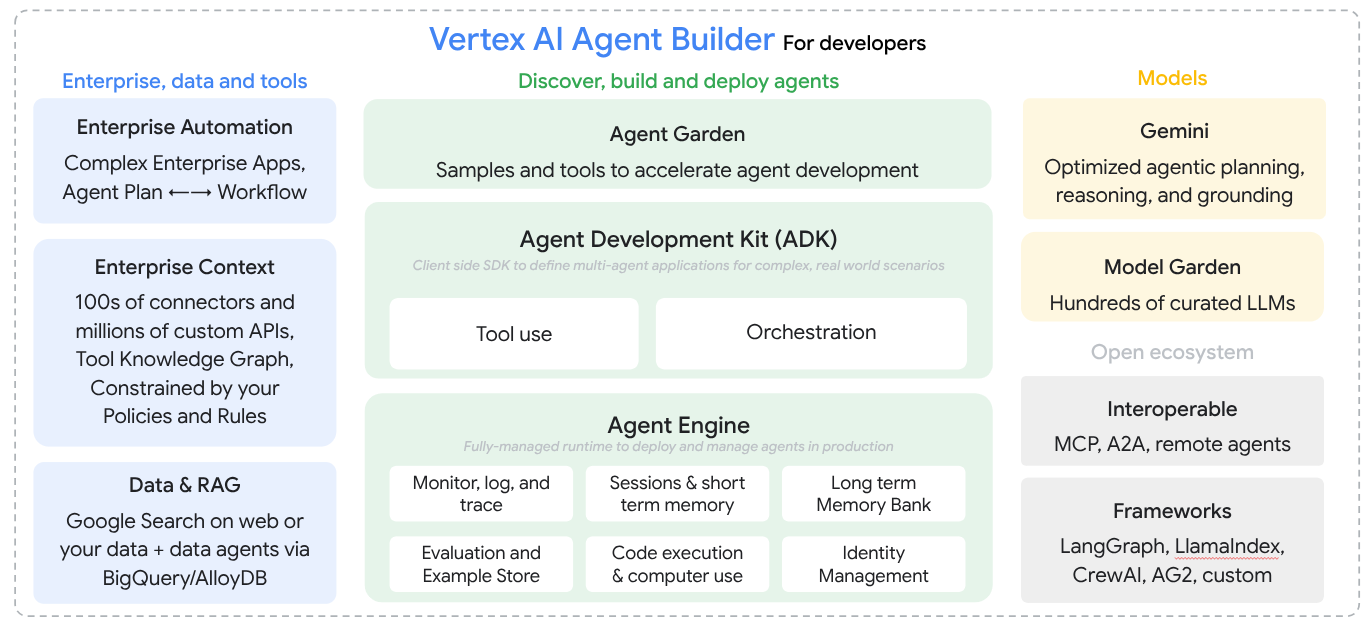
Image Courtesy: cloud.google
Vertex AI Agent Builderis a suite of tools by Google Cloud that helps developers and businesses create, deploy, and manage AI agents— applications that are more capable than chatbots, able to take actions, reason over context, and integrate with data systems.
At a high level, Vertex AI Agent Builder includes:
- Agent Garden— a library of sample agents and tools to help jumpstart your agent design.
- Agent Development Kit (ADK)— an open-source framework to build custom agents with fine-grained control.
- Vertex AI Agent Engine— the runtime environment for executing, scaling, and managing agents in production, with support for memory, sessions, evaluation, and more.
- Agent Tools / Plugins— built-in and external tools agents can use (e.g. API calls, search, code execution, datastores).
It’s tightly integrated with other Vertex AI components (search, RAG, embeddings) and Google Cloud infrastructure, offering security, scalability, and governance out-of-the-box.
Use Cases / Problem Statements Solved with Vertex AI Agent Builder
Here are concrete scenarios where Agent Builder shines:
- Automated Process Agents
- HR automation (e.g. process leave requests, benefits answers)
- IT agents (e.g. password reset, system status, diagnostics)
- Sales assistants (e.g. quote generation, follow-up tasks)
- Conversational Agents with Actions
- Not just replying — agents can call APIs, perform database operations, send emails, schedule appointments.
- Example: A “Booking Agent” that finalizes reservations by talking to flight/hotel APIs.
- Multi-Agent Orchestration / Pipelines
- Breaking down tasks into subagents (planning, execution, verification).
- Agents talk to each other — Agent2Agent (A2A) coordination.
- RAG + Grounded Agents
- Agents that fetch facts from a vector search (Vertex AI Search) or knowledge base and then reason.
- Allows safe generative responses anchored in real data.
- Domain-Specific Assistants
- Healthcare, legal, finance — agents customized to domain logic, compliance, and data context.
- Embedded Agents in Apps / Products
- Integrate the agent into your mobile/web app to assist users (e.g. product recommendation agents, tutor agents).
- Prototypes to Production
- Rapid prototyping via no-code UI + sandbox, then scale via Agent Engine.
Problem Statements Addressed:
- Chatbots are limited: they can’t perform actions reliably.
- Building full agent systems from scratch is complex (state, memory, tool integration, evaluation).
- Maintaining agents in production (monitoring, security, updates) is operationally burdensome.
- Grounding LLMs to real data (avoiding hallucination) is essential for business use.
Vertex AI Agent Builder offers a structured, managed way to do this.
How the Components Are Connected (Architecture & Flow)of Vertex AI Agent Builder
One of Agent Builder’s strengths is how its pieces work together. Below is the architecture flow and internal connectivity.
- Agent Definition / Design
- You pick or define agent types via UI or code (ADK).
- You choose tools the agent can use (datastores, APIs, RAG search).
- You set playbooks or prompts and define how the agent should behave.
- Agent Garden & Templates
- Use sample agents or scaffolding as starting points (e.g. FAQ bots, booking, knowledge agents).
- Customize templates to your domain/business logic.
- Agent Development Kit (ADK)
- Code-level layer where developers define logic, integrate custom tools, manage prompts or fallback logic.
- Agent Tool Integration
- Agents can use built-in tools like Vertex AI Search, Grounding tools, Code Execution, or custom connectors to your internal APIs. The Model Context Protocol (MCP)defines a protocol for context, tool invocation, and result passing.
- Agent Engine / Runtime
- This is where your agent runs in production.
- It manages Sessions, Memory Banks(tracking context over turns), Evaluation / Logging, scaling, error handling.
- Interaction Layer
- Agents get input (text, voice, UI triggers).
- They may call tools or external APIs.
- They reason and generate output.
- Feedback loops or chaining to sub-agents possible (multi-agent flows).
- Monitoring, Governance, Updates
- Logging, evaluation metrics, versioning, safety checks.
- Role-based access, compliance controls.
- Integration / Exposure
- Agents can be exposed via API, embedded widgets, in-app UI, web chat, or integrated inside larger systems.
In practice, the flow might look like this:
- User asks a question → Agent receives it
- Agent uses a grounding toolto retrieve relevant facts (e.g. Vertex AI Search)
- Agent uses logic/control to plan a sequence of steps (if multi-step)
- Agent calls APIs or tools to perform tasks (e.g. check availability, book, send email)
- Agent returns a final response or triggers follow-up steps
Because Google handles much of the plumbing (scaling, logging, tool orchestration), you can focus on agent logic and domain knowledgeinstead of infrastructure.
Pros of Vertex AI Agent Builder
Here are the key advantages of using Vertex AI Agent Builder:
- Lower Barrier to Agentic AI
You don’t need to build the entire infrastructure from scratch — UI, tools, runtime, memory, evaluation are provided. - Tight Integration with Google Cloud Ecosystem
Works well with Vertex AI Search, RAG pipelines, BigQuery, Cloud Storage, IAM, etc. - Scalability & Managed Runtime
Agent Engine scales per workload, handles sessions, memory, concurrency. - Tooling Support & Extensibility
Built-in tools + ability to plug in custom connectors and APIs. - Grounded Reasoning
Because agents can be linked to data sources, they can avoid hallucination by grounding responses. - Agent Templates + Garden
Pre-built agents and tools accelerate development. - Evaluation & Monitoring Built-In
Logging, performance metrics, memory logs, versioning for safe iteration. - Agent2Agent (Multi-Agent) Support Planned
Enables orchestration between agents in a system of agents.
Cons of Vertex AI Agent Builder
No tool is without trade-offs. Here are the drawbacks and things to watch out for:
- Less Control Over Low-Level Mechanics
Because it is managed, you have limited access to adjust internal scoring, memory layout, or core model internals.
- Learning Curve for Complex Agents
For multi-agent orchestration or deeply customized logic, you’ll still need to work with ADK and understand agent design.
- Cost Considerations
Running multiple agents with tool usage, data grounding, memory, sessions — especially with LLM overhead — can get expensive.
- Domain Embedding / Fine-Tuning Needs
Generic embeddings may underperform in niche domains unless you fine-tune or customize models.
- Feature Maturity / Gaps
Some advanced capabilities (very custom ranking, exotic connectors) may be missing or in preview.
- Vendor Lock-In
Deep use of Google’s native connectors, protocols, and runtime may make migration harder later.
- Performance Constraints at Scale
Agents with many tools/triggers may incur latency unless optimized carefully (caching, batching, pipeline design).
- Safety / Hallucination Risks
Even with grounding, agents can still misinterpret or incorrectly chain steps if prompts or logic aren’t carefully designed.
Alternativesof Vertex AI Agent Builder
If Vertex AI Agent Builder doesn’t fit your needs (cost, flexibility, platform), here are alternatives:
| Approach | Example | Trade-Offs |
| Open-Source Agent Frameworks | LangChain, AutoGPT, Agentic frameworks | Full control, but you manage runtime, memory, tool orchestration. |
| Other Cloud Agent Platforms | Amazon SageMaker Agent, Azure AI Agent offerings | May tie to respective cloud ecosystems. |
| Custom Build from Scratch | Your own orchestration, memory, model + tool integration | Maximum flexibility, but high engineering overhead. |
| Chatbot Platforms with Extension | Dialogflow, Rasa etc. extended with LLMs + APIs | Good for conversational use but less action / reasoning depth. |
Many teams adopt a hybridapproach: start with Agent Builder, but once scale or customization demands arise, migrate certain components to custom agent frameworks.
Upcoming Updates / Industry Insightsof Vertex AI Agent Builder
Here’s what’s happening or expected in the Agent Builder / agentic AI space:
- Deeper Gemini & Model Integration
Google is pushing tighter integration with Gemini models, enabling agents to reason with multimodal inputs (text, image, etc.).
- Agent2Agent Communication (A2A)
Coordinating multiple specialized agents (planner, executor, verifier) is becoming more feasible.
- Better Grounding & Fact Verification
Agents will have more robust support for verifying facts from sources and flagging uncertainty.
- Improved Tool Ecosystem / Connectors
More plug-and-play connectors to enterprise systems (Salesforce, SAP, databases) and third-party APIs.
- No-Code & Low-Code Enhancements
Building agents via visual flows will become richer, allowing non-engineers to build agents.
- Safety & Guardrails
More built-in prompt guards, feedback loops, validation layers to prevent rogue actions.
- Edge / Offline Agent Support
Agents that can act with limited connectivity or on-device components.
- Auto-Scaling Memory & Caching
Smart memory management (forgetting or summarizing old context) to maintain performance over long sessions.
These trends mean that the platform will become more powerful, flexible, and safer over time.
Project References of Vertex AI Agent Builder
Frequently Asked Questions of Vertex AI Agent Builder
Q1: Do I need to code at all?
You can start with no-code using the Agent Builder UI and Agent Garden templates. When you want custom logic or advanced flows, you’ll work with ADK.
Q2: Can agents interact with my internal APIs / systems?
Yes — you can integrate custom connectors or tools to call your internal APIs or systems from within the agent.
Q3: How do agents avoid hallucination?
By using grounding tools (like Vertex AI Search or datastores) to fetch facts, and configuring agents to rely more on data than free-form generation.
Q4: How is pricing handled?
Costs depend on agent usage, tool invocations, model inference, data retrieval, and memory/storage use. The more complex the agent, the more cost.
Q5: Can I host the agent outside Google Cloud?
The agent runtime (Agent Engine) is Google-managed, but you can expose the agent endpoint or embed it in external apps via APIs or widgets.
Q6: What is Agent2Agent / multi-agent support?
A feature (in preview) that allows different agents to talk to each other — e.g., a planner agent delegating tasks to executor agents.
Q7: What limitations exist currently?
Some advanced tool types or connectors may be missing; deep customization is limited in the UI layer; maturity is still evolving.
Third Eye Data’s Take on Vertex AI Agent Builder
Vertex AI Agent Builder is a powerful leap forward for organizations aiming to adopt agentic AIrather than just chatbots. It wraps up the infrastructural complexity — memory, sessions, tool integration, runtime scaling — into a more accessible platform.
For developers, it means faster iteration. For product teams, it means embedding reasoning agents in your apps. And for enterprises, it means safer, grounded AI that aligns with governance and compliance.
If you want to build agents that do, not just talk — agents that act, reason, and integrate — Agent Builder is a strong foundation.
Call to Action
- Head to the Google Codelab: Building AI Agents with Vertex AI Agent Builderand build your first agent step by step. Google Codelabs
- Try customizing it for your domain — add a datastore, plug in an API, test actions.
- Embed or expose it in your web or mobile app and see how users respond.