







Agentic AI Automation Solutions for Enterprises

Explore our customized approach to agentic AI automation at enterprise scale. We are enabling businesses to transform their AI and automation initiatives into value-generating processes.  

We orchestrate AI agents, people, and systems, along with embedded governance and security, to achieve specific business objectives. Our agentic AI solutions bridge the gap between innovation and revenue.

Introduction to Our Agentic AI Solutions

While embracing AI automation, enterprises look for intelligent systems that can perceive their environment, reason about it, take actions, and continuously improve. And they prefer AI solutions that can surpass the baggage of human supervision at every step. 

This is where our approach to building agentic AI solutionscomes in and serves the purpose of value-generating AI automation. 

At ThirdEye Data, we specialize in designing and deploying enterprise-grade AI agents to deliver measurable outcomes in terms of business value, risk, and practicality. We develop goal-based AI agents and orchestrate them to connect directly to the measurable KPIs, such as revenue, cost, sales, productivity, engagement, retention, and compliance.

The image is the Graphical Representation of Agentic AI Workflow

Our Approach: How We Automate Workflows

We believe automation should go beyond scripting repetitive tasks. True transformation happens when workflows can think, adapt, and executewith minimal to no human intervention. That’s where our approach works best. Backed by autonomous AI agents, Agentic AI orchestration, and Multi-Agent Systems, itstands apart. 

We don’t just deliver automation. We design business ecosystems where AI agents collaborate, decisions evolve, and your workflows run as smoothly as your best-performing team.

From Workflows to Autonomous Intelligence

Traditional workflow automationis rigid: if X happens, do Y. But businesses don’t operate in a static world. Customer needs change, supply chains shift, and compliance rules evolve. 

Our focus is on building AI-powered workflowsthat are: 

  • Adaptive:Powered by Agentic AI loops, AI agents continuously perceive, reason, act, and learn from their environment. 
  • Context-Aware: We leverage LLMs (Large Language Models)for complex reasoning and SLMs (Small Language Models)for lightweight, domain-specific tasks. 
  • Resilient: Workflows don’t break when exceptions occur; agents find alternative paths to keep processes running.

Orchestration Through Multi-Agent Systems

The real value-for-money comes when multiple agents work together towards a specific goal and achieve it autonomously, just like teams in any business. We use Agentic AI orchestration to coordinate them. Here are some worth-to-be-mentioned agents types: 

  • Worker Agents:Carry out specialized tasks; such as data validation, report generation, risk checks. 
  • Custom AI Agents:Designed for a specific domain, whether it’s claims processing, customer onboarding, or predictive maintenance. 
  • Custom Copilots:Embedded into employee workflows, giving real-time guidance, drafting documents, or triggering actions on request. 
  • Orchestrator Agent: Ensures all agents collaborate in sync, like a digital project manager. 

This multi-agent approach makes our agentic AI automation modular, scalable, and easier to evolve with any business.

Flexibility With Low Code / No Code Development

We understand not every organization wants to dive deep into complex AI engineering. That’s why our approach also supports Low Code / No Code development, enabling business users to: 

  • Configure agents for specific tasks without heavy coding. 
  • Adjust workflows quickly when business needs change. 
  • Prototype automation fast before scaling enterprise-wide. 

This means IT teams stay in control while business units move with agility.

The Agentic AI Loop in Action

Every AI agent we build follows the Agentic AI loop, a continuous cycle that ensures reliability and improvement. Here are some core components of our Agentic AI loop: 

  • Perception:The agent observes data, events, or user input. 
  • Reasoning:It interprets the situation using predefined business rules + AI models. 
  • Decision-making: It identifies the optimal next action. 
  • Execution: The agent acts autonomously for tasks like triggering APIs, updating systems, sending notifications. 
  • Learning or Upgrading Memory:It refines future actions by remembering context, feedbacks, and outcomes. 

We rely on this agentic AI loop to turn automation into an evolving system as a part of future scale up, so that the processes don’t just run, they improve over time.

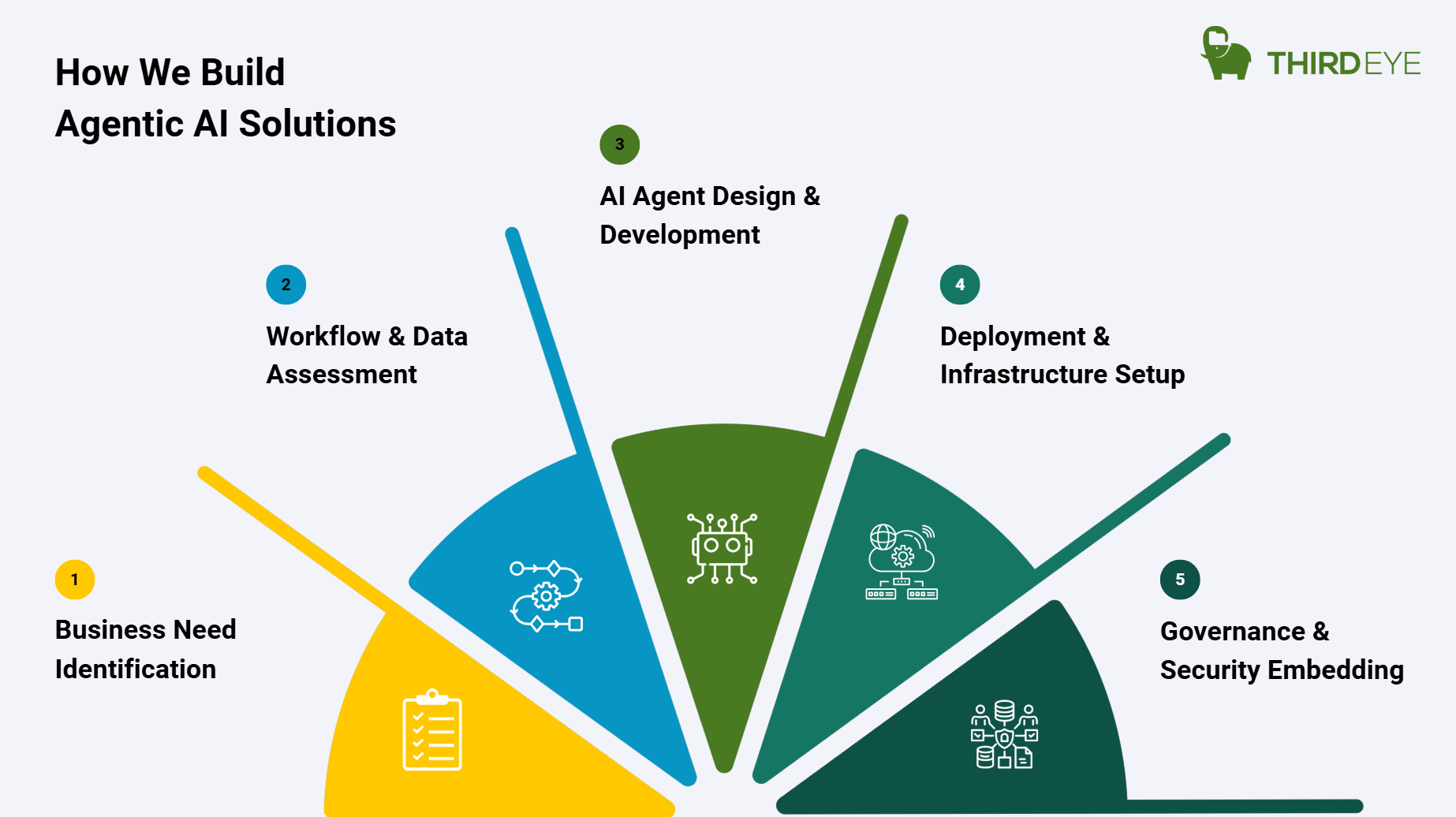
A 9-step workflow diagram illustrating the AI agent implementation lifecycle, including Business Need Identification, Workflow & Data Assessment, AI Agent Design, Integration, Multi-Agent Orchestration, Customization, Deployment, Governance, and Monitoring & Optimization.
ThirdEye Data's Agentic AI Solutions Development Process

Use Cases Where Our Agentic AI Solutions Add Values

We start with helping enterprises to identify where Agentic AI actually moves the needle in their real business terms, across industries and departments. Businesses invest serious money in agentic AI automation, so we don’t make fluffy promises, we only build solutions to deliver hard business value. 

Once we identify the use case & objective, we develop and deploy an adaptive agentic intelligence layerinto the existing operational process. That’s the way we deliver ROI for businesses.

Sales, Marketing & Revenue

Our Agentic AI solutions empower sales and marketing teams with autonomous AI agents to automate the entire workflow for use cases like: 

  • Automated lead qualification & scoring 
  • Hyper-personalized prospect outreach 
  • Campaign orchestration & optimization 
  • Intelligent upselling & cross-selling copilots 
  • Real-time revenue forecasting 
  • Proposal & contract automation 
  • Customer Loyalty Program Automation

Human Resource & Recruitment

With our custom AI agents, HR teams streamline and automate workflows for recruitment, employee engagement, and performance management. 

  • AI-driven talent sourcing & screening 
  • Automated interview scheduling 
  • Smart onboarding & compliance automation 
  • Employee query copilots 
  • Continuous performance monitoring 
  • Predictive attrition analysis 
  • Task and Asset Allocation 
  • Personalized training program

Customer Support & Experience

Unlike traditional chatbots, our autonomous AI agents go beyond scripted interactions. They execute tasks autonomously for the best results.

  • Autonomous tier-1 & tier-2 resolution 
  • Customer sentiment monitoring 
  • Intelligent ticket routing & escalation 
  • Support copilots with real-time knowledge 
  • Proactive issue detection & alerts
  • Personalized post-purchase engagement

Research & Innovation

Our AI agent developmentfocuses on empowering research teams with autonomous copilotsthat can search, summarize, and analyze vast knowledge bases. Through multi-agent systems, complex problems are broken down and solved collaboratively. 

  • Semantic search across research & patents 
  • Automated literature reviews & trend analysis 
  • Data preparation & simulation automation 
  • Research copilots for hypothesis testing 
  • Competitor innovation tracking 
  • Compliance & citation automation

Knowledge Management

Enterprises generate massive knowledge assets, but most remain underutilized. We deploy custom AI agents and agentic AI frameworksto make enterprise knowledge instantly usable. 

  • Enterprise-wide semantic search copilots 
  • Knowledge tagging & curation automation 
  • Intelligent Q&A copilots for employees 
  • Meeting & report summarization 
  • Knowledge graph construction 
  • AI-powered decision recommendations

Operations & Security

Business operations demand reliability, and security demands vigilance. Our Agentic AI Orchestrationbrings together monitoring, analysis, and automated response in one continuous loop. 

  • Real-time IT & ops monitoring 
  • Worker agents for anomaly fixes 
  • Automated incident response orchestration 
  • Compliance & regulatory monitoring 
  • Predictive downtime prevention 
  • Operations optimization copilots

Have an Agentic Process Automation Use Case in Mind?

Please feel free to consult with our AI agent developers to get a clear road map for your project.

Our Success Stories: Agentic AI Solutions We Developed

Hire generative AI engineers with expertise in large language models, prompt engineering and enterprise GenAI deployment.

Multi-agent System to Enhance Customer Loyalty Program

Developed a multi-agent system that transforms how loyalty programs are managed and experienced for a leading marketing company.
A woman working on a desktop computer displaying a Human Resources dashboard with sections such as Employees, Payroll, Accounts, Recruitment, Training, and Performance.

Onboarding Buddy – Automating New Employee Onboarding Process

Developed and delivered a Copilot-powered Onboarding Buddy chatbot as part of the HR process automation built on the Microsoft Power Platform.
Person using smartphone for online banking while analyzing financial data on tablet, with notepad, credit card, and calculator on table, illustrating AI-based billing solutions and automation in business processes.

AI-based Billing Assistant - LLM-based Chatbot

Developed and deployed an intelligent billing assistant chatbot powered by LLMs and a robust data intelligence platform to streamline billing query resolutions.

Tools & Technologies We Use for Developing Agentic AI Solutions

Large & Small Language Models (LLMs / SLMs)

  • OpenAI GPT 
  • Anthropic Claude 
  • Google Gemini 
  • Meta LLaMA 
  • Mistral 
  • Cohere Command R+ 
  • AWS Titan 
  • Azure OpenAI (Enterprise GPT service) 
  • Phi (Microsoft SLMs)

Development Frameworks & SDKs

  • HuggingFace Transformers 
  • Rasa
  • spaCy
  • LangChain Agents SDK 
  • Anthropic Tools API 
  • OpenAI Function Calling 
  • Botpress
  • Azure Bot Service

Agentic AI Orchestration Frameworks for Multi-Agent Systems

Databases or Knowledge & Memory Stores

  • Vector DBs: Pinecone, Weaviate, Milvus, Qdrant, Chroma 
  • Relational: PostgreSQL, MySQL, SQL Server (Azure SQL) 
  • NoSQL: MongoDB, DynamoDB, Cosmos DB 
  • Search: ElasticSearch, OpenSearch, Azure Cognitive Search 
  • Graph: Neo4j, TigerGraph, Stardog
Agentic AI tools and technologies illustrating autonomous workflows for enterprise automation.

Leverage Our Expertise For Your Agentic AI Automation Initiative

Many talk about automation. But a few can deliver agentic AI automation solutions that integrate with the business DNA in a practical scenario.

We bring 14+ years of experience across industries (Finance, Healthcare, Manufacturing, Energy, Retail). Our team has proven ability to blend LLMs, SLMs, and custom AI models for specific contexts. We follow a practical roadmap – starting small, scaling fast, and aligning with business ROI. 

With ThirdEye Data, automation is no longer only about saving time. It’s about creating an intelligent layer across your business that scales, adapts, and grows with you. 

Answering Frequently Asked Questions on Agentic AI Automation

What is an AI agent?

An AI agent is a digital entity that doesn’t just respond to your instructions but can act on your behalf. Unlike traditional software, an AI agent perceives its environment, reasons over goals, makes decisions, and executes tasks. Think of it as a smart teammate that works alongside your people, not just a tool.

What is Agentic AI?

Agentic AI is the next evolution of AI - where systems don’t just generate answers but take actions autonomously. Instead of waiting for step-by-step instructions, agentic AI can plan, adapt, and complete workflows end-to-end. For businesses, this means moving from "chatting with AI" to "getting real work done with AI."

What is agentic process automation?

Agentic process automation is when AI agents handle entire workflows, not just individual tasks. For example, instead of automating only data entry, an agent can pull data, validate it, trigger approvals, send notifications, and update records; all in one loop. This brings efficiency at a process level, not just at a task level.

How does agentic AI work?

Agentic AI works through a loop:

- Perception → The agent observes data/events in real-time.
- Reasoning → It analyzes goals, constraints, and available actions.
- Decision-making → It selects the best course of action.
- Execution → It takes steps autonomously (triggering APIs, sending emails, updating systems).
- Learning → With memory, it refines future actions for better outcomes.

This loop keeps repeating, making the agent smarter and more reliable over time.

What are the types of AI agents I should choose for my business?

The type depends on your goals:

- Task Agents → Handle repetitive, well-defined tasks.
- Orchestrator Agents → Manage workflows by coordinating multiple agents.
- Worker Agents → Execute domain-specific jobs (HR, finance, ops).
- Decision-Support Agents → Help managers by analyzing data and recommending actions.
- Custom Copilots → Embedded AI assistants tailored to your business processes.

At ThirdEye Data, we map your business needs first, then recommend the right mix.

What is the difference between AI agents and traditional AI chatbots?

Chatbots talk. Agents act. A chatbot answers queries based on predefined rules and a knowledge base. But an AI agent understands context, makes decisions, and executes actions. For example, a chatbot can answer “What’s the order status?” An agent can check the order system, find delays, trigger an escalation, and notify the customer automatically.

How can businesses use multi-agent systems?

Multi-agent systems are like specialized teams inside your organization. Instead of one “super AI,” you deploy a group of agents to collaborate. For example, a lead qualification agent hands info to a sales agent, which triggers a billing agent. This modular approach makes automation flexible, scalable, and easier to maintain.

Can custom AI agents integrate with my existing infrastructure?

Yes. Our AI agents are designed to connect with ERP, CRM, HRMS, billing platforms, or even legacy systems. Through APIs, connectors, and custom adapters, we make sure AI works with your stack, not against it.

How do I engage ThirdEye Data for Agentic AI Automation Solutions?

Start with a discovery call. We’ll assess your workflows, identify automation opportunities, and recommend agent solutions (custom or pre-built). From there, we handle design, development, deployment, and scaling; end-to-end.

What is the purpose of an orchestrator agent?

The orchestrator agent is the “project manager”; it coordinates multiple worker agents, manages dependencies, and ensures workflows are completed correctly. Without it, agents act in isolation.

What happens during the perception part of the agentic AI loop?

Perception is where the agent collects data from its environment by reading databases, monitoring APIs, scanning documents, or listening to user input. This is how it “knows what’s happening now” before deciding what to do next.

What is the role of memory in an agentic AI system?

Memory allows agents to retain context, past interactions, and learning. For example, an HR onboarding agent remembers which documents an employee already submitted, instead of asking again. Memory makes agents intelligent, not just reactive.

What is the purpose of a worker agent?

Worker agents are the “doers.” They execute specific tasks such as updating records, sending emails, generating invoices, and qualifying leads. They are the hands and legs of your AI system.

What is Agentic AI and Its Capabilities?

Humans remain responsible for setting goals, defining boundaries, and making strategic decisions. Agents handle execution, but accountability, oversight, and ethical responsibility stay with people. In short: AI runs the processes, humans steer the direction.

How is agentic AI different from traditional automation?

Traditional automation follows fixed scripts (if X, then Y). Agentic AI adapts, perceives changes, reasons about them, and decides actions dynamically. This makes it resilient in real-world scenarios where things don’t always go as planned.

How do worker agents contribute to the processes of an AI system?

Worker agents execute the atomic actions that make up a larger process. One worker may extract data, another may validate it, and another may update systems. Together, they form a chain of reliable automation.

How will work change as the use of AI agents increases?

Work will shift from repetitive execution to strategic decision-making. Employees will spend less time on routine tasks and more on creative, analytical, and customer-facing work. AI agents free people to focus where human intelligence is irreplaceable in areas like judgment, innovation, and relationships.
CONTACT US