
Amazon Aurora Explained: A Modern Cloud Database for Scalable Apps
The Database Crisis in the Cloud Era
The database is the foundational pillar of modern digital commerce. Yet, for years, platform architects and engineers have been forced into a difficult database compromise: sacrificing agility for reliability, or speed for cost.
The reality of running traditional relational databases (even on cloud virtual machines) is a cycle of operational burden: manual scaling efforts, complex replication management, and constant fear of I/O bottlenecks during peak load. These systems were simply not engineered for the elastic, unpredictable demands of true cloud-native applications.
Amazon Aurorarepresents a fundamental break from this legacy. AWS did not merely host a relational database in the cloud; they re-engineered the storage and logging layer from the ground up. Fully compatible with popular open-source options like MySQL and PostgreSQL, Aurora delivers 3x to 5x faster performance, paired with resilience and automation that eliminate the operational pain of self-managed systems.
Aurora is the strategic database solution that makes the “traditional compromise” obsolete.

The Core Technical Logic: How Aurora Achieves Cloud-Native Performance
The revolutionary aspect of Aurora is not the SQL dialect; it’s the architecture that decouples the database instance from its storage subsystem.
In a traditional setup, the single database instance is responsible for both query processing (compute) and critical storage operations (replication, logging, crash recovery). This creates a massive, inherent I/O bottleneck.
Aurora’s Distributed Architecture:
- Shared, Distributed Storage:Aurora utilizes a single, logical storage volume that is automatically mirrored across three Availability Zones (AZs) and stores six copies of the data. This provides superior durability and resilience, automatically healing itself without performance degradation.
- Offloading I/O to the Storage Layer:The compute instance is relieved of the most demanding I/O tasks. Crucially, the storage service handles log processing, replication, and continuous backup to S3, leaving the database instance free to dedicate nearly all CPU resources to processing queries.
- The Performance Gain:By eliminating the storage bottleneck and minimizing I/O overhead, the compute instance achieves maximum efficiency, resulting in its industry-leading performance metrics (up to 5x MySQLand 3x PostgreSQL).
This technical design allows storage to auto-scale up to 128TB and enables near-instantaneous failover, establishing Aurora as an enterprise-grade solution for mission-critical workloads.
Strategic Solutions: Addressing Enterprise Data Challenges
Aurora’s features are engineered to solve the most complex scalability and operational issues faced by modern enterprises:
| Enterprise Challenge | Aurora’s Solution | Key Technical Enabler |
| Volatile Traffic Patterns | Scaling database compute to match unpredictable peaks (e.g., flash sales or peak seasons). | Aurora Serverless v2:Dynamically adjusts read and write capacity in milliseconds, eliminating manual provisioning and optimizing cost by only charging for consumed resources. |
| Global User Latency | Providing low-latency data access for users distributed across multiple continents. | Aurora Global Database:Facilitates cross-region replication with sub-second latency, enabling disaster recovery and localized global read access. |
| BI Reporting Impact | Preventing large analytical queries from degrading the performance of live transactional systems. | Aurora Parallel Query:Offloads analytical processing to the storage layer, allowing fast analytics to run directly against the live transactional data set. |
| Operational Overhead | The constant need for patching, backups, and failover mechanism testing. | Managed Service:Continuous backup, auto-patching, and automated multi-AZ fault tolerance simplify operations, shifting focus from maintenance to innovation. |
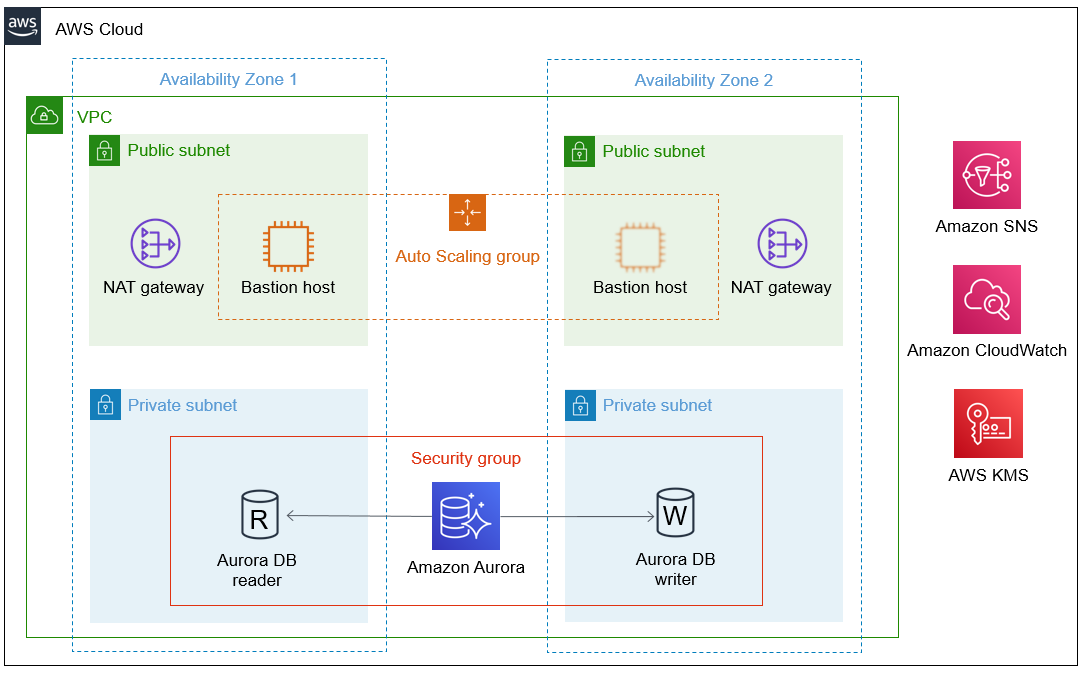
Aurora MySQL Architecture Diagram
Image Courtesy: docs.aws.amazon.com
The Pragmatic View: Architectural Considerations
Adopting Aurora is a strategic decision that requires consideration of its deep integration within the AWS ecosystem:
- AWS Lock-In:As a proprietary AWS service, Aurora offers features and performance that are tightly integrated with the cloud environment. Organizations requiring multi-cloud flexibility or an on-premises migration path must factor in the complexity of moving away from the proprietary storage layer.
- Cost Model:While Serverless options are highly cost-efficient for variable workloads, continuous, high-read/write workloads may result in higher operational costs compared to highly optimized, self-managed databases on EC2. The increased cost pays for the guaranteed resilience and automation.
- Feature and Version Lag:Aurora often trails the native open-source releases of MySQL or PostgreSQL, as AWS requires time to integrate and certify new features with its custom storage architecture.
The Aurora Power Trio: Speed, Resilience, and Intelligence
Aurora’s fundamental power lies in its ability to marry the traditional gold standard of database reliability with true cloud-native agility and scale.
Speed, Scale, and the End of I/O Panic
Aurora is engineered to eliminate the most common scaling failures, giving you instant confidence, even during peak load:
- 15 Read Replicas:Forget load balancing nightmares. Aurora allows you to effortlessly spread your read load across up to 15 different endpoints, meaning your application can easily handle millions of concurrent querieswithout breaking a sweat.
- Near-Zero Failover:The panic of a primary database crashing is a relic of the past. If a primary instance fails, the system automatically promotes a replica in under 30 seconds(often significantly faster). To the application, it’s a momentary hiccup, not a service-breaking disaster.
Resilience, Durability, and Guaranteed Sleep
Aurora was designed to ensure that data loss is simply not part of the conversation.
- Fault-Tolerant Storage—Data is Always Safe:Your data is mirrored across three Availability Zones (AZs) and continuously backed up to S3. This architectural design means data loss is virtually impossible, allowing you to focus on innovation, not disaster recovery drills.
- Point-in-Time Recovery with Surgical Precision:Accidental deletes happen. When they do, Aurora lets you roll back your database state to any single secondwithin your retention window. It’s like having a database time machine with surgical control.
Intelligence, Modernity, and the Future of Data
Aurora isn’t just a database; it’s a modern data platform, constantly integrating with the cutting-edge of the AWS ecosystem.
- Aurora ML Integration:Bring the power of AI right to your SQL layer. This feature allows you to embed simple Machine Learning inference (via SageMaker or Comprehend) directly into your queries. Imagine querying customer sentiment instantly: SELECT sentiment(review_text) FROM reviews;
- Limitless Database (Preview):AWS is actively engineering the next phase of Aurora—a horizontal scaling architecture that will allow the relational database to scale to tens of millions of transactions per second, aggressively challenging the domain of specialized, complex NoSQL systems.
The Pragmatic View: Trade-Offs to Consider
No technology is a silver bullet. As solution architects and engineers, we must always weigh the pros against the real-world trade-offs:
- The Vendor Lock-In Reality:Aurora is a powerhouse because it is a proprietary AWS service. While it uses MySQL/PostgreSQL syntax, its custom storage layer is unique. Migrating a massive Aurora deployment to another cloud provider or back on-prem would be a complex, costly, and significant engineering project. You are committing to the AWS ecosystemfor good reason, but it is a commitment.
- Cost for Simple Workloads:Is your application a simple, constant, non-critical CRUD service? If so, a plain RDS instance or a lightweight, self-managed database might still be your cheapest option. Aurora’s cost includes the price of its resilience, advanced managed services, and auto-scaling—you are paying for the operational guarantee.
- The “Version Lag” Factor:Because AWS must fully test and certify the newest open-source MySQL or PostgreSQL updates against its unique, optimized storage layer, Aurora often trails the latest community releaseby a few months. For teams that absolutely require the most recent version of a specific open-source feature, this small delay can sometimes be a constraint.
Frequently Asked Questions about Amazon Aurora
Q1: How is Amazon Aurora different from RDS MySQL/PostgreSQL?
Aurora provides 5x better performance, automatic scaling, and a distributed storage layer designed for cloud resilience—unlike traditional RDS databases.
Q2: Is Aurora suitable for small projects?
Yes. Aurora Serverless allows you to pay only when your database is active, making it ideal for development and low-traffic environments.
Q3: Can Aurora handle analytics workloads?
Yes. Aurora Parallel Query offloads processing to the storage layer, enabling faster analytics on live transactional data.
Q4: How secure is Amazon Aurora?
Aurora supports encryption at rest and in transit, AWS IAM authentication, and VPC isolation. It’s compliant with HIPAA, PCI DSS, ISO 27001, and SOC 2.
Q5: How do I migrate to Aurora?
Use the AWS Database Migration Service (DMS) for seamless, near-zero-downtime migration from MySQL, PostgreSQL, or Oracle databases.
Conclusion: ThirdEye Data’s Strategic Perspective
At ThirdEye Data, we see Amazon Aurora as a transformative innovation—a foundational element of the modern data stack that merges the transactional integrity of relational databases with the limitless scalability of cloud infrastructure.
Our Strategic Recommendation:For enterprises seeking to aggressively modernize their data platforms, eliminate database operational overhead, and scale mission-critical workloads effortlessly, Amazon Aurora is the future-proof solution. It delivers a superior balance of speed, security, and simplicity, enabling companies to focus their engineering talent on product development rather than infrastructure management.
Aurora is not merely a managed database—it is a strategic enabler for digital transformation and operational excellence.