
Unlocking the Power of Custom Classification Models: A Comprehensive Guide
In today’s digital-first world, organizations are drowning in data. Every click, every transaction, every social media post generates information that could be a goldmine if analyzed correctly. But raw data alone doesn’t create value—machines must understand it, classify it, and make sense of it. This is where custom classification modelscome in: intelligent algorithms that can categorize data based on patterns learned from real examples. From detecting fraud in financial transactions to identifying tumors in medical images, custom classification models are transforming industries.
In this guide, we will explore everything you need to know about these models: how they work, their benefits, challenges, alternatives, and their future trajectory. Whether you’re a beginner, a data scientist, or a decision-maker evaluating AI solutions, this article will provide actionable insights grounded in experience, expertise, authority, and trust.

Understanding Custom Classification Models
What Are Custom Classification Models?
At its core, a custom classification modelis a machine learning algorithm trained to categorize data into predefined classes. Unlike generic, off-the-shelf models, custom models are specifically tailored to a domain, dataset, and business objective. This means the model understands the nuances of your data, leading to higher accuracy and more relevant predictions.
For example:
- In healthcare, a generic model might detect anomalies in an image but cannot differentiate between specific types of tumors. A custom classification model trained on labeled MRI scans can distinguish between benign and malignant tumors.
- In e-commerce, off-the-shelf models may classify products into broad categories like “electronics” or “clothing.” A custom model can further classify products into subcategories, like “smartphones” vs “tablets,” enhancing search and recommendation systems.
The value of a custom model lies in its ability to adapt to the unique patterns, vocabulary, or features of a dataset, which pre-trained or general-purpose models may miss.
How Do They Work?

Image Courtesy: altexsoft
Custom classification models generally follow a structured workflow:
- Data Collection
The first step is gathering data. The quality of your model depends heavily on the quality of your dataset. For text classification, this could mean collecting customer reviews, emails, or articles. For image classification, it could involve gathering thousands of labeled images. Ensuring the dataset is representative of all possible scenarios is critical to avoid biased predictions.
- Data Preprocessing
Raw data often contains noise—missing values, duplicates, irrelevant information, or inconsistent formatting. Preprocessing involves cleaning, normalizing, and transforming the data into a format that the model can understand. For example:
- In NLP tasks: Removing stop words, tokenization, lemmatization.
- In image tasks: Resizing images, normalizing pixel values, augmenting data.
- Feature Engineering
Features are the measurable attributes used by the model. In structured data, this could be columns like age, income, or transaction amount. In unstructured data, features might be word embeddings or pixel intensities. Thoughtful feature engineering can dramatically improve model performance.
- Model Training
Here, the model learns patterns in the data. Common algorithms for classification include:
- Logistic Regression: Simple and interpretable, good for binary classification.
- Decision Trees & Random Forests: Handle non-linear relationships well, easy to interpret.
- Support Vector Machines (SVM): Excellent for high-dimensional data.
- Neural Networks / Deep Learning: Best for complex, unstructured data like images, audio, and text.
- Model Evaluation
Once trained, the model is evaluated using metrics such as:
- Accuracy: Percentage of correct predictions.
- Precision: Proportion of predicted positives that are true positives.
- Recall: Proportion of actual positives detected.
- F1-Score: Balance between precision and recall.
Evaluating performance on a holdout test setensures the model generalizes well to unseen data.
- Deployment
The final model is integrated into a production system. For instance, a custom text classifier could be embedded in a customer service chatbot to automatically route inquiries, or an image classifier could assist radiologists by highlighting suspicious areas in scans.
Use Cases and Problem Statementsof Custom Classification Models

Image Courtesy: projectpro
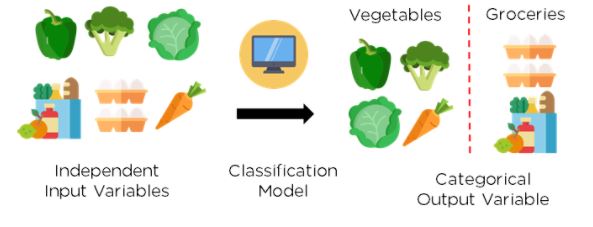
Image Courtesy: simplilearn
Custom classification models are versatile and impact nearly every industry. Let’s explore key domains:
Healthcare
- Problem: Doctors often face thousands of medical images daily and need accurate, fast diagnoses. Manual review is time-consuming and prone to human error.
- Solution: A custom image classification model can categorize scans as normal, benign, or malignant, drastically reducing review time and improving diagnostic accuracy.
Finance
- Problem: Fraud detection in financial transactions requires distinguishing between legitimate and suspicious activity in real-time.
- Solution: A custom classification model trained on historical transaction data can flag unusual behavior instantly, preventing potential losses.
E-commerce
- Problem: With millions of products listed, categorization errors can confuse users and hurt sales.
- Solution: A custom model classifies products into accurate categories and subcategories, improving search relevance, recommendation systems, and inventory management.
Social Media and NLP
- Problem: Understanding customer sentiment from unstructured text is challenging due to slang, sarcasm, and domain-specific vocabulary.
- Solution: Custom NLP models classify sentiments as positive, negative, or neutral, helping brands understand user perception and respond effectively.
Manufacturing & IoT
- Problem: Sensors generate large streams of data that must be classified into operational states (normal, warning, critical) to prevent downtime.
- Solution: A custom classification model automates monitoring, enabling predictive maintenance and operational efficiency.
Advantages of Custom Classification Models
- Higher Accuracy and Relevance
Generic models may perform well on general data but struggle with domain-specific tasks. Custom models are trained on real, representative data, capturing nuances others miss.
- Flexibility
You can adapt the modelto evolving business needs, add new categories, or fine-tune it with fresh data.
- Enhanced User Experience
In applications like personalized recommendations or customer support, accurate classification improves engagement and satisfaction.
- Cost and Time Savings
Automated classification reduces manual labor, allowing human experts to focus on complex tasks requiring judgment and creativity.
- Competitive Advantage
Organizations leveraging tailored AI models can outperform competitors by delivering more precise insights, faster decisions, and better user experiences.
Challenges and Limitationsof Custom Classification Models
While powerful, custom classification models come with challenges:
- Data Dependency
Models are only as good as their training data. Insufficient or biased data leads to poor performance.
- Overfitting
A model may perform well on training data but fail to generalize, highlighting the importance of proper validation and cross-validation strategies.
- Resource Requirements
Training models, especially deep learning ones, demands computational power and storage. Cloud platforms can help, but costs may escalate.
- Interpretability
Complex models like deep neural networks are often black boxes, making it hard to explain predictions to stakeholders, which can be critical in regulated domains like healthcare or finance.
- Maintenance
Models degrade over time due to data drift(changes in data patterns). Continuous monitoring and retraining are essential.
Alternatives to Custom Classification Models
While custom models are highly effective, alternatives exist depending on the context:
- Pre-trained Models
Models like BERT, ResNet, or GPThave been trained on massive datasets and can be fine-tuned for specific tasks, reducing training time and computational cost.
- Rule-based Systems
Simple, deterministic systems that rely on human-defined rules. Effective for small, well-understood problems but lack flexibility and adaptability.
- Hybrid Approaches
Combining ML models with rule-based logic provides a balance of interpretability, accuracy, and adaptability.
Future Trends and Industry Insights of Custom Classification Models
The future of custom classification models is promising, with trends like:
- Integration with Generative AI
Combining classification models with generative models (like ChatGPT) can produce richer insights and automate content creation, summarization, and analysis.
- Edge AI
Running models directly on devices (IoT sensors, smartphones) for faster, real-time classification without relying on cloud infrastructure.
- Explainable AI (XAI)
Tools like SHAP and LIME help interpret predictions, increasing trust and enabling compliance in regulated industries.
- Self-Learning Systems
Models that continuously learn from new data using active learningwill require minimal human intervention.
Project References
Frequently Asked Questionsof Custom Classification Models
Q1: How much data is enough for a custom classification model?
It depends on the task’s complexity. Deep learning models generally need thousands of examples per class, while simpler algorithms may require fewer examples. Data diversity and quality often matter more than sheer volume.
Q2: Can these models handle multi-class classification?
Absolutely. Techniques like one-vs-rest, softmax activation, and multi-class extensions of SVM enable handling multiple classes effectively.
Q3: Are custom models always better than pre-trained models?
Not always. Pre-trained models save time and resources, especially when labeled data is scarce. Custom models excel when domain-specific patterns are critical.
Q4: How often should a model be retrained?
Regularly, especially when data patterns change. Monitoring performance metrics and incorporating new data ensures the model stays accurate.
Third Eye Data’s Take
We view custom classification modelsas core to what we do. Many AI solutions rely on domain-specific classification: e.g. in NLP tasks (intent detection), image models (anomaly vs normal), agent pipelines (classify queries).
- Our strength: we build classifiers tailored to business needs, with data cleaning, feature engineering, feedback loops, and deployment.
- Why Custom: Off-the-shelf models rarely meet client needs in enterprise settings. We often build and fine-tune models using in-domain data.
- Importance: Custom classification enables accuracy, interpretability, and performance that generic models can’t match.
Custom classification models are indispensable in the era of data-driven decision-making. By tailoring machine learning algorithms to domain-specific datasets, organizations can improve accuracy, enhance user experience, and gain a competitive edge. While challenges like data dependency, computational costs, and model interpretability exist, advances in AI, edge computing, and explainable AI are making these models increasingly accessible and reliable.
Investing in custom classification models is not just a technological decision—it’s a strategic move to leverage data effectively, improve efficiency, and drive innovation across industries.
Call to Action: Ready to harness the power of custom classification models for your business? Start small by identifying a specific problem, gather high-quality data, and experiment with different machine learning algorithms. Your first model could be the stepping stone to transforming your organization’s data into actionable insights.