

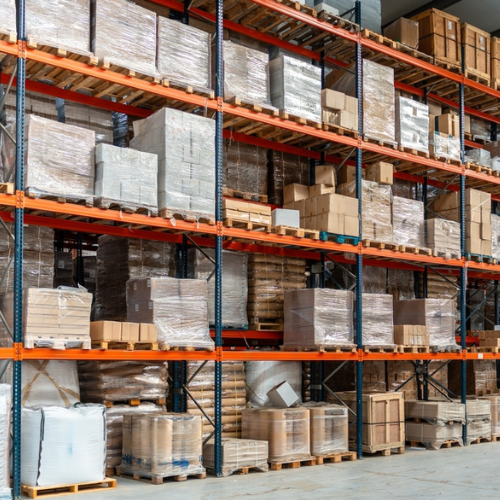
AI-based Automated Inventory Counting System for Smart Warehousing
ThirdEye Data partnered with a leading Tier-1 Agricultural Logistics & Collateral Management firm to modernize inventory management across its international warehouse network. By replacing labor-intensive manual counting with a custom Computer Vision (CV) and Large Language Model (LLM) hybrid solution. We have transformed how bulk commodities, such as sacks, bales, and crates, are audited and reconciled.
The system utilizes a “Mobile-First” approach, allowing field operators to generate auditable, highly accurate inventory counts in seconds using standard smartphones. This shift from manual tallies to AI-driven evidence has significantly improved audit defensibility and operational throughput for one of the country’s largest warehousing footprints.
THE CUSTOMER
BUSINESS GOALS OR CHALLENGES
Business Goals
- Eliminate Manual Dependencies: Reduce the 100% reliance on manual labor for stock verification and audits.
- Minimize Discrepancies: Bridge the 5–15% error rate common in high-density, high-volume stacking environments.
- Provide Visual Audit Trails: Create timestamped, photographic evidence for every inventory count to satisfy strict compliance requirements.
- Enable Multi-Commodity Scaling: Build a single platform capable of counting sacks, oil tins, boxes, and cotton bales.
- Seamless ERP Integration: Automate the flow of physical count data directly into the corporate ERP for real-time reconciliation.
Understanding the Challenges:
- Occlusion & Density: Dense stacks with irregular rows and varying heights made traditional 2D counting models insufficient.
- Infrastructure Constraints: Many regional warehouses lacked consistent CCTV coverage at entry gates and specific stacking zones.
- Environmental Variability: Variable lighting, dust, and different packaging materials (jute vs. HDPE) created high “noise” for standard vision models.
- Operational Latency: Manual audits were slow, creating bottlenecks during peak procurement seasons and delaying financial reporting.
Prerequisites and Preconditions:
- Field-testing at primary regional hubs to establish environmental baselines.
- Development of a “Dual-Image” capture methodology to account for stack depth.
- Implementation of a secondary AI validation layer to build organizational trust during the initial rollout.
THE SOLUTION
ThirdEye Data developed a custom inventory counting platform utilizing multiple advanced computer vision models. The solution employs a unique “Dual-Image” mathematical approach: a front-face image determines height and width (Rows x Columns), while a side-face image determines the number of depth layers.
Solution Highlights
Guided Mobile PWA (Progressive Web App):
Operators use a lightweight mobile app with real-time “Framing Guides” and “Quality Gates” that detect blur, poor lighting, or incorrect angles before the image is uploaded.
Dual-Layer AI Inference:
Primary: A YOLOv8-X model detects individual objects with sub-second latency.
Secondary (PoC Phase): An LLM-based validation layer cross-checks the CV count. If the discrepancy exceeds a 5% threshold, the system flags the session for human review.
Mathematical Counting Logic:
The system calculates total inventory using the formula: $Total = (Front\ Count) \times (Side\ Depth\ Layers)$. This effectively accounts for 3D stack volume using standard mobile photography.
Automated Reconciliation Engine:
The system pulls “Book Stock” from the client’s ERP and compares it to the “AI Count”:
<3% Variance: Auto-approves and updates the ERP.
>10% Variance: Triggers an immediate mandatory physical recount and blocks ERP updates.
Continuous Learning Flywheel:
Every manually corrected count is fed back into the training pipeline, allowing the model to “learn” the specific stacking idiosyncrasies of different warehouse locations.
Supported Use Cases
Daily Stock Verification: Rapid end-of-day counts for regional warehouse managers.
External Audits: Providing annotated image proofs to banking and insurance auditors.
Inbound/Outbound Ingestion: Counting sacks during loading/unloading at entry gates.
Historical Trend Analysis: Tracking warehouse utilization and “airspace” efficiency over time.
Technologies Used
YOLOv8 & RT-DETR: Core computer vision models for dense object detection.
Claude Vision API: High-reasoning LLM for count validation and anomaly detection.
FastAPI: Scalable backend for processing high-resolution image payloads.
Next.js PWA: Cross-platform mobile interface for warehouse floor use.
PostgreSQL & Cloud Object Storage: Secure storage for session metadata and annotated audit images.
VALUE CREATED
The implementation of the automated inventory counting system across the client’s pilot hubs delivered transformative results for the Indian logistics landscape:
- 80% Reduction in Audit Time: Stock verification that previously took 4–6 hours for large stacks is now completed in under 10 minutes.
- Accuracy Improvement to 97%+: By combining CV detection with mathematical volume estimation, error rates dropped from a 10% average to less than 3% in standard conditions.
- ₹40–60 Lakhs Estimated Annual Savings: Projected per major warehouse cluster through the reduction of manual labor costs and the elimination of “ghost inventory” discrepancies.
- Tamper-Evident Audit Trails: 100% of counts now include annotated visual proof, significantly reducing the “audit defense” burden and improving compliance scores with banking partners.
- Scalable Without Headcount: The firm can now onboard 5x more warehouse volume without a proportional increase in audit staff.
- Real-Time Visibility: Leadership now has a “Control Tower” view of physical stock across regional hubs, updated daily rather than monthly.

Transforming Enterprises with
Data & AI Services & Solutions.
ThirdEye delivers Data and AI services & solutions for enterprises worldwide by
leveraging state-of-the-art Data & AI technologies.