Artificial intelligence has moved from experimentation to expectation.
Over the past two years, enterprises rushed to deploy large language models, copilots, document intelligence systems, and early-stage agents. Many of those deployments delivered value. Many also revealed something uncomfortable: AI systems do not behave like traditional software. They are probabilistic, adaptive, and sensitive to context. When left loosely defined, they drift.
This realization marks a turning point.
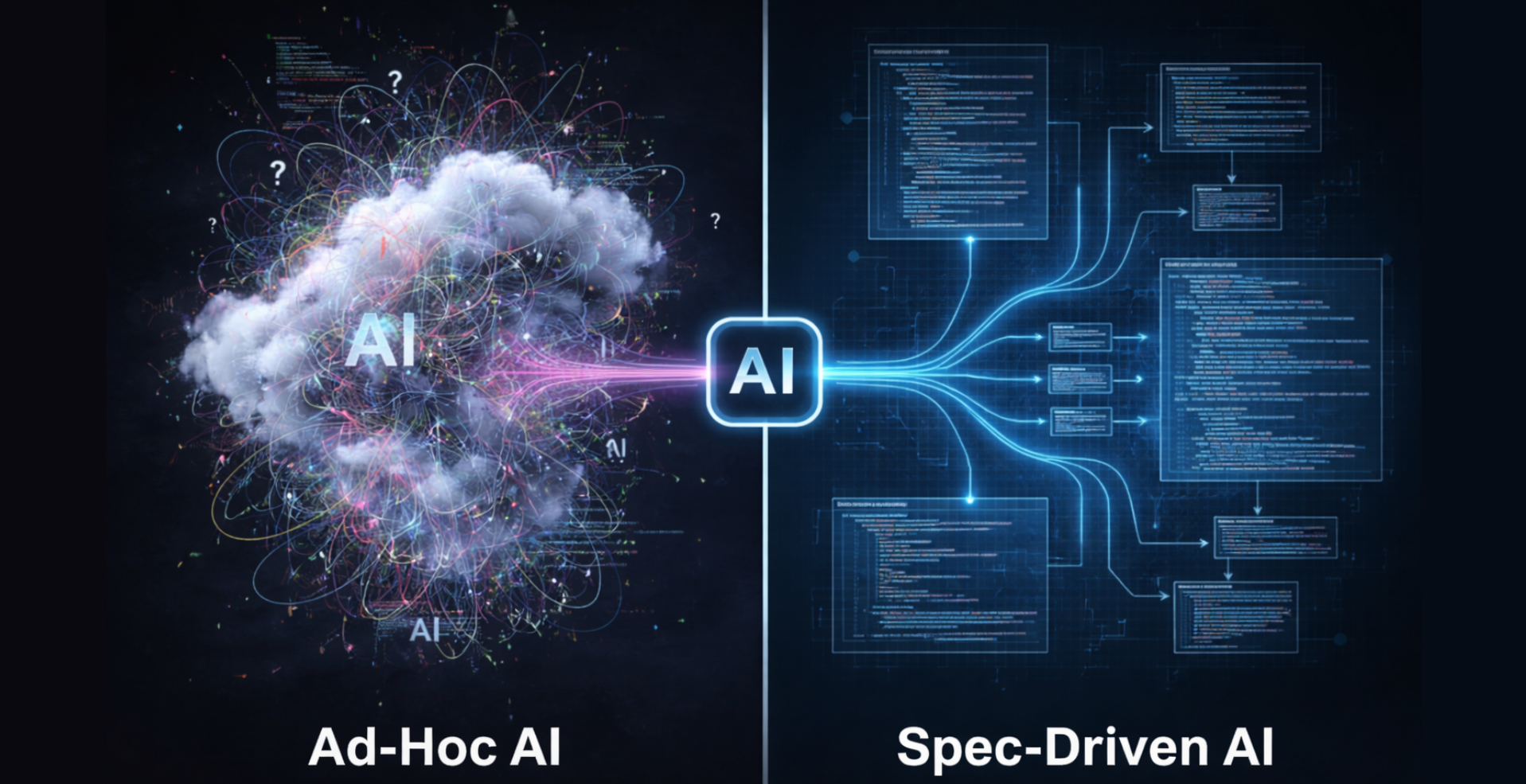
The conversation inside boardrooms has shifted from “How do we use AI?” to “How do we control, govern, and scale AI safely?”
That shift is what is driving the rise of spec-driven AI development.
Spec-driven AI is not a trend built on buzzwords. It is an architectural discipline emerging from real production lessons. It reflects maturation of AI from experimentation to infrastructure.
At ThirdEye Data, across our AI readiness programs, governed document intelligence deployments, and workflow automation systems, we have seen a consistent pattern. The difference between fragile AI and enterprise-grade AI is not the model. It is the specification.
Early generative AI deployments were prompt centric.
Teams focused on crafting instructions that produced acceptable responses. In controlled environments, this worked. But as systems scaled, weaknesses surfaced:
None of these failures stemmed from poor models. They stemmed from insufficient system definition.
Traditional software engineering matured decades ago around contracts. APIs have schemas. Services have SLAs. Security layers have policies. Changes are versioned. Tests enforce behavior.
AI systems must now undergo the same discipline.
Spec-driven AI development formalizes how AI systems are expected to behave before they are deployed.
It treats AI outputs as governed, testable artifacts rather than hopeful responses.
In conventional software, a specification defines what the system should do. In AI systems, specifications must define not only the function but the behavior under uncertainty.
A mature AI specification includes multiple layers that have concrete answers to the specific questions:
What task must the AI perform?
Example: Extract structured insurance claim fields from unstructured documents.
How should the AI reason, respond, and structure output?
Should it be conservative in uncertain cases? Should it abstain if confidence is low?
What must never occur?
What regulatory language must be enforced?
What escalation triggers are required?
What output schema must be respected?
What format must downstream systems rely on?
How will correctness be measured?
What test cases define acceptable vs unacceptable behavior?
What latency is acceptable?
What token or cost budget applies?
What logging and traceability are required?
When these layers are defined explicitly, AI systems become governable components rather than opaque black boxes.
Spec-driven AI is emerging because enterprise conditions demand it.
These pressures are not theoretical. They are visible in production deployments across industries.
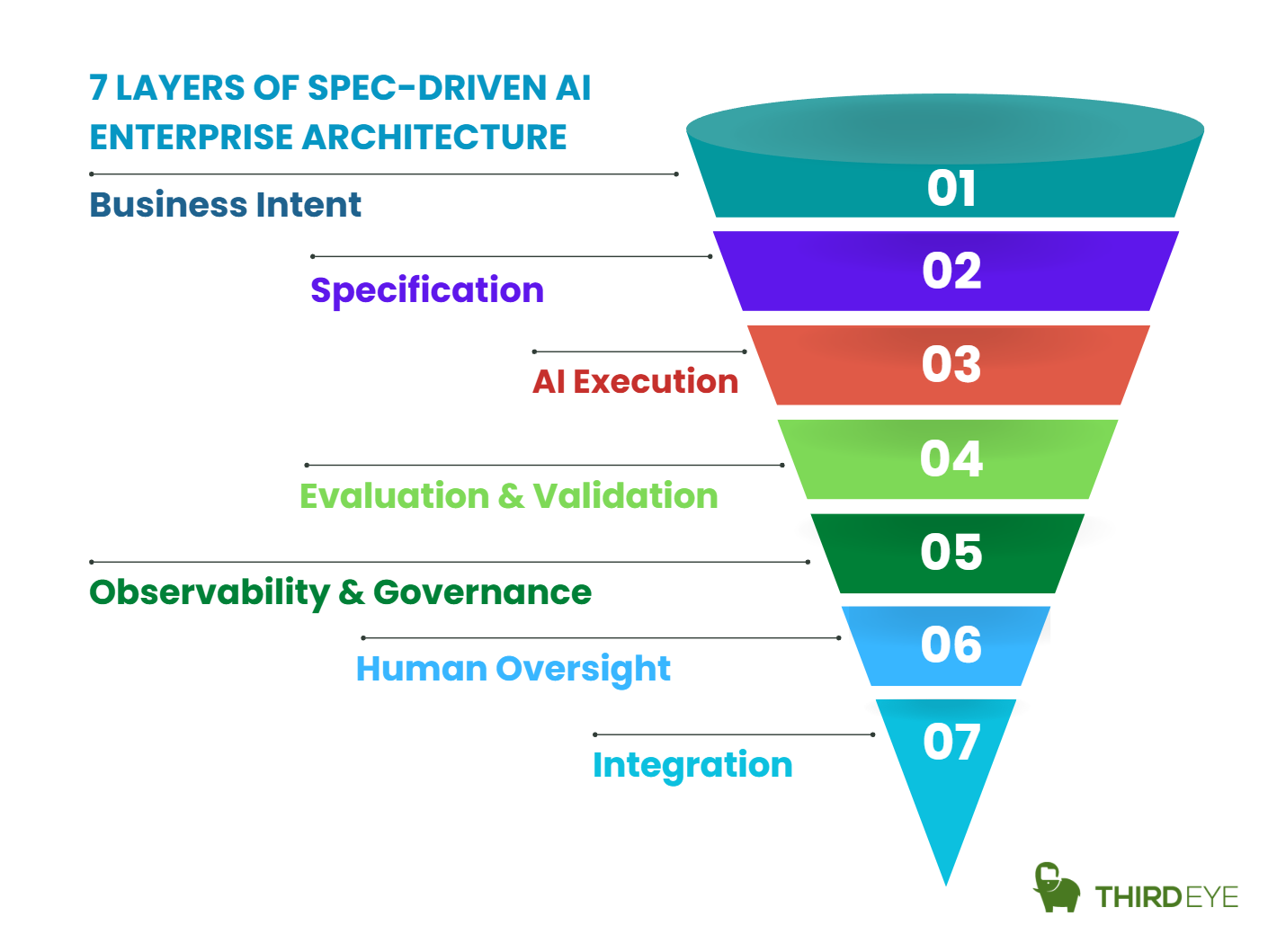
A spec-driven system is not a prompt wrapped in an API. It is an orchestrated architecture.
A typical enterprise pattern includes:
Specification Layer
Model Abstraction Layer
Retrieval and Context Layer
Evaluation Harness
Observability and Logging Layer
Human Oversight Layer
In our document intelligence deployments, this layered approach allowed systems to maintain stable performance across model upgrades and regulatory reviews. The difference was not model capability. It was an architectural discipline.
One of the defining characteristics of spec-driven AI is evaluation before deployment.
Evaluation moves beyond ad hoc testing. It becomes continuous.
Enterprises should define:
In CI/CD pipelines, AI behavior must be regression tested just like traditional code.
This principle has become foundational in our AI Readiness engagements. Organizations frequently underestimate how quickly AI behavior can shift without explicit evaluation pipelines.
Specification without evaluation is documentation. Specification with evaluation is engineering.
AI governance is often treated as a policy conversation. In reality, governance must be operationalized.
Spec-driven AI enables governance through:
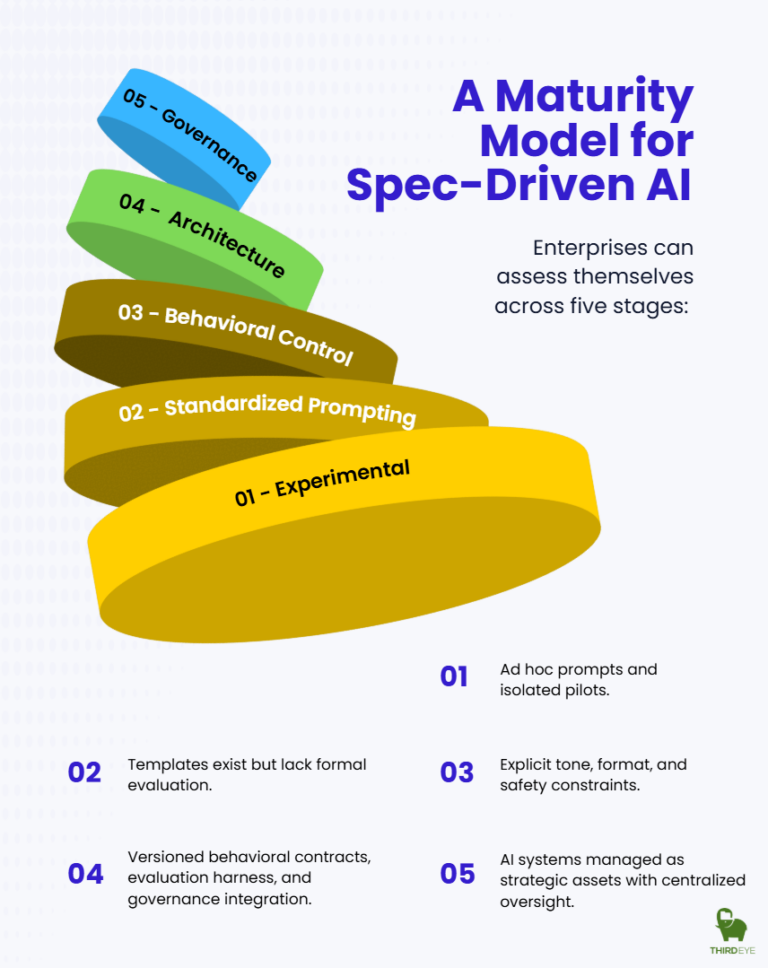
Within enterprise AI Governance programs, we see a common maturity progression:
The shift from level 2 to level 4 is where enterprises begin to reduce risk meaningfully.
Without specification, governance remains aspirational.
We have seen CIOs increasingly evaluate AI not as innovation spend but as operating expenditure.
Spec-driven systems improve financial discipline by:
In one workflow automation deployment, introducing structured evaluation and budget controls reduced monthly token expenditure variance significantly without sacrificing performance.
Financial predictability is rarely discussed in AI marketing material. It becomes critical in enterprise operations.
Spec-driven AI changes team structure.
Enterprises begin to require:
Prompt engineers alone cannot sustain enterprise systems.
AI becomes a product discipline.
Based on our experience, we strongly state that specification has proven essential across different domains.
Unstructured document processing systems must extract structured data with high reliability. Without strict output schemas and fallback rules, integration with downstream ERP or claims systems fails.
Specification ensures:
Visual AI systems deployed in industrial environments require conservative bias. False negatives may be unacceptable. Behavioral specs define escalationthresholds and override rules.
When AI coordinates multi-step processes, specifications define boundaries:
These systems become manageable only when autonomy is explicitly bounded.
To illustrate how spec-driven AI moves from theory to enterprise-grade execution, consider a real-world pattern we frequently encounter: intelligent document processing in a regulated industry.
An enterprise needed to automate extraction and validation of structured data from high-volume, semi-structured documents. These documents directly influenced downstream operational decisions and regulatory reporting.
The initial pilot worked well using prompt engineering. However, once scaled:
The challenge was not model accuracy. It was architectural rigor.
This is where spec-driven AI fundamentally changed the system design.
Instead of iterating prompts informally, the team defined an explicit AI contract consisting of:
Functional Contract
Behavioral Contract
Compliance Contract
Interface Contract
This specification became version-controlled.
The AI system was no longer defined by a prompt. It was defined by a contract.
Rather than embedding vendor-specific prompt logic across services, a model abstraction layer was introduced.
This layer:
When foundation models were upgraded, regression testing validated behavior against the specification before production release.
This prevented silent drift.
A dedicated evaluation harness was implemented with:
Evaluation was integrated into CI/CD.
Every specification update or model change triggered automated validation.
This transformed AI deployment from experimental release to controlled rollout.
To satisfy compliance and audit requirements:
During regulatory reviews, the enterprise could demonstrate:
That level of traceability is impossible without specification discipline.
Instead of full automation, bounded autonomy was implemented:
This preserved efficiency while managing risk exposure.
The document handling process automation became controlled, not reckless.
The impact was measurable:
Most importantly, AI transitioned from pilot success to operational infrastructure.
The key enabler was not a better model.
It was a better specification.
Spec-Driven AI does not emerge overnight. It reflects a gradual architectural evolution in how organizations design, control, and scale AI systems.
The movement from Level 2 to Level 4 is transformative because it represents a shift from operational discipline to architectural discipline. It is the difference between organizing prompts and engineering systems. One improves consistency. The other creates durability.
The next wave of enterprise AI will involve multi-agent orchestration and semi-autonomous decision systems.
Without specification:
Spec-driven foundations make agentic systems viable. They establish boundaries before autonomy expands.
Spec-driven AI reframes artificial intelligence from experimentation to infrastructure.
It aligns AI development with:
For CIOs and CTOs, this shift is not optional. It defines whether AI remains a controlled asset or becomes an unmanaged liability.
Enterprises that invest in specification discipline now will scale faster later.
Those that do not will spend more time correcting drift than creating value.
AI capability is no longer the bottleneck.
Architectural maturity is.
Spec-driven AI development represents the next stage of enterprise intelligence engineering. It transforms AI from a probabilistic experiment into a governed, testable, scalable system.
This is not about restricting AI. It is about making AI reliable enough to trust.
And in enterprise environments, trust is the foundation of scale.
From a specific use case to a full-scale modernization, share your requirements, and our engineers will take it from there. We typically respond within 24 hours with a transparent, detailed assessment of what's possible for your business.

We are a full-stack AI development company that helps enterprises make better decisions, reduce costs, and operate more efficiently.






333 West San Carlos Street, San Jose, CA 95110 USA
6000 Rome Blvd, Brossard, Quebec J4Y 0B6 Canada
Technopolis, Kolkata, India
CTIE, Hubli, India
We are a full-stack AI development company that helps enterprises make better decisions, reduce costs, and operate more efficiently.
333 West San Carlos Street, San Jose, CA 95110 USA
India: Kolkata, WB & Hubli, KA
Canada: Brossard, Quebec