
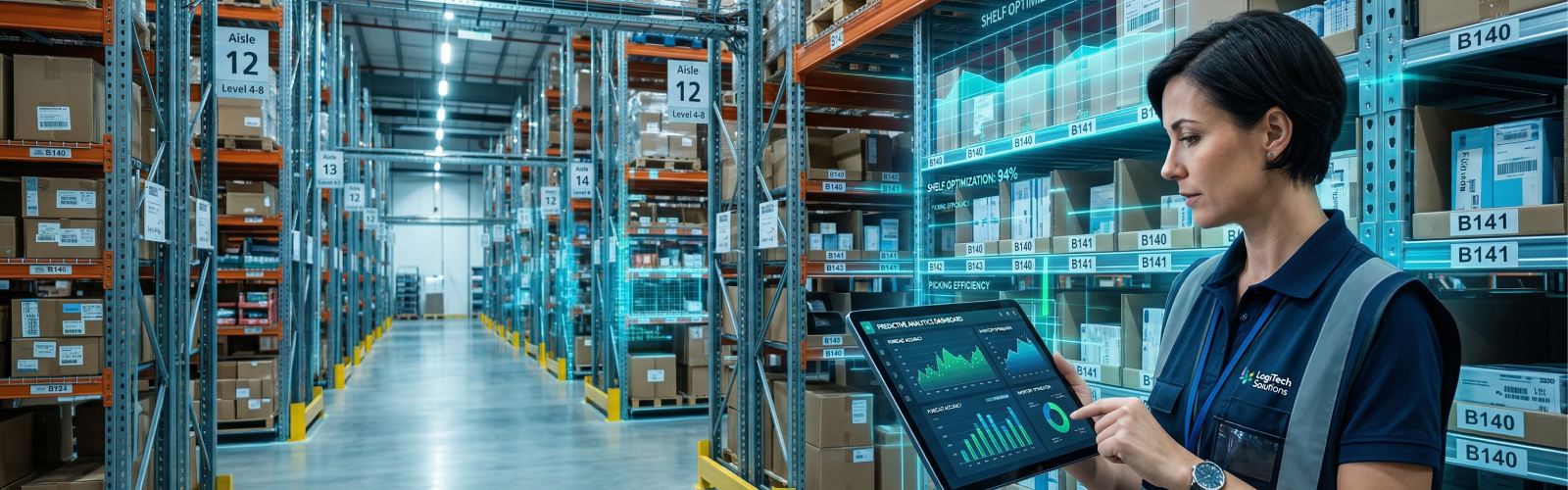
The global logistics and warehousing sector is currently navigating a structural transition from legacy, rule-based operations to predictive, autonomous intelligence. This shift is characterized by the move from “System of Record” to “System of Intelligence,” where existing platforms like SAP HANA and modern cloud data lakes serve as the foundational bedrock for high-impact artificial intelligence (AI) use cases.
While industrial robotics often dominates the public narrative, the most significant immediate gains in throughput, accuracy, and capital efficiency are occurring through non-robotic AI implementations. These digital-first strategies leverage sophisticated algorithms, real-time data streams, and existing material handling equipment (MHE) to redefine the economics of fulfillment.
This report provides an exhaustive analysis of the top AI implementation use cases, their technical architectures, the structural blockers to their adoption, and the practical financial frameworks required to measure their return on investment.
Modern smart warehousing is defined by its ability to ingest vast quantities of unstructured data and transform it into actionable operational signals. At the heart of this transformation is the integration of advanced analytics into the core Warehouse Management System (WMS). For many global enterprises, this core is SAP Extended Warehouse Management (EWM) running on the SAP HANA in-memory database. HANA serves as a critical infrastructure component, enabling the sub-second processing of inventory transactions, sensor telemetry, and labor tasks. However, the evolution toward a “thinking” warehouse requires extending this core through the SAP Business Technology Platform (BTP), which provides the orchestration layer for AI models and external data federation.
The industry is currently moving through a phased maturity model. In the initial phase, AI was used in isolated pilots for demand forecasting. In the current maturity phase, we are seeing the rise of Agentic AI, systems capable of not just recommending actions, but planning and executing them within controlled boundaries, such as automatically rebalancing task interleaving or triggering replenishment orders. Gartner reports that while 72% of supply chain organizations have deployed generative AI, the leaders achieving breakthrough results are those who have successfully integrated these models into their core transactional workflows.
Demand forecasting is the most mature and impactful application of AI in the warehouse ecosystem. Traditional forecasting methods often rely on backward-looking moving averages, which create a “lag” that leaves teams overstocked in one region and understocked in another. AI-driven demand sensing shifts this paradigm by integrating forward-looking signals, including promotional calendars, weather patterns, economic indicators, and social media trends.
The primary value of AI in demand forecasting is the release of working capital.
Furthermore, AI reduces the “Bullwhip Effect” by identifyingrelationships across thousands of input variables without the need for hand-coded rules.
This results in improved service levels, higher fill rates (often exceeding 95%), and a significant reduction in stockouts.
The tech stack for advanced forecasting typically involves a multi-layered cloud architecture. Data is extracted from SAP HANA using the OData protocol and fed into a cloud data warehouse like Snowflake or an AWS S3 data lake. AWS Glue is frequently utilizedfor the serverless integration of these disparate data sources.
Layer | Component | Function |
|---|---|---|
Data Ingestion | SAP OData, AWS Glue | Extracts transactional data from SAP S/4HANA. |
Data Storage | Snowflake, SAP Datasphere | Centralizes internal and external signals for analysis. |
Modeling | Python, TensorFlow, PyTorch | ImplementsLSTM (Long Short-Term Memory) or Random Forest models. |
Orchestration | SAP AI Core | Manages model training, deployment, and versioning. |
The primary blocker for forecasting is data fragmentation and the “60% Barrier”- a structural reality where 60% of AI leaders identify legacy system integration as their primary hurdle.
Many legacy ERPs utilizebatch processing, which introduces latency that makes real-time sensing impossible. Additionally, “Data Inconsistency” across supply chain actors leads to skewed estimates and a lack of trust in AI-generated outputs.
The return on investment forforecasting is calculated by quantifying the reduction in carrying costs and recovered sales.

Slotting is the process of determining the optimal storage location for every SKU to minimize travel time and maximize storage density. In traditional warehouses, slotting is often static. AI-driven slotting continuously re-evaluates SKU movement velocity (A, B, C classification) and co-occurrence patterns (items frequently picked together) to suggest dynamic rearrangements.
Picker travel time typically accounts for 50% or more of total warehouse labor hours. AI-optimized slotting reduces picking walk distances by 15-30% and improves capacity utilizationby 20-40%. This efficiency gain directly translates to higher throughput per square foot, allowing organizations to delay expensive warehouse expansions.
Slotting optimization leveragesthe spatial engines within SAP HANA and digital twin technology.
Component | Preferred Technology | Role |
|---|---|---|
Spatial Analytics | SAP HANA Spatial, ESRI | Maps warehouse coordinates and calculates optimal paths |
Digital Twin | NVIDIA Omniverse, SAP Build | Simulates "what-if" scenarios for layout changes. |
Logic Engine | Python-based solvers | Balancestravel reduction against the labor cost of moving items. |
Existing infrastructure like SAP EWM provides the “Rearrangement” task framework. The AI model identifies the “optimal next state” for the warehouse and generates standard warehouse tasks within EWM to move the SKUs during low-volume periods.
“Reslotting Inertia” is a significant blocker. While the AI may suggest thousands of moves for marginal gains, the labor cost to execute those moves must be weighed against the picking benefit. Furthermore, “Model Drift” occurs as seasonal patterns change, requiring the AI to be retrained frequentlyto avoid providing outdated location recommendations.
The financial return is primarily labor-driven.
Annual Savings = (Hours Saved/Day \times Operating Days/Year) \times Fully Loaded Hourly Rate
A worked example for a mid-size facility: If AI slotting reduces travel by 20 hours per day across a 250-day operation, and the wage is $28/hour, the annual savings are $140,000. For an $80,000 investment, the ROI is 75% in the first year.
Computer Vision (CV) uses industrial cameras and deep learning to monitor warehouse activities without manual barcode scanning. CV systems can count pallets, verify put-away accuracy, detect damaged goods at the receiving dock, and ensure the correct items are packed into every order.
The most profound impact of CV is the elimination of periodic cycle counts. CV system maintains inventory accuracy at 99.5% or higher by detecting discrepanciesthe moment they occur, preventing “phantom inventory” that leads to mis-picks and lost sales. At packing stations, the CV system reduces mis-ships to near zero, saving the high costs associated with return processing and customer dissatisfaction.
CV systems prioritize “Edge Processing” to manage bandwidth and latency.
Environmental factors such as lighting variations, dust on lenses, and vibration from MHE can degrade model accuracy. Furthermore, “Bandwidth Constraints” are common in older facilities; streaming high-definition video from hundreds of cameras requires a robust fiber backbone or Private 5G.
ROI is calculated by measuring the reduction in audit labor and mis-pick penalties.

A mid-size facility can often reduce cycle count labor by 90% and mis-picksby 80%, yielding a payback period of 6-9 months.
Material Handling Equipment (MHE) like high-speed conveyors and sorters are the lifeblood of high-volume fulfillment. AI-driven Predictive Maintenance (PdM) uses vibration, temperature, and current sensors to identifyearly signs of mechanical failure, such as bearing wear or motor overheating.
PdM shifts maintenance from reactive “firefighting” to scheduled interventions during low-volume windows. This reduces unplanned downtime by 30-50% and lowers overall repair costs by 15-25%. Because planned repairs cost 3-5 times less than emergency callouts, the financial impactis immediate.
PdM relies on a combination of IoT sensors and survival modeling.
The primary blocker is the “Incompatibility between AI and Legacy PLCs.” Older Programmable Logic Controllers (PLCs) often lack the processing power or open protocols (like OPC-UA) needed to stream telemetry to the cloud. Additionally, “Alert Noise” can lead to maintenance teams ignoring the system if it generates too many low-confidence warnings.
The “PdMEffectiveness Ratio” is the gold standard for ROI.

An industry-average ratio of 3:1 yields a 17% savings in total maintenance costs. For a plant with $1.9 million in maintenance costs, the annual savings can reach $399,000, with an ROI of nearly 1900%when measured against sensor costs.
For warehouses currently running SAP HANA, the integration of AI is not a “rip-and-replace” exercise but a “Strangler Fig” modernization. The SAP Business Technology Platform (BTP) serves as the bridge between the stable “Clean Core” of the ERP and the rapidly evolving world of AI models.
SAP AI Core provides the central hub for managing the AI lifecycle, from data preparation to model deployment and monitoring. It allows organizations to leverage large language models (LLMs) through the Generative AI Hub, ensuring that sensitive data is masked and filtered before being sent to foundation models like those in AWS Bedrock or Azure OpenAI.
A critical modern componentof the SAP HANA database is the Vector Engine. This allows for Retrieval Augmented Generation (RAG), where the AI can search through unstructured documents, such as maintenance manuals or shipping regulations, and provide grounded, context-aware answers to warehouse operators through conversational interfaces like Joule.
Many warehouses possess“dark data” trapped in legacy systems that do not communicate with the primary WMS. Modern AI architectures use Snowflake and AWS to break down these silos.
The partnership between Blue Yonder and Snowflake allows for “Zero-ETL” data sharing. This enables warehouses to ingest real-time insights from across the extended supply chain network, such as carrier delays or weather disruptions, without the cost and latency of traditional data integrations.
AWS Glue acts as a serverless data integration service that facilitates the consolidation of data from SAP, S3, and other SaaS applications. By utilizing “PrivateLink,” organizations can establisha secure connection between their AWS and Snowflake accounts, ensuring that sensitive warehouse telemetry never traverses the public internet.
To navigate the complexities of AI integration, warehouses should follow a phased transformation roadmap.
The integration of AI into warehouse operations is no longer an optional R&D; it is a structural necessity for maintaining competitiveness in a volatile global market.
By focusingon non-robotic use cases, such as demand forecasting, dynamic slotting, computer vision-based counting & inspection, and predictive maintenance, businesses can achieve breakthrough ROI while leveraging their existing SAP HANA and legacy infrastructure.
The shift toward digital intelligence allows warehouses to transform from static storage hubs into adaptive, resilient engines of fulfillment. Success in this era will not be determinedby the sheer amount of hardware deployed, but by the ability of an organization to intelligently integrate AI into its core processes, standardize its data streams, and cultivate a culture of data-driven decision-making.
From a specific use case to a full-scale modernization, share your requirements, and our engineers will take it from there. We typically respond within 24 hours with a transparent, detailed assessment of what's possible for your business.

We are a full-stack AI development company that helps enterprises make better decisions, reduce costs, and operate more efficiently.








333 West San Carlos Street, San Jose, CA 95110 USA
6000 Rome Blvd, Brossard, Quebec J4Y 0B6 Canada
Technopolis, Kolkata, India
CTIE, Hubli, India
We are a full-stack AI development company that helps enterprises make better decisions, reduce costs, and operate more efficiently.
333 West San Carlos Street, San Jose, CA 95110 USA
India: Kolkata, WB & Hubli, KA
Canada: Brossard, Quebec