Azure AI Content Understanding: Turning Unstructured Content into Intelligent Insights
In the modern enterprise, data exists everywhere — in documents, emails, scanned forms, images, audio recordings, and videos. The challenge isn’t a lack of data; it’s making sense of it efficiently. Azure AI Content Understanding is Microsoft’s powerful solution for bridging this gap. It’s designed to help organizations extract structured information from unstructured content, enabling faster decision-making, deeper insights, and smarter automation.
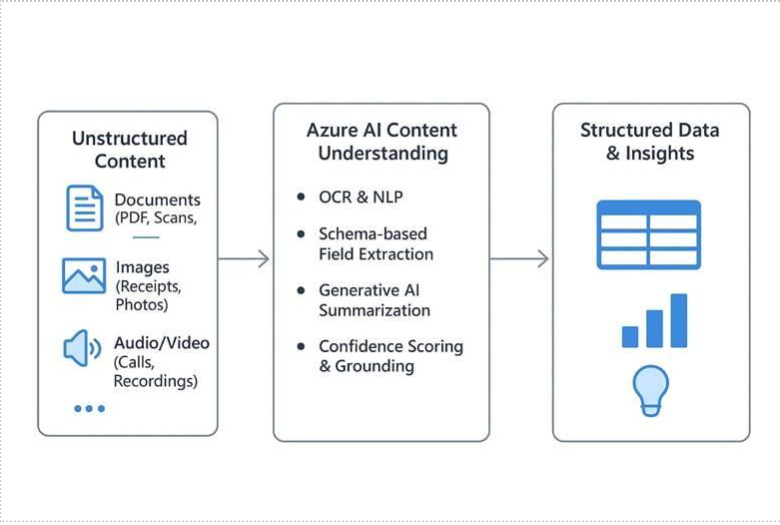
Unlike traditional tools that focus on a single content type, Azure AI Content Understanding is multimodal and schema-driven. This means it can handle text, images, audio, video, and documents in a unified workflow, while allowing users to define exactly what data they need extracted. It’s a combination of advanced AI models, generative AI capabilities, and enterprise-grade reliability, providing a scalable and efficient content intelligence solution.
Azure AI Content Understanding

At its core, the platform does two things exceptionally well:
- Content Extraction – Capturing the raw elements of any input, whether it’s text, tables, forms, layout structure, handwriting, or speech.
- Field Extraction – Organizing and structuring this raw content into meaningful, actionable data points using pre-defined or custom schemas.
With additional features like confidence scoring, grounding, and optional add-ons for layout detection or facial/speaker recognition, enterprises can ensure the information they extract is both accurate and traceable. In short, Azure AI Content Understanding bridges the gap between human-readable content and machine-actionable intelligence.
Problem Statements Solved with Azure AI Content Understanding
The platform is versatile and has real-world applications across industries. Here are some scenarios illustrating how businesses benefit from it:
- Financial Services
Problem: Banks and financial institutions deal with thousands of documents every day, such as loan applications, invoices, tax forms, and contracts. Manual processing is slow, error-prone, and often requires specialized staff.
Solution: Azure AI Content Understanding automates the extraction of key fields like customer names, account numbers, amounts, dates, and terms. By validating extracted data and providing confidence scores, it ensures compliance and reduces operational risk while speeding up transaction processing.
- Healthcare and Clinical Documentation
Problem: Healthcare providers face mountains of patient records, prescriptions, test results, and scanned handwritten notes. Extracting key information manually is labor-intensive and prone to errors.
Solution: The platform uses OCR and NLP to digitize handwritten notes, extract critical patient information, and even summarize complex reports. Clinicians can quickly access structured insights, improving patient care while reducing administrative overhead.
- Legal and Compliance
Problem: Reviewing contracts, agreements, and regulatory documents is time-consuming, and missing a clause can have severe consequences.
Solution: With schema-driven extraction, Azure AI Content Understanding identifies key clauses, obligations, and risks, classifies documents, and assigns confidence scores. Legal teams can focus on interpretation and strategy rather than labor-intensive review.
- Media and Entertainment
Problem: Media companies manage vast libraries of video, audio, and images. Manually tagging, summarizing, or indexing content is inefficient and expensive.
Solution: Azure AI Content Understanding can transcribe speech from videos, recognize faces and scenes, and summarize content. This enables efficient content indexing, search, and recommendation systems, enhancing both operational efficiency and content discoverability.
- Customer Support
Problem: Customer service teams handle emails, chats, and call recordings that contain valuable insights but are difficult to analyze at scale.
Solution: The platform can transcribe calls, analyze sentiment, classify issues, and generate summaries. This helps teams respond faster, identify patterns, and optimize customer interactions, leading to improved satisfaction and retention.
- Research and Academia
Problem: Researchers process hundreds of documents, papers, and datasets, often with complex tables, charts, and figures. Manual extraction is slow and error-prone.
Solution: Azure AI Content Understanding extracts structured data from tables and figures, interprets chart types, and even summarizes content using generative AI. This accelerates knowledge discovery and allows researchers to focus on analysis rather than extraction.
Technical Capabilities
Azure AI Content Understanding is a multifaceted, enterprise-grade platform. Here’s a deeper look at its capabilities:
Multimodal Processing
The platform handles text, images, audio, video, and documents in a single pipeline. It’s capable of recognizing handwritten text, printed forms, layouts, barcodes, formulas, and even speaker roles in audio content.
Schema-Driven Field Extraction
Users define a schema indicating which fields or elements are important. Azure AI Content Understanding then automatically extracts this data across documents or media. Generative AI further enhances this by interpreting complex patterns or varied document structures.
Grounding and Confidence Scoring
Every extracted field comes with a confidence score, helping users decide which data may require human review. Grounding ensures that the extracted data can be traced back to its source in the document or media file, minimizing errors and increasing trustworthiness.
Integration with Azure Ecosystem
The platform works seamlessly with Azure Machine Learning, Azure Synapse Analytics, and Azure OpenAI Service, allowing enterprises to build complex workflows for analytics, RAG (retrieval-augmented generation), and automation.
Scalability and Security
Built on Azure’s cloud infrastructure, the service scales to handle enterprise workloads, while maintaining high security standards and compliance with HIPAA, GDPR, and ISO regulations.

Content Understanding
Image Courtesy: learn.microsoft.com
Prosof Azure AI Content Understanding
- Unified Multimodal Platform: No need for separate tools for documents, audio, or video.
- Reduced Engineering Effort: Schema-driven extraction and generative AI reduce manual coding.
- Scalability: Handles high-volume, enterprise-grade workloads.
- Traceability: Confidence scores and grounding enhance reliability.
- Integration: Works seamlessly with Azure ecosystem for analytics and AI pipelines.
- Customizable: Schemas and add-ons allow domain-specific tuning.
- Enhanced Accuracy: Generative AI improves extraction across varied content formats.
Limitationsof Azure AI Content Understanding
- Some Features in Preview: Not all capabilities are fully mature.
- Cost of Complex Workloads: Large-scale or multimodal projects may be expensive.
- Processing Time for Heavy Media: Large video/audio files may increase latency.
- Human Oversight Required: Critical applications may still need manual validation.
- Language and Regional Constraints: Some languages or modalities may be limited.
Alternatives
- Google Document AI: Focused on documents and structured data extraction.
- AWS Textract & Rekognition: Good for forms and media content processing.
- Open-Source Tools(Tesseract, PyTorch, TensorFlow): Useful for on-premise or offline deployment.
- Hybrid Approaches: Combining Azure services with custom ML pipelines for specialized needs.
Upcoming Updates
Azure AI Content Understanding is evolving rapidly:
- Pro mode enhancements: Multi-document reasoning and advanced inference.
- Better chart/graph interpretation: Semantic understanding for finance, research, and analytics.
- Expanded language and regional support: Including accents and handwriting recognition.
- Integration with LLMs: Advanced retrieval-augmented generation for enterprise knowledge systems.
- Edge and hybrid deployments: Processing closer to source for low-latency or privacy-sensitive tasks.
- Ethical AI enhancements: Transparency, grounding, and bias detection for trustworthy outputs.
Frequently Asked Questions on Azure AI Content Understanding
Q1. What content types are supported?
Documents, text, images, audio, video — including handwritten notes and scanned forms.
Q2. Can I define custom extraction schemas?
Yes, you can define specific fields, and generative AI helps handle complex variations.
Q3. How accurate is the extraction?
Accuracy depends on data quality and schema definition; confidence scores guide validation.
Q4. How secure is the service?
Azure provides enterprise-grade encryption and privacy controls, compliant with HIPAA, GDPR, and ISO standards.
Q5. Is it suitable for small businesses?
Yes, flexible pricing and standard mode make it accessible for small and medium enterprises.
Conclusion: ThirdEye Data’s Take
At ThirdEye Data, we view Azure AI Content Understanding as a transformative tool for modern enterprises. By unifying multimodal content processing, schema-driven extraction, and generative AI insights, it eliminates fragmented workflows, accelerates automation, and turns unstructured content into actionable intelligence.
Our experience shows:
- Enterprises gain faster time-to-value with minimal engineering effort.
- Operational efficiency increases while reducing errors and compliance risks.
- Structured insights enable better decision-making, reporting, and strategic planning.
For organizations struggling with unstructured documents, multimedia content, or large-scale customer interactions, Azure AI Content Understanding is a reliable, scalable, and intelligent solution, turning complexity into clarity.