Django: The High-Power Web Framework That Still Powers the Web
A few years ago, I was building a web app for a client: user registration, dashboards, content uploads, admin panels. As the project grew, so did the complexity—routes, forms, authentication, database migrations, admin interfaces. I tried assembly after assembly of libraries, and inertia set in.
Then I switched the stack to Django, and everything changed. Within days, I had user auth, CRUD, admin UI, and forms working reliably. No fuss. The framework’s built-in features handled many repetitive chores I used to code myself.
That’s the power of Django: it helps you go from idea to launchfaster, without reinventing core web app plumbing. Even though new frameworks like FastAPI, Next.js, or serverless stacks make headlines, Django remains deeply relevant—because it solves real problems with maturity, security, and community backing.

What Is Django?
Djangois a high-level, open-source web framework written in Python, designed for rapid development, clean design, and pragmatic applications. It follows the Model-Template-View (MTV)architectural pattern, which is a variant of MVC (Model-View-Controller).
Some of the guiding principles behind Django include:
- “Batteries included”— it includes many tools out of the box (authentication, admin, routing, ORM, forms).
- Don’t Repeat Yourself (DRY)— avoid duplication in code design.
- Security-first— built-in safeguards against common vulnerabilities.
- Reusability & Pluggability— you can build modular apps and reuse across projects.
It’s maintained by the Django Software Foundation (DSF)and has a strong community of contributors and users.
Core Components
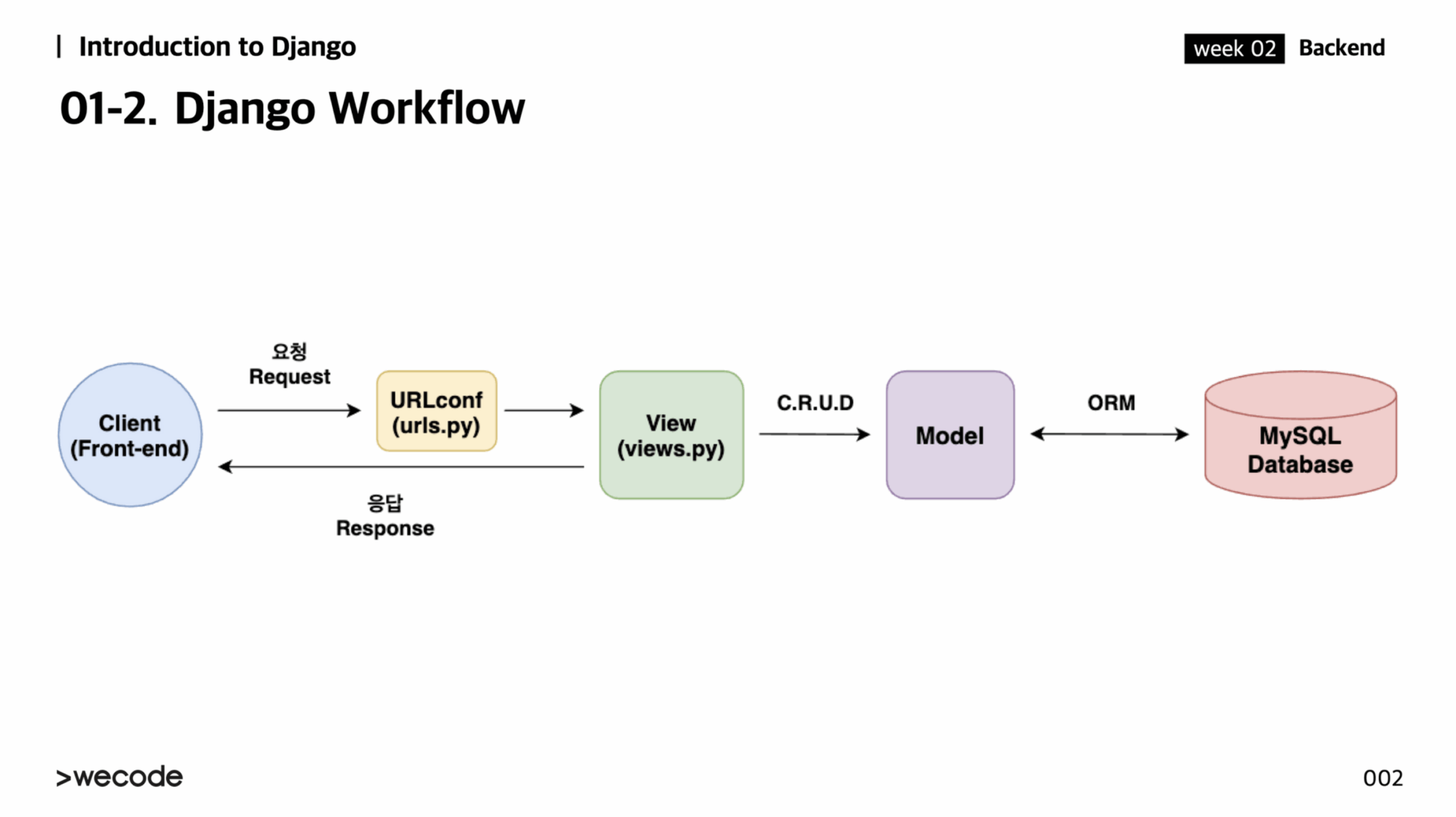
Image Courtesy: Velog
To see how Django connects to your web app, here are its foundational parts:
- Models / ORM:Define Python classes that map to database tables; Django handles SQL generation, migrations, and query APIs.
- Views / Controllers:Handle HTTP requests, business logic, and responses.
- Templates:Render HTML (or other formats) using a template language with variables, filters, and inheritance.
- URL Dispatcher / Routing:Maps URL patterns to view functions or classes.
- Forms & Validation:Generate HTML forms, validate input, and convert between form data and Python models.
- Authentication & Permissions:User login, registration, user roles, and permissions.
- Admin Interface:Auto-generated, customizable admin dashboard for models.
- Middleware & Request Lifecycle:Hooks for processing requests/responses, managing sessions, security checks, etc.
- Static Files / Media Handling / File Uploads:Managing CSS, JS, images, and user-uploaded files.
- Caching, Sessions, Internationalization (i18n), Logging, Security Features— built-in or easily configurable.
Because all these exist in one coherent framework, you often avoid stitching together disparate libraries.
How Django Connects in a Typical Stack?
To see how Django interacts with other technologies:
User Browser / Mobile App
↕ HTTP/web requests
Django App (Views, Templates)
↕ ORM / Models
Relational Database (PostgreSQL, MySQL, etc.)
↕ External Services (via APIs)
Cache, Message Queues, Third-party APIs, Cloud Storage
In modern apps, Django also often exposes REST APIs / GraphQL endpoints(via Django REST Framework or Graphene), acting as a backend to front-end SPA or mobile apps.
Because Django is Python-based, it also integrates naturally with ML/AI components(TensorFlow, PyTorch, scikit-learn), making it popular in data science–adjacent domains
Use Cases / Problems Django Solves Best
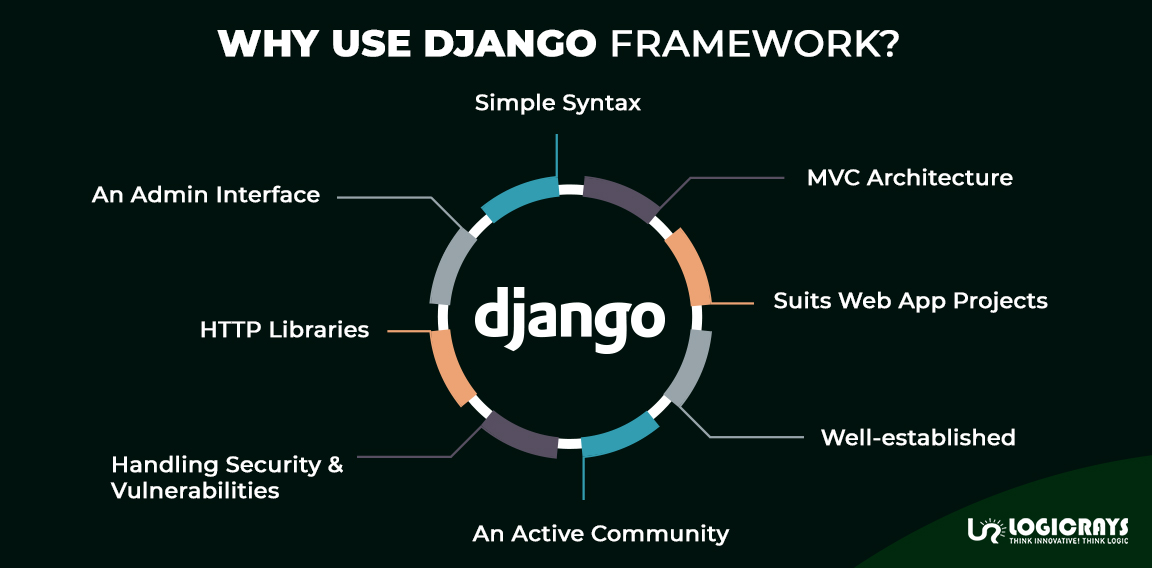
Image Courtesy: Logicrays
Django shines when your project needs a robust, maintainable, secure, full-featured web application. It’s less ideal when you’re building microservices only returning small JSON blobs (though Django can do that too). Here are domains and problems where Django is often a strong candidate:
- Content-rich Websites, Platforms & CMS
When your site involves content management, editorial workflows, user submissions, media, permissions, versioning — Django handles this elegantly (often with CMSs built on top, e.g. Wagtail).
- SaaS / Web Applications
Applications with user accounts, data storage, admin control panels, dashboards — Django provides building blocks (user models, forms, auth, admin) out of the box.
- Data-driven / Analytics Web Frontends
Because Django is Python-based, connecting it to data pipelines, ML models, or analytic backends is more straightforward than with many other web frameworks.
- API Backends for Mobile or SPA
Often combined with Django REST Framework (DRF)or GraphQL, Django serves as a robust backend for React, Angular, Flutter apps, etc.
- Rapid Prototyping & MVPs
Because many features (admin interface, auth, forms) are ready to go, you can build an MVP quickly. As one developer posted:
“Django is definitely worth learning… its batteries-included strategy means you can produce feature-rich apps fast.”
- Secure & Enterprise Applications
With features like CSRF, XSS prevention, SQL injection guards, built-in security best practices, Django is a good foundation in regulated contexts.
Strengths of Django
Here’s where Django earns its reputation — from both developer experience and production viability:
Rapid Development & Productivity
Because so many repetitive elements are built in, you spend less time wiring infrastructure and more time building features.
Full-stack / Batteries-included
You don’t have to cobble together a dozen separate components for ORM, admin, authentication — they’re already part of Django.
Security First
Django helps protect you from common web attacks by default: SQL injection, XSS, CSRF, clickjacking, cross-site request forgery, etc.
Mature Ecosystem & Community
Because Django has been around since 2005, it has many high-quality third-party apps, plugins, and battle-tested extensions.
Scalability & Proven Use in Large Sites
Sites like Instagram, Disqus, and others have scaled with Django, proving it can handle serious load (with the right architecture).
Python Integration
If your stack includes Python (for AI, data, automation), Django fits naturally. This avoids context switching between languages.
Admin UI, CLI tools, Migrations, Forms
These conveniences reduce boilerplate and let you focus on business logic.
Limitations of Django
No tool is perfect. Here are challenges Django brings:
Monolithic / Opinionated
Django’s “one framework for many tasks” philosophy means that for highly modular microservice architectures, it might feel heavyweight.
Async / Real-Time Limitations
While Django now supports asynchronous views (as of Django 3.1+), it’s still not as naturally suited for WebSocket-heavy real-time apps compared to frameworks built for that (e.g., FastAPI, Node.js).
Learning Curve
Because Django covers so much, newcomers must learn many concepts—models, templating, admin, middleware, signals, etc.
Not “Best” for Slim API-only Services
If your service is just a tiny JSON microservice, the overhead of Django may be overkill. Lighter frameworks may perform better in minimal contexts.
Database-centric
Because Django’s ORM is tailored for relational databases, though there is support for non-relational backends, it’s less common.
Performance Overhead
If not optimized (caching, query optimization, lazy loading), Django can be slower under heavy loads.
Alternatives to Django
When Django might not be a perfect fit, these are popular alternatives:
- Flask— minimal, micro-framework. Good if you want more control, lighter stack.
- FastAPI— modern, async-first, excellent for building APIs.
- Express.js / Node.js frameworks— if your stack is JavaScript/TypeScript.
- Ruby on Rails— similar philosophy in Ruby.
- Spring Boot / Java / Kotlin frameworks— for Java shops.
- Phoenix (Elixir)— for real-time, highly concurrent web apps.
Each has trade-offs (flexibility vs built-in features, ecosystem, performance). Compare based on your project size, team skills, and architecture style.
Upcoming Updates / Industry Trends & Insights of Django
Here’s what I see shaping Django’s future and how it’s adapting:
- Async & Concurrency Improvements
Django is increasingly embracing async — more views, database drivers, streaming responses. This helps it compete in real-time or high-concurrency domains.
- Better API & Microservices Support
With the rise of headless / decoupled front ends (React, Vue, SPAs), Django is evolving to make API-first architectures cleaner (REST, GraphQL integration).
- Serverless / Cloud-native Deployment
More support and guidance for deploying Django apps on serverless platforms, containers (Docker, Kubernetes), auto-scaling.
- AI / ML Integration
Because Python is dominant in AI, Django apps increasingly embed ML features — e.g., recommendation modules, classification APIs, chatbots. Django becomes a natural web front door for ML services.
- GraphQL Adoption
More Django projects are using GraphQL (via Graphene, Strawberry) as an alternative to REST for more flexible APIs.
- Performance & Observability
Focus on profiling tools, caching strategies (Redis, Memcached), async task queues (Celery / Django Channels), and observability (APM, monitoring) for scaling Django in production.
- Community & Ecosystem Growth
Despite claims of decline, Django retains a strong community. PyCharm’s “State of Django 2024” survey shows many developers still use Django for both full-stack and API work.
Project References of Django
Frequently Asked Questions on Django
Q1: Is Django still relevant in 2025?
Yes. Despite newer frameworks, it retains strong adoption, a large ecosystem, and continues evolving. Several articles note it’s “still thriving” in 2025.
Q2: Should I choose Django or FastAPI for my project?
Use Django if you need built-in admin, forms, templating, full-stack features. Use FastAPI if your project is API-only, needs high concurrency, or you prefer async-first design.
Q3: Can Django support real-time WebSockets / chat apps?
Yes, using Django Channelsor third-party libs. But for heavy real-time loads, frameworks built for concurrency may excel.
Q4: Does Django handle microservices well?
It can. You’d often break parts of your app into services (e.g. Django for core, microservices for specific tasks). Django’s evolutions in async and modular architecture help.
Q5: What is Django REST Framework (DRF)?
A popular extension/library for building REST APIs on top of Django, with serialization, viewsets, authentication, pagination, etc.
Third Eye Data’s Take on Django
Over a decade and a half after its debut, Django remains more than just a relic — it’s a continuously evolving, reliable, and powerful web framework. Its strengths — security, rapid development, mature ecosystem, and Python integration — keep it relevant, especially when combined with careful architecture, modern tooling, and awareness of its trade-offs.
If you’re building a web application, admin dashboard, content site, SaaS product, or data-driven platform, Django is still a highly credible choice.
Call to Action:If you haven’t already, start a small side project with Django — scaffold an app, explore the admin, build a REST API with DRF, and deploy it via Docker/Kubernetes. See how fast you go from zero to working app compared to wiring everything manually.