Graph Neural Networks
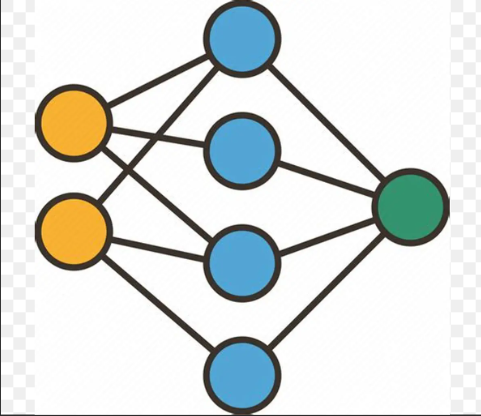
Graph Neural Networks (GNNs) extend traditional neural networks to operate on graph data, where:
- Nodes represent entities (e.g., users, proteins, documents)
- Edges represent relationships or interactions (e.g., friendships, chemical bonds, hyperlinks)
Unlike CNNs or RNNs that work on grid-like data (images, sequences), GNNs use message passing to aggregate information from neighboring nodes, enabling context-aware learning.
Key Components:
- Node features: Attributes of each node (e.g., age, type, embedding)
- Edge features: Relationship metadata (e.g., weight, type)
- Graph structure: Connectivity pattern used to propagate information
Graph Neural Networks are special types of neural networks capable of working with a graph data structure. They are highly influenced by Convolutional Neural Networks (CNNs) and graph embedding. GNNs are used in predicting nodes, edges, and graph-based tasks.
- CNNs are used for image classification. Similarly, GNNs are applied to graph structure (grid of pixels) to predict a class.
- Recurrence Neural Networks are used in text classification. Similarly, GNNs are applied to graph structures where every word is a node in a sentence.
GNNs were introduced when Convolutional Neural Networks failed to achieve optimal results due to the arbitrary size of the graph and complex structure.
Types of Graph Neural Networks:
- Graph Convolutional Networks (GCNs)
Think of GCNs as the CNNs of graph data. Instead of scanning pixels in an image, they scan neighboring nodes in a graph.
- How it works:
- Each node gathers info from its neighbors (like gossip spreading in a social circle).
- This aggregated info is passed through a linear layer (like a filter) and then through an activation function (adds non-linearity).
- Two flavors:
- Spatial GCNs: Focus on direct neighbors—like walking through the graph.
- Spectral GCNs: Use graph Laplacians—like analyzing the graph’s frequency components.
- Use case: Node classification, community detection, molecular property prediction.
- Graph Auto-Encoder Networks (GAEs)
These are like compress-decompress machines for graphs.
- How it works:
- The encoder learns a compact representation of the graph (like summarizing a book).
- The decoder tries to reconstruct the original graph from that summary.
- The middle layer (bottleneck) forces the network to learn meaningful patterns.
- Why it’s useful:
- Great for link prediction—figuring out which nodes should be connected.
- Handles imbalanced data well, since it doesn’t rely on labels.
- Use case: Social network expansion, recommendation systems, knowledge graph completion.
- Recurrent Graph Neural Networks (RGNNs)
Imagine a GNN that remembers past steps and learns how information flows over time.
- How it works:
- Uses recurrence (like RNNs) to model how node states evolve.
- Learns diffusion patterns—how information spreads across the graph.
- Uses regularizers to keep things smooth and prevent overfitting.
- Why it’s powerful:
- Handles multi-relational graphs—nodes with many types of connections.
- Efficient—uses less compute but still gets strong results.
- Use case: Text generation, speech recognition, video tagging, summarization.
- Gated Graph Neural Networks (GGNNs)
These are RGNNs with memory gates—like giving each node a brain that decides what to remember or forget.
- How it works:
- Adds gates (like GRUs) to control how node states update over time.
- Includes node gates, edge gates, and time gates to manage long-term dependencies.
- Why it’s better:
- More robust for tasks where sequence and memory matter.
- Learns temporal patterns and contextual dependencies better than RGNNs.
- Use case: Long-form text generation, machine translation, dynamic graph modeling.
Use Cases or Problem Statement Solved with Graph Neural Networks:
- Molecular Property Prediction
- Problem: Predicting toxicity or solubility of molecules from their structure is hard using tabular features.
- GNN Solution: Treat atoms as nodes and bonds as edges; use GCN to learn molecular embeddings.
- Goal: Achieve accurate predictions for drug discovery and material science.
- Social Network Influence Modeling
- Problem: Identifying influential users or communities is difficult due to complex interactions.
- GNN Solution: Model users as nodes and interactions as edges; use GAT to learn influence scores.
- Goal: Improve targeted marketing and misinformation detection.
- Recommendation Systems
- Problem: Traditional collaborative filtering fails to capture user-item relationships beyond direct interactions.
- GNN Solution: Build a bipartite graph of users and items; use GraphSAGE to learn embeddings.
- Goal: Deliver personalized recommendations with higher relevance.
- Traffic Flow Prediction
- Problem: Predicting congestion across a city requires modeling road network dependencies.
- GNN Solution: Represent intersections as nodes and roads as edges; use temporal GNNs for dynamic prediction.
- Goal: Enable smart routing and urban planning.
- Fraud Detection in Financial Networks
- Problem: Fraudsters often operate in coordinated patterns that evade rule-based systems.
- GNN Solution: Model transactions and accounts as a graph; use GNN to detect anomalous subgraphs.
- Goal:Identify suspicious behavior with high precision.
Pros of Graph Neural Networks:
- Captures Complex Relationships
- Why it matters: GNNs excel at modeling non-Euclidean data—where relationships matter more than spatial proximity.
- Example: In fraud detection, GNNs can uncover hidden collusion patterns across accounts that traditional models miss.
- Context-Aware Learning via Message Passing
- Why it matters: Each node aggregates information from its neighbors, enabling local and global context.
- Example: In molecular property prediction, atoms learn from their bonded neighbors, improving chemical understanding.
- Flexible Input Structures
- Why it matters: GNNs can handle graphs of varying sizes, shapes, and connectivity—unlike CNNs which require fixed grids.
- Example: Social networks, citation graphs, and road networks all benefit from this flexibility.
- Strong Performance in Sparse Data Regimes
- Why it matters: GNNs leverage graph topology to compensate for missing features or labels.
- Example: In recommendation systems, even cold-start users can be embedded meaningfully via their connections.
- Natural Fit for Knowledge Graphs and RAG Pipelines
- Why it matters: GNNs can enrich embeddings for semantic search, entity linking, and retrieval-augmented generation.
- Example: In chatbot memory systems, GNNs help model relationships between intents, responses, and context nodes.
Cons of Graph Neural Networks:
- Computational Complexity
- Challenge: Message passing across large graphs can be expensive—especially with deep layers or high-degree nodes.
- Mitigation: Use sampling methods (GraphSAGE), sparse matrices, or mini-batch training.
- Over-smoothing in Deep Architectures
- Challenge: As layers increase, node embeddings become indistinguishable—losing discriminative power.
- Mitigation: Use residual connections, attention mechanisms, or shallow architectures.
- Difficult to Interpret
- Challenge: Unlike decision trees or linear models, GNNs are black-boxes—hard to explain to stakeholders.
- Mitigation: Use attention weights, node importance scores, or graph explainability tools like GNNExplainer.
- Dynamic Graphs Are Hard
- Challenge: Most GNNs assume static graphs; modeling time-evolving relationships is non-trivial.
- Mitigation: Use temporal GNNs (e.g., TGAT, DySAT) or recurrent architectures.
- Data Preprocessing Is Non-Trivial
- Challenge: Building graphs from raw data (e.g., tabular, text, images) requires domain expertise.
- Mitigation: Use libraries like NetworkX, DGL, or PyTorch Geometric with helper functions.
Alternatives to Graph Neural Networks:
- Traditional Machine Learning on Engineered Features
- Use Case: When graph structure is implicit or weak.
- Tech: Random Forests, XGBoost, SVMs
- Pros:
- Fast training and inference
- Easier to interpret and debug
- Cons:
- Requires manual feature engineering
- Cannot capture relational dependencies
- Best Fit: Tabular fraud detection, churn prediction, or credit scoring
- Deep Learning on Flattened Representations
- Use Case: When graph data can be transformed into sequences or grids.
- Tech: CNNs, RNNs, Transformers
- Pros:
- Mature tooling and pretrained models
- Easier integration with NLP and vision pipelines
- Cons:
- Loses topological information
- Loses topological information
- Requires careful preprocessing
- Best Fit: Text classification, image-based graphs, or time-series from graph sensors
- Knowledge Graph Embedding Models
- Use Case: Link prediction, entity classification
- Tech: TransE, DistMult, ComplEx, RotatE
- Pros:
- Lightweight and scalable
- Designed for sparse relational data
- Cons:
- Limited expressiveness compared to GNNs
- Graph Kernels and Spectral Methods
- Use Case: Graph classification without deep learning
- Tech: Weisfeiler-Lehman kernel, Laplacian eigenmaps
- Pros:
- Strong theoretical foundation
- Good for small graphs
- Cons:
- Poor scalability
- Less flexible than GNNs
- Best Fit: Bioinformatics, chemical compound analysis
- Relational Transformers
- Use Case: Graphs with rich node/edge features and long-range dependencies
- Tech: Graphormer, Relational BERT
- Pros:
- Combines graph structure with attention
- Handles dynamic and heterogeneous graphs
- Cons:
- Computationally expensive
- Best Fit: Large-scale knowledge graphs, multi-hop reasoning
Answering some Frequently asked questions about Graph Neural Networks:
Q1: Can I use GNNs for tabular data?
Answer: Not directly. GNNs require graph structure. However, you can construct graphs from tabular data using similarity metrics, shared attributes, or temporal links.
Q2: How do GNNs compare to Transformers?
Answer: Transformers excel in sequence modeling with global attention. GNNs specialize in relational modeling with local message passing. Relational Transformers aim to bridge both.
Q3: Are GNNs suitable for real-time inference?
Answer: GNNs can be slow on large graphs due to message passing. For real-time use, consider GraphSAGE with sampling or precompute embeddings offline.
Q4: What libraries should I use for GNNs?
Answer: Top choices include:
- PyTorch Geometric (PyG) – modular, fast, and well-documented
- DGL (Deep Graph Library) – scalable and backend-flexible
- Spektral – Keras-based, good for quick prototyping
Q5: How do I deploy GNNs in production?
Answer:
- Precompute node embeddings and serve via FastAPI
- Use ONNX for model export
- Integrate with Streamlit or Dash for visualization
- Use Redis or Pinecone for fast embedding retrieval
Conclusion:
Graph Neural Networks are transformative for relational learning, enabling models to reason over structure, context, and connectivity. But they come with trade-offs in scalability, interpretability, and deployment complexity.
When to Use GNNs:
- Your data is inherently graph-structured (e.g., molecules, social networks, knowledge graphs)
- Relationships between entities are critical to prediction
- You need context-aware embeddings for downstream tasks
When to Consider Alternatives:
- Your data is flat or lacks meaningful structure
- You need fast, interpretable models
- You’re constrained by compute or latency