
Azure SQL Datawarehouse
Azure SQL Data Warehouse, now rebranded as Azure Synapse Analytics, is a cloud-based, fully managed data warehousing solution designed for large-scale data analytics. It combines enterprise data warehousing with big data analytics, enabling organizations to query both relational and non-relational data using familiar SQL syntax. This service is ideal for handling massive datasets and performing complex analytical queries.
Architecture of SQL Datawarehouse:
- Unified Analytics Platform
Azure Synapse Analytics is positioned as the evolution of Azure SQL Data Warehouse, merging:
- Enterprise Data Warehousing (EDW): Provisioned, scalable SQL-based workloads.
- Big Data Analytics: Serverless, on-demand querying over data lakes.
This convergence enables:
- A single pane of glass for ingestion, preparation, management, and serving of data.
- Seamless integration across structured and unstructured data sources.
- SQL-first experience for both relational and non-relational data.
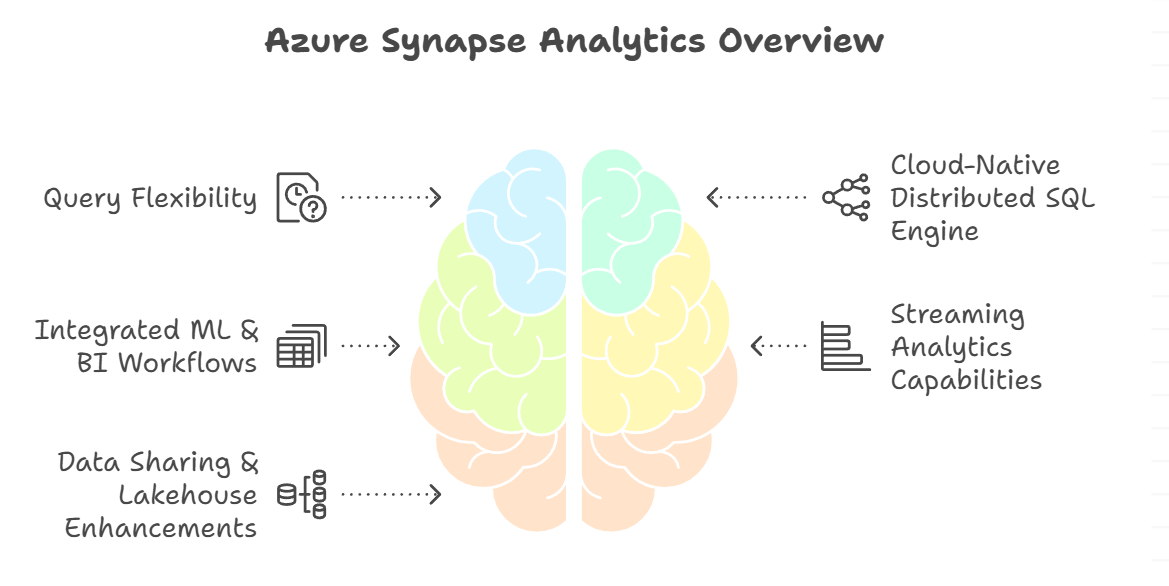
- Query Flexibility: Serverless vs Provisioned
This dual-mode architecture allows backend architects to optimize cost-performance tradeoffs per workload.
- Cloud-Native Distributed SQL Engine
At its core, Synapse uses a distributed SQL processing engine that:
- Supports MPP (Massively Parallel Processing) for petabyte-scale workloads.
- Is the first system to run all TPC-H queries at petabyte scale, showcasing its analytical depth and performance.
This engine underpins both serverless and provisioned modes, abstracting complexity while delivering scale.
- Integrated ML & BI Workflows
Azure Synapse integrates natively with:
- Power BI: For real-time dashboards and business user analytics.
- Azure Machine Learning: For model training, scoring, and operationalization.
- Streaming Analytics in SQL
Azure Synapse now supports:
- Direct streaming ingestion from Event Hubs, Kafka, and IoT Hubs.
- SQL-based analytics over streaming data, including:
- Joins across multiple streams
- Aggregations and temporal windows
- Transformation of semi-structured formats
This allows real-time analytics pipelines to be built entirely within the data warehouse, reducing architectural sprawl.
- Data Sharing & Lakehouse Enhancements
Azure Data Share Integration
- Securely share data across org boundaries.
- Supports both data lake and warehouse formats.
ParquetDirect Technology
- Native engine-level support for Parquet files.
- Enables interactive querying over data lakes.
- Boosts Polybase performance by 13x via:
- Intelligent caching
- Columnstore batch processing
- Optimized scan rates
This bridges the gap between lakehouse and warehouse paradigms, ideal for hybrid retrieval architectures.
Use Cases or Problem Statement solved with Azure SQL Datawarehouse:
- Enterprise Data Warehousing Modernization
Problem Statement
Legacy data warehouses are expensive, rigid, and slow to scale. ETL pipelines are brittle, and analytics teams struggle with siloed data and delayed insights.
Goal
Migrate to a cloud-native, scalable data warehouse that supports both batch and real-time analytics, with unified SQL access and integration with BI/ML tools.
Synapse Fit
- Provisioned pools for predictable performance
- Serverless SQL for ad hoc exploration
- Native Power BI integration for dashboards
- Built-in ML scoring via PREDICT for operational analytics
- Real-Time Analytics on Streaming Data
Problem Statement
IoT and event-driven systems generate high-velocity data streams. Traditional warehouses can’t ingest or query this data in real time, delaying decisions.
Goal
Enable real-time ingestion, transformation, and querying of streaming data directly within the analytics platform.
Synapse Fit
- Direct ingestion from Event Hubs, Kafka, IoT Hubs
- SQL support for joins, aggregations, and temporal windows
- Unified experience for batch + stream analytics
- No need for separate stream processors (e.g., Spark Streaming)
- In-Database Machine Learning Scoring
Problem Statement
ML models trained in external environments require complex data movement for scoring, increasing latency and operational overhead.
Goal
Score ML models directly within the data warehouse using SQL, minimizing data movement and accelerating time-to-insight.
Synapse Fit
- Native PREDICT statement for in-database scoring
- Supports models from Azure ML, Spark, ONNX
- Converts models to internal format for SQL inference
- Ideal for fraud detection, churn prediction, recommendation engines
- Lakehouse Query Acceleration
Problem Statement
Data lakes offer flexibility but suffer from slow query performance and lack of schema enforcement, making interactive analytics difficult.
Goal
Enable fast, interactive querying over Parquet files in the lake with SQL, without needing full ETL into a warehouse.
Synapse Fit
- ParquetDirect technology for native Parquet access
- Columnstore batch processing and intelligent caching
- Polybase improvements (13x faster)
- Ideal for exploratory analytics, data science, and hybrid lakehouse setups
- Cross-Organization Data Sharing
Problem Statement
Sharing data securely across departments or external partners is complex, often requiring manual exports, duplication, or custom APIs.
Goal
Enable governed, secure, and seamless data sharing across organizational boundaries without data duplication.
Synapse Fit
- Azure Data Share integration
- Share both warehouse and lake data
- Supports snapshot and in-place sharing
- Ideal for B2B analytics, vendor reporting, federated data ecosystems
Pros of Azure SQL Datawarehouse:
- Unified Platform: Combines data warehousing, big data analytics, and ML/BI integration in one workspace.
- Scalability: MPP architecture handles petabyte-scale workloads efficiently.
- Serverless + Provisioned Modes: Flexibility to choose cost-effective or performance-optimized compute.
- Deep Azure Integration: Seamless with Power BI, Azure ML, Data Factory, ADLS, Event Hubs.
- Security: Robust data protection and compliance features.
- In-Database ML Scoring: Native PREDICT support for scoring models without data movement.
- Streaming Analytics: SQL-based joins, aggregations, and transformations on real-time data.
- ParquetDirect & Polybase Boost: 13x faster lake queries via native Parquet support.
Cons of Azure Datawarehouse:
- Steep Learning Curve: Initial setup and workspace configuration can be complex.
- Billing Complexity: Serverless and provisioned pricing models can lead to unpredictable costs.
- Limited Cross-Pool Migration: Moving data between serverless and dedicated pools is manual and error-prone.
- UI Limitations: Lacks drag-and-drop features for non-technical users.
- Active Directory Integration Issues: Configuration can be cumbersome in hybrid environments.
- Performance Variability: Scaling operations may impact stability under large workloads.
Alternatives to Azure SQL Datawarehouse:
Snowflake
Snowflake is a cloud-native data platform known for its separation of storage and compute, allowing independent scaling of resources. It supports multi-cloud deployment across AWS, Azure, and GCP, making it ideal for organizations with hybrid or multi-cloud strategies. Snowflake’s auto-scaling and auto-suspend features optimize cost efficiency, and its data sharing capabilities are robust, enabling seamless collaboration across teams and partners. However, it lacks native machine learning integration and may incur higher costs for frequent, compute-intensive queries. For backend architects, Snowflake excels in lakehouse-style architectures, elastic workloads, and cross-cloud orchestration.
Google BigQuery
BigQuery is Google Cloud’s fully serverless data warehouse, designed for ad hoc analytics at scale. It abstracts infrastructure management entirely, allowing users to focus on querying massive datasets using standard SQL. BigQuery’s pricing model is based on data scanned per query, which can be cost-effective for occasional use but unpredictable for heavy workloads. It integrates tightly with GCP services like Vertex AI and Looker, making it a strong choice for GCP-native pipelines. While it lacks fine-grained control over compute resources, its simplicity and speed make it ideal for exploratory analytics and real-time dashboards.
Databricks Lakehouse
Databricks offers a unified platform for data engineering, analytics, and machine learning, built on Apache Spark. Its Lakehouse architecture combines the reliability of data warehouses with the flexibility of data lakes, using Delta Lake for ACID transactions and schema enforcement. Databricks is particularly strong in ML-heavy workflows, supporting notebooks, AutoML, and deep integration with ML frameworks. However, it requires Spark expertise and is less SQL-centric than Synapse or Snowflake. For backend systems focused on agentic orchestration, streaming pipelines, and ML model lifecycle, Databricks is a compelling choice.
Teradata Vantage
Teradata Vantage is a high-performance analytics platform tailored for large-scale enterprise workloads. It offers advanced workload management, in-database analytics, and support for multiple data formats. Vantage is often used in regulated industries like finance and telecom due to its robust governance and security features. While it’s less cloud-native and involves higher setup costs, it excels in mission-critical EDW scenarios where performance and reliability are paramount.
Amazon Redshift
Redshift is AWS’s managed data warehouse solution, offering tight integration with the AWS ecosystem. It supports Spectrum for querying data in S3, and Redshift ML for basic model scoring. Redshift is well-suited for traditional warehousing workloads, but its scaling model is less flexible than Snowflake or BigQuery. It’s a solid choice for AWS-centric architectures, especially when paired with services like Glue, SageMaker, and QuickSight.
Third Eye Project Reference where we used Azure SQL Datawarehouse:
Answering some Frequently asked questions about Azure SQL Datawarehouse:
- Can I secure Synapse workspaces with RBAC?
Yes. Synapse supports granular RBAC roles like Synapse Administrator, SQL Administrator, Spark Administrator, etc., across workspaces, pools, runtimes, and linked services.
- How do I manage costs across pools?
- Dedicated SQL pools: You control size and scale directly.
- Serverless SQL pools: Monitor and cap spending daily/weekly/monthly.
- Spark pools: Restrict creation via RBAC.
- Does Synapse support CI/CD?
Yes. Artifacts (pipelines, notebooks, scripts) are Git-integrated. Pool definitions use ARM templates. Dedicated SQL objects can be managed via database projects.
- Can I link multiple Power BI workspaces?
Yes. Synapse Studio supports multiple Power BI workspace connections.
- Is Synapse Link available for Cosmos DB and SQL?
Yes. Synapse Link for Cosmos DB (Spark and serverless SQL) and SQL Server/Azure SQL DB are generally available.
Conclusion:
Azure Synapse Analytics is ideal for organizations seeking:
- Unified analytics across SQL, Spark, and streaming
- Deep Azure integration with Power BI, Azure ML, Data Factory
- Flexible compute models (serverless + provisioned)
- In-database ML scoring and real-time analytics
- Lakehouse acceleration via ParquetDirect and Polybase
However, choose alternatives when:
- You need multi-cloud flexibility → Snowflake
- You prefer fully serverless simplicity → BigQuery
- You prioritize ML-first pipelines → Databricks
- You operate in regulated, high-performance EDW environments → Teradata