






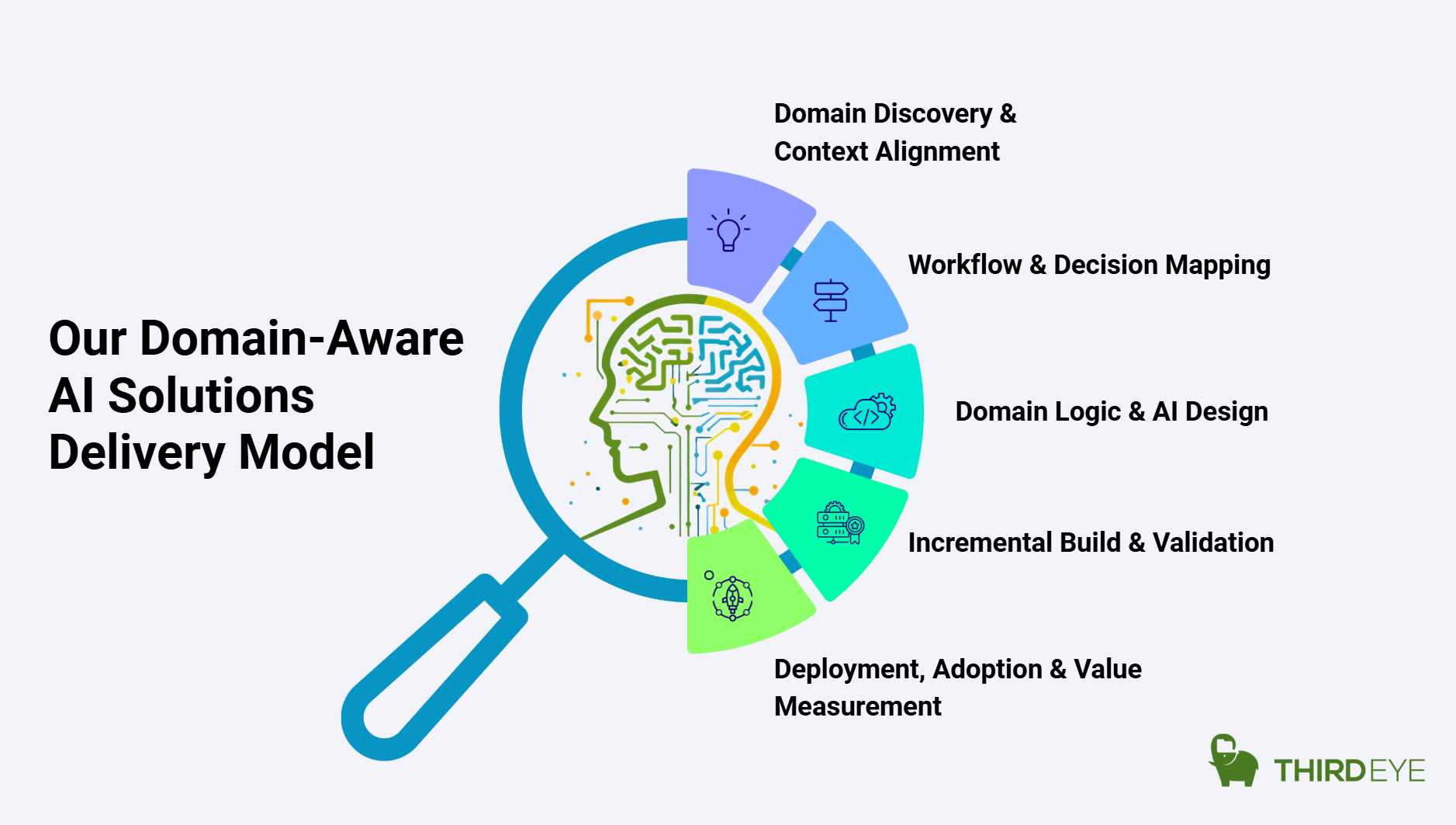
ThirdEye Data works as a domain-aware AI partner for enterprises. We help organizations embed decision intelligence and workflow automation into existing systems. Our AI applications are designed to align with real business processes, domain-specific logic, and operational constraints. We do not build generic AI solutions. We build systems that work inside your industry, your data, and your workflows.
We have seen many enterprise AI initiatives fail not because of models, but because of context. Generic AI systems do not understand the industry terminology, process dependencies, compliance boundaries, or how decisions are actually made. Without domain grounding, AI outputs may look correct but fail in real operations.
Our domain-specific AI development approach addresses this gap. It ensures that AI applications reflect business reality. Decisions become consistent. Automation becomes reliable. Adoption improves because users trust the system. This is how we are trying to shift AI from experimentation to enterprise transformation.
At ThirdEye Data, we build domain-specific AI applications to solve problems where scale, complexity, and risk intersect. These are not theoretical challenges. They are issues we have addressed repeatedly across industries.
Enterprises struggle with AI systems that generate responses without understanding domain rules, constraints, or exceptions. This leads to incorrect recommendations and low trust.
We design AI applications that operate within defined domain logic and data boundaries. Outputs are grounded, traceable, and aligned with how the business works.
Many critical decisions still depend on human judgment because existing systems cannot synthesize data across sources or apply consistent reasoning.
We embed decision intelligence into workflows so teams can make faster, more consistent decisions without increasing risk.
Enterprise data is spread across platforms, departments, and formats. AI initiatives fail when they cannot work across this fragmentation.
We build AI layers that sit on top of existing systems and unify insights without disrupting core platforms.
Rule-based automation often fails in complex domains where exceptions, regulations, and judgment matter.
Our AI applications are designed with governance, auditability, and human oversight built in from the start.
We do not start with tools. We start with understanding.
Our delivery model is built around close collaboration with enterprise teams and deep engagement with domain knowledge.
We begin by mapping workflows, decision points, and data flows. We work with subject matter experts to capture terminology, rules, and exceptions. This domain understanding is translated into AI logic, retrieval strategies, and decision frameworks.
We build incrementally. We validate with real users. Likewise, we measure impact against business outcomes. This approach ensures adoption, trust, and long-term value.
We focus on industries where decision complexity and operational scale demand domain-aware AI. We do not claim expertise everywhere. Furthermore, we focus on where we have real experience and delivery depth.

We have expertise in building AI applications for production monitoring, quality analysis, predictive maintenance, and supply chain decision support.

We build AI systems for asset intelligence, wildfire risk mitigation, operational risk monitoring, and regulatory reporting.
We develop domain-aware AI solutions for campaign optimization, attribution analysis, audience intelligence, and performance forecasting.

We deliver AI applications for network intelligence, customer operations, revenue assurance, and service optimization.

Built an AI-powered platform that can detect the quality of the third-party-provided electric poles’ images and process them for anomaly detection to avoid potential hazards.
Developed an AI-based real time alerting system for the operating personnels to address the issue of maintaining the optimum size of plywood sheets during the manufacturing process.
Developed an AI-based computer vision solution for automating the extraction of fixed products from architectural floor plan images.
Developed a scalable AI-powered product counting solution using computer vision technology to detect and count SKUs from images and videos captured during loading and unloading.
If AI decisions matter in your business, domain understanding is not optional. Let’s explore how our domain-aware AI development can support your transformation goals.
General AI applications focus on models and outputs. Domain-specific AI focuses on how work actually happens.
At ThirdEye Data, we design AI systems around industry workflows, terminology, business rules, and decision paths. This ensures the AI behaves correctly inside real operations, not just in controlled demos.
Off-the-shelf tools are built for broad use cases. They lack awareness of your domain’s exceptions, constraints, and risk factors.
We build AI applications that reflect your data behavior, compliance requirements, and operational logic. This is why enterprises come to us after generic tools fail to deliver reliable outcomes.
We work closely with your subject matter experts and operational teams.
We map workflows, decision points, and terminology before designing the AI logic. Domain knowledge is embedded into prompts, retrieval strategies, validation rules, and governance layers. This is not guesswork. It is structured and deliberate.
We recommend it, especially during the discovery and validation phase. If required, we also deploy SMEs from our end.
However, we respect enterprise constraints. Our teams are experienced in extracting domain knowledge efficiently and minimizing disruption. We work as an extension of your team, not a dependency.
We do not rely on model knowledge alone.
Our AI applications are grounded in enterprise data, validated sources, and domain-specific rules. We design guardrails, confidence thresholds, and fallback mechanisms to ensure outputs remain accurate and defensible.
Yes. That is the intent.
We design AI as an intelligent layer on top of your current platforms, such as ERP, CRM, data warehouses, and operational tools. We do not push rip-and-replace strategies unless there is a strong business reason.
We base this decision on business needs, not our preferences.
Our team considers factors like data sensitivity, compliance, scale, cost, latency, and your existing ecosystem. Our long-term experience with open source, cloud-native platforms, Microsoft Azure, and Snowflake allows us to remain flexible and objective.
Trust comes from consistency and relevance.
We validate AI outputs with real users during development. We measure accuracy against business expectations. Furthermore, we design interfaces and workflows that fit how teams already work. Adoption is treated as a design goal, not an afterthought.
Yes. Our approach is designed for long-term enterprise roadmaps.
We deliver in phases, align with transformation milestones, and build foundations that scale across teams, geographies, and business units.
Governance is built into the system design.
We support audit trails, role-based access, decision traceability, and compliance controls based on your regulatory environment. This is especially critical in industries where AI decisions must be explainable.
We focus on early, measurable wins.
Most projects deliver visible value within the first few months through targeted use cases. Larger transformation programs are structured to show progress and ROI at each stage.
We stay involved.
We offer support, monitoring, enhancements, and continuous improvement. Domain knowledge evolves, and AI systems must evolve with it. We treat this as a partnership, not a handoff.
We operate as a domain-aware AI partner.
Our role is to help you make better decisions, automate responsibly, and scale with confidence. Technology is a means, not the objective.
If AI decisions matter in your business and domain understanding is critical, that’s when we are the right partner.
We work best with enterprises looking for reliability, trust, and long-term impact, not quick experiments.