
GraphQL: Redefining How We Communicate with APIs
The Story of a Developer’s Frustration
Imagine this: you’re a developer building a sleek, data-driven dashboard. You pull data from multiple REST APIs — user profiles, transaction histories, preferences, and notifications. You spend hours writing endpoints, filtering unwanted data, and trying to merge everything into one coherent format.
After a week of debugging and endless API calls, your app is functional but sluggish — drowning in over-fetching and under-fetching problems.
Now, imagine if you could just ask your backend exactly for the data you want — nothing more, nothing less — and receive it in one neat, predictable response.
That’s the magic GraphQL brings.
Born at Facebook in 2012 (and open-sourced in 2015), GraphQL has become a revolutionary alternative to REST — transforming how developers design, consume, and scale APIs. Today, giants like GitHub, Shopify, Twitter, and Netflix rely on it to make their systems more efficient and developer-friendly.
GraphQL Overview: What It Really Is
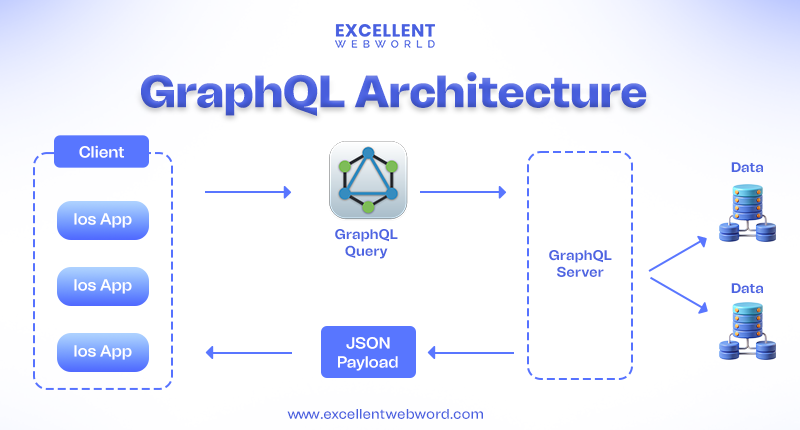 Image Courtesy: excellentwebword
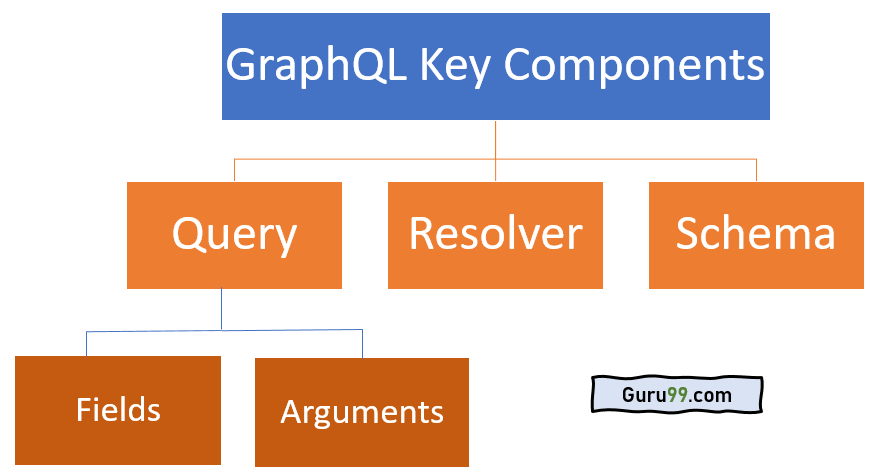
Image Courtesy: guru99
At its core, GraphQL is a query language for APIs and a runtime for executing those queries with your existing data. Instead of multiple REST endpoints, GraphQL exposes a single endpoint that clients can query for exactly the data they need.
How It Works
- Client-Side Querying: The client defines the structure of the response in a query, specifying exactly which fields and relationships it needs.
- Server-Side Resolver: The GraphQL server interprets the query, calls the relevant data sources, and returns a JSON response matching the request’s shape.
- Schema-Centric Design: Everything revolves around a GraphQL schema — a contract between client and server defining data types, relationships, and operations (queries, mutations, and subscriptions).
This flexible architecture is what makes GraphQL a favorite for modern applications, especially those combining multiple data sources like databases, third-party APIs, and microservices.
Use Cases / Problem Statements Solved with GraphQL
- Solving the Over-fetching and Under-fetching Problem
In REST, every endpoint is predefined. You might get too much data (over-fetching) or too little (under-fetching), forcing extra calls.
GraphQL fixes this by allowing clients to define what they need in a single query. The server responds with just that.
Example:
Instead of fetching /users, /users/:id/posts, and /posts/:id/comments, you can do all of this in one GraphQL query.
- Unifying Data from Multiple Sources
Modern applications depend on multiple data sources — SQL databases, NoSQL stores, APIs, and cloud services. GraphQL acts as a data unification layer, aggregating these into one endpoint.
This is especially useful for microservice architectures, where data is scattered across several APIs. GraphQL hides that complexity, letting developers interact with a unified schema.
- Faster Development and Easier API Evolution
With REST, changing an API often means creating a new version (/v2, /v3, etc.).
In contrast, GraphQL is versionless — clients can query new fields without breaking older ones. This encourages incremental improvements and continuous evolution of your API.
- Real-Time Data with Subscriptions
GraphQL supports real-time data via subscriptions — allowing clients to stay updated on live events like stock prices, chat messages, or IoT data streams.
This makes it ideal for real-time applications such as dashboards, collaborative platforms, or multiplayer games.
- Improved Developer Experience
GraphQL offers strong typing, self-documenting schemas, and interactive query tools like GraphiQL or Apollo Studio.
Developers can explore the entire API visually, test queries, and get instant feedback, dramatically improving productivity.
Pros of GraphQL
- Efficient Data Fetching
Clients get exactly what they request — improving performance, especially for mobile and bandwidth-sensitive apps. - Single Endpoint Simplicity
No more managing dozens of REST endpoints. One endpoint handles all operations. - Strongly Typed Schema
The schema ensures data consistency, makes debugging easier, and improves collaboration between front-end and back-end teams. - Powerful Developer Tools
GraphQL’s introspection and ecosystem (Apollo, Graphene, Hasura) make it easy to build, test, and scale. - Reduced API Versioning Chaos
Schema evolution is smooth — add fields without breaking existing clients. - Real-Time Subscriptions
Ideal for applications needing live updates.
Cons of GraphQL
- Complexity for Simple Use Cases
For small apps or simple data fetches, REST may still be easier and faster to set up. - Caching Challenges
Unlike REST’s natural URL-based caching, GraphQL responses are dynamic and require custom caching strategies. - Overhead on the Server Side
Resolvers can be computationally heavy if not optimized, leading to slower performance on large queries. - Security Considerations
GraphQL endpoints are flexible — but that means you must carefully handle query depth limits, authorization, and rate limiting to avoid misuse. - Learning Curve
Teams new to GraphQL need time to understand schemas, resolvers, and query structures.
Alternatives to GraphQL
- REST (Representational State Transfer)
The traditional standard for APIs. Simpler and widely supported, but lacks flexibility in data fetching. - gRPC
Google’s high-performance RPC framework. Best for internal microservice communication rather than public APIs. - OData
Microsoft’s queryable RESTful protocol. Similar conceptually to GraphQL but with a steeper learning curve. - Falcor (by Netflix)
Another data-fetching framework similar to GraphQL but less popular.
Each alternative has its place — GraphQL shines when flexibility, unification, and developer efficiency are key priorities.
Upcoming Updates / Industry Insights of GraphQL
- GraphQL Federation: Enables combining multiple GraphQL services into one unified API — ideal for large enterprises using microservices.
- GraphQL over HTTP/3 and WebSockets: Better performance for real-time apps.
- AI-Driven Query Optimization: Emerging tools use AI to suggest optimal queries and caching mechanisms.
- GraphQL in Edge Computing: With providers like Cloudflare and Vercel integrating GraphQL at the edge, latency is being slashed dramatically.
The GraphQL Foundation, part of the Linux Foundation, continues to expand the standard, ensuring long-term reliability and interoperability.
Project References of GraphQL
Frequently Asked Questions
- Is GraphQL better than REST?
It depends on your use case. For flexible, multi-source data needs — yes. For simple CRUD APIs — REST may suffice. - Can GraphQL work with existing REST APIs?
Absolutely. GraphQL can act as a wrapper layer on top of REST endpoints, gradually modernizing legacy systems. - How secure is GraphQL?
Very secure when configured correctly. Use query depth limits, field whitelisting, and strong authentication. - Is GraphQL good for large enterprises?
Yes, especially with GraphQL Federation, which scales across teams and microservices. - Which are the best GraphQL frameworks?
Popular ones include Apollo Server, Hasura, Graphene (Python), and Yoga GraphQL.
Third Eye Data’s Take
At ThirdEye Data, we see GraphQLas a modern, flexible API layer well-suited for our AI + data services. Here’s how we think about it and when we apply it:
- Flexible Data Fetching for Clients: We use GraphQL in solutions where clients (web, mobile, AI agents) need to query multiple types of data (documents, tags, embeddings, metadata) in one request. This avoids over-fetching or under-fetching compared to rigid REST endpoints.
- Composable API Layer: In demos like our document indexing system, GraphQL enables us to unify different underlying data sources or services (text embeddings, search index, metadata store) under a single schema.
- Interoperability with FastAPI + AI Backends: We pair GraphQL with frameworks like FastAPI to expose AI services and pipelines in a consistent, type-safe API form.
- Selective Use in Suitable Scenarios: We don’t name GraphQL in every solution, which suggests we apply it where its flexibility and client-side control is valuable, but fallback to simpler APIs when requirements are simple or performance-critical.
In summary: GraphQL is part of our API strategy when delivering AI services that benefit from data flexibility, unified schemas, and client-driven queries. It complements our backend stack and helps us surface AI-powered data in a more expressive way.
Call to Action
Ready to move beyond REST and build faster, more flexible APIs?
Our team of GraphQL experts can help you design, optimize, and scaleyour GraphQL ecosystem — from schema design to production deployment.
Let’s build your next-generation API today.