
Care Roster AI is an intelligent workforce orchestration platform that automates nurse scheduling, aligns staff skills with patient demand, and dynamically adapts to real-time hospital conditions.
By integrating hospital operations data, availability, leave patterns, and bed occupancy, the system replaces manual spreadsheets with AI-driven rostering. The result is faster scheduling, reduced overtime, improved compliance, and better patient care continuity.
Manual roster creation consumes significant administrative time.
Skill mismatches occur between nurse expertise and patient acuity.
Sudden leaves, admissions, and emergencies disrupt plans.
Inconsistent enforcement of labor rules increases compliance risk.
Limited visibility prevents proactive staffing decisions.
Overstaffing inflates costs while understaffing impacts care quality.
Communication gaps delay response to shift changes.
Care Roster AI uses intelligent rules and optimization algorithms to match workforce supply with clinical demand.
How it works:
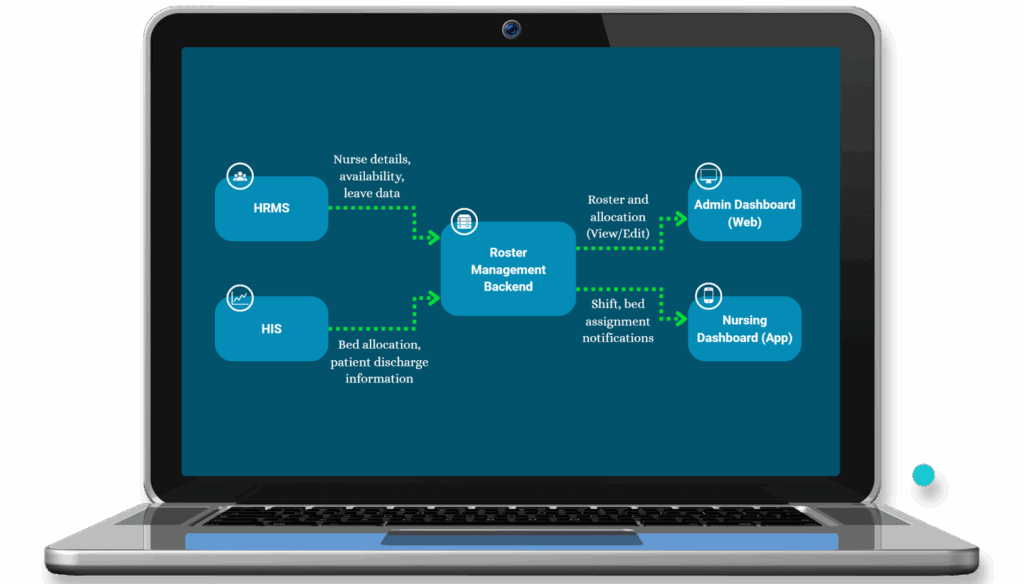
Pulls nurse profiles, certifications, and leave data from HR systems.
Monitors real-time admissions, discharges, and bed status.
Calculates staffing needs by ward, acuity, and shift.
Generates optimized rosters automatically.
Reassigns staff dynamically when situations change.
Notifies teams instantly via dashboards and mobile access.
Maintains full traceability for audits and compliance.
AI & Optimization:TensorFlow, PyTorch
Data & ML:scikit-learn
Backend:Flask, Node.js
Frontend: React, TypeScript
Mobile: Flutter / React Native
Integration Standards:FHIR, HL7
Databases: PostgreSQL / MySQL
Notifications:Firebase Cloud Messaging
Security: RBAC, encryption, audit trails
Deployment: Cloud or on-prem with Docker

Generates optimized rosters by analyzing nurse availability, specialty, and leave records, ensuring accuracy and efficiency.

Continuously maps nurses to patients based on live occupancy and care requirements.
Automatically updates assignments when someone calls in sick or when patient load changes.

Nurses receive schedules, updates, and alerts instantly on their devices.

Provides staffing heat maps, approvals, override options, and workforce analytics.

Ensures adherence to union agreements, rest rules, and regulatory limits.

Reduce manual scheduling effort by up to 80% while improving governance.

Maintain staffing continuity even during high volatility.

Ensure the right expertise is always present in critical units.

Improve transparency, fairness, and work-life balance.

Better alignment between skill mix and clinical demand enhances outcomes.
API-driven integration extends existing investments in HIS and HRMS.
Optimize workforce allocation, reduce overtime, and improve patient care delivery.
70–80% reduction in roster preparation time.
Lower overtime through balanced allocation.
Faster emergency response with real-time reassignment.
Higher nurse satisfaction and retention.
Consistent enforcement of staffing policies.
Improved patient-to-nurse matching.
Traditional rostering tools digitize schedules.
Care Roster AI continuously optimizes them.
It brings together workforce intelligence, patient dynamics, and operational rules into one adaptive system that evolves throughout the day.

We have deployed this automated nursing roster system to one of the largest hospitals in Asia. This solution has seamlessly integrated with the hospital’s HIS and HRMS platforms, enabling real-time shift scheduling, bed-to-nurse allocations, and instant notifications.
Q1: Do we need to replace our HIS or HRMS?
No. The platform integrates via APIs and standard healthcare protocols.
Q2: How configurable are policies?
Fully customizable — work hours, ratios, rotations, specialties, seniority rules.
Q3: Can supervisors override assignments?
Yes, with full audit tracking.
Q4: How quickly can we deploy?
Pilots can begin within weeks, typically starting by department.
Q5: How are nurses informed of changes?
Through real-time mobile and dashboard notifications.
Q6: Can it scale to multi-hospital networks?
Yes, the architecture supports enterprise expansion.
Q7: What analytics are available?
Utilization, overtime trends, staffing adequacy, and workload balance.
From a specific use case to a full-scale modernization, share your requirements, and our engineers will take it from there. We typically respond within 24 hours with a transparent, detailed assessment of what's possible for your business.

We are a full-stack AI development company that helps enterprises make better decisions, reduce costs, and operate more efficiently.





333 West San Carlos Street, San Jose, CA 95110 USA
6000 Rome Blvd, Brossard, Quebec J4Y 0B6 Canada
Technopolis, Kolkata, India
CTIE, Hubli, India
We are a full-stack AI development company that helps enterprises make better decisions, reduce costs, and operate more efficiently.
333 West San Carlos Street, San Jose, CA 95110 USA
India: Kolkata, WB & Hubli, KA
Canada: Brossard, Quebec