
You are spending the maintenance budget on schedule. Your assets are failing on their own schedule. These two schedules are not the same.
Every asset in your operation runs on borrowed time. The question is whether you know which one and when. Predictive Reliability & Asset Intelligence is a pre-configured AI suite that shifts your maintenance program from reactive firefighting to precision-guided intervention, with 30+ days of prior warning before critical failures occur. Built from our field-deployed predictive AI capabilities.

Reactive vs. planned repair cost ratio
Maintenance budget wasted on over-maintenance
Days of prior warning before critical failure
Average downtime reduction achievable
Every unplanned failure carries a cost multiplier that your maintenance budget never anticipated. The math changes entirely when you replace schedule-based maintenance with condition-based intelligence.
Emergency labor premiums, expedited parts shipping, production line shutdowns, and lost revenue per hour; these costs compound across every unplanned event. Multiply this across dozens of assets over a fiscal year, and the true cost of deferred intelligence becomes impossible to ignore.
Calendar-based maintenance schedules replace components at time intervals, not condition thresholds. You are servicing equipment at 60% of its useful life while missing the asset that is three weeks from failure. Predictive intelligence reallocates every maintenance dollar based on actual risk.
A single unexpected compressor failure does not stop one machine; it halts the line, delays shipments, triggers contractual penalties, and consumes engineering hours on root cause analysis. Predictive intelligence breaks this cascade before it starts, converting unplanned events into scheduled interventions.
This suite is not a collection of tools. It is a pre-integrated intelligence architecture covering equipment health, field infrastructure, production processes, and maintenance operations. Each module is field-tested. All four operate as a unified system.

Continuously monitors rotating machinery, electrical systems, and mechanical components using sensor data streams: vibration, temperature, pressure, acoustic signals. The engine detects anomaly signatures weeks before human inspection would surface them, classifies failure types across dozens of known fault patterns, and calculates Remaining Useful Life (RUL) for each monitored asset. Maintenance teams receive ranked intervention windows: not “this bearing might fail,” but “this bearing has a 91% probability of failure in 18-24 days.”

Extends predictive intelligence beyond the plant floor to distributed infrastructure: transmission poles, pipeline segments, substation equipment, tower structures, and field assets managed across geographies. Combines drone imagery, satellite data, IoT sensors, and inspection records to build continuous deterioration models. Inspection crews receive risk-ranked field routing, prioritized by structural deterioration score, not by geography or schedule. High-risk assets get flagged before they become failures; low-risk assets are deferred without guesswork.

Monitors manufacturing process parameters in real time: coating thickness, temperature gradients, pressure curves, mixing ratios, chemical concentrations, against learned baselines. Detects process drift before it produces off-spec product or equipment strain. Isolates root causes of quality deviation and surfaces corrective action recommendations directly to shop floor operators through a live dashboard. Eliminates the gap between a process going wrong and the team knowing about it — shifting quality control from post-hoc inspection to real-time intervention.

Integrates with your CMMS and ERP to transform how maintenance work is planned, prioritized, and executed. Ingests technician logs, maintenance histories, and NLP-parsed equipment manuals to build failure pattern libraries that improve with every event. Outputs intelligent work order prioritization ranked by failure probability and business impact, spare parts demand forecasts tied to predicted failure timelines, and technician dispatch routing optimized for response time and skill match. Your maintenance backlog stops being a calendar event.
Predictive reliability intelligence is not a manufacturing-only capability. These modules have been deployed across six distinct asset-intensive industries, each with quantifiable outcomes for the business.
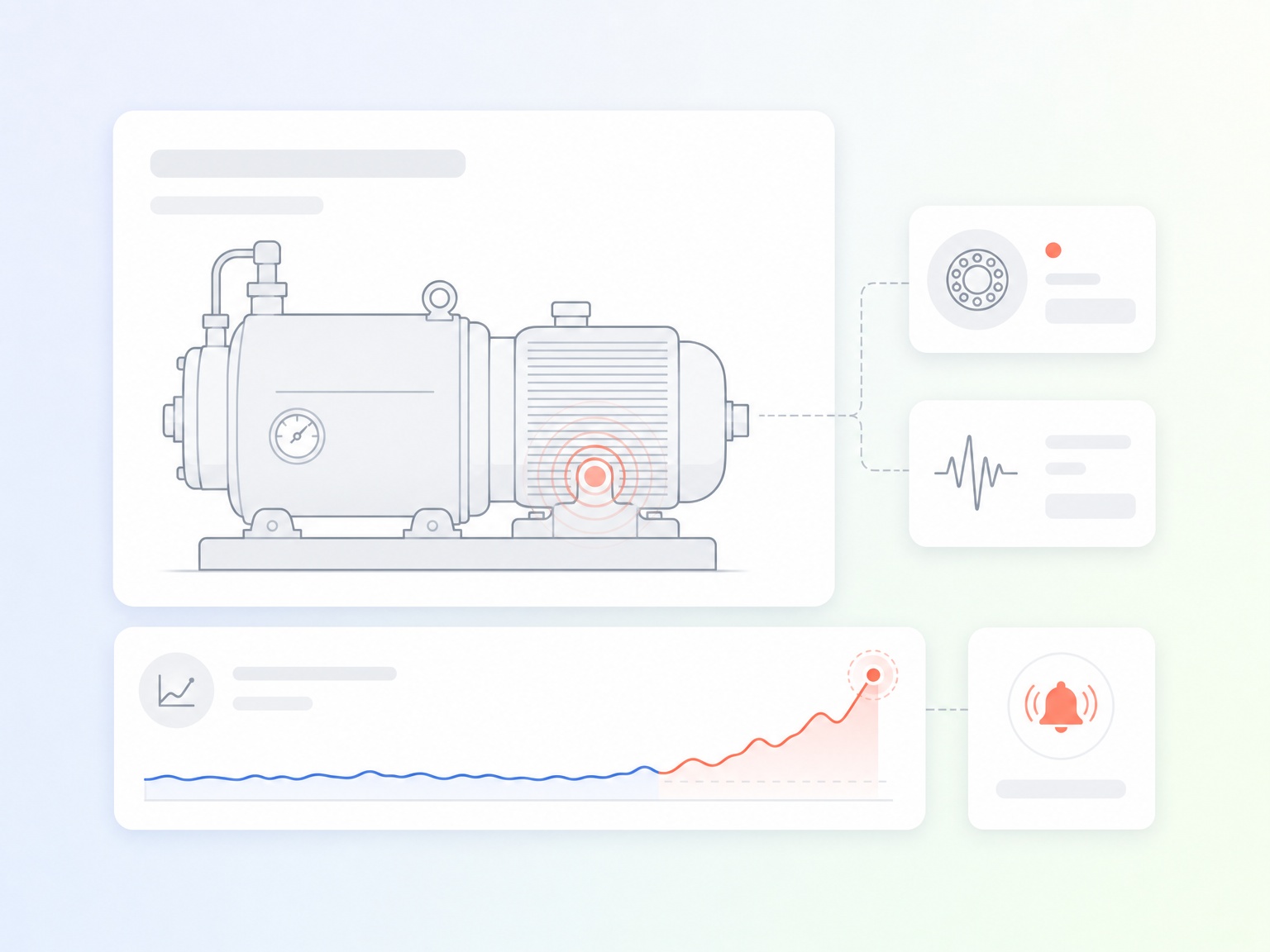
Monitors motors, compressors, gearboxes, and pumps using vibration and acoustic signatures. Detects bearing wear, misalignment, and cavitation 3-6 weeks before failure, enabling replacement during planned downtime windows rather than emergency shutdowns.
Operational Outcome: 60-70% reduction in unplanned stoppages
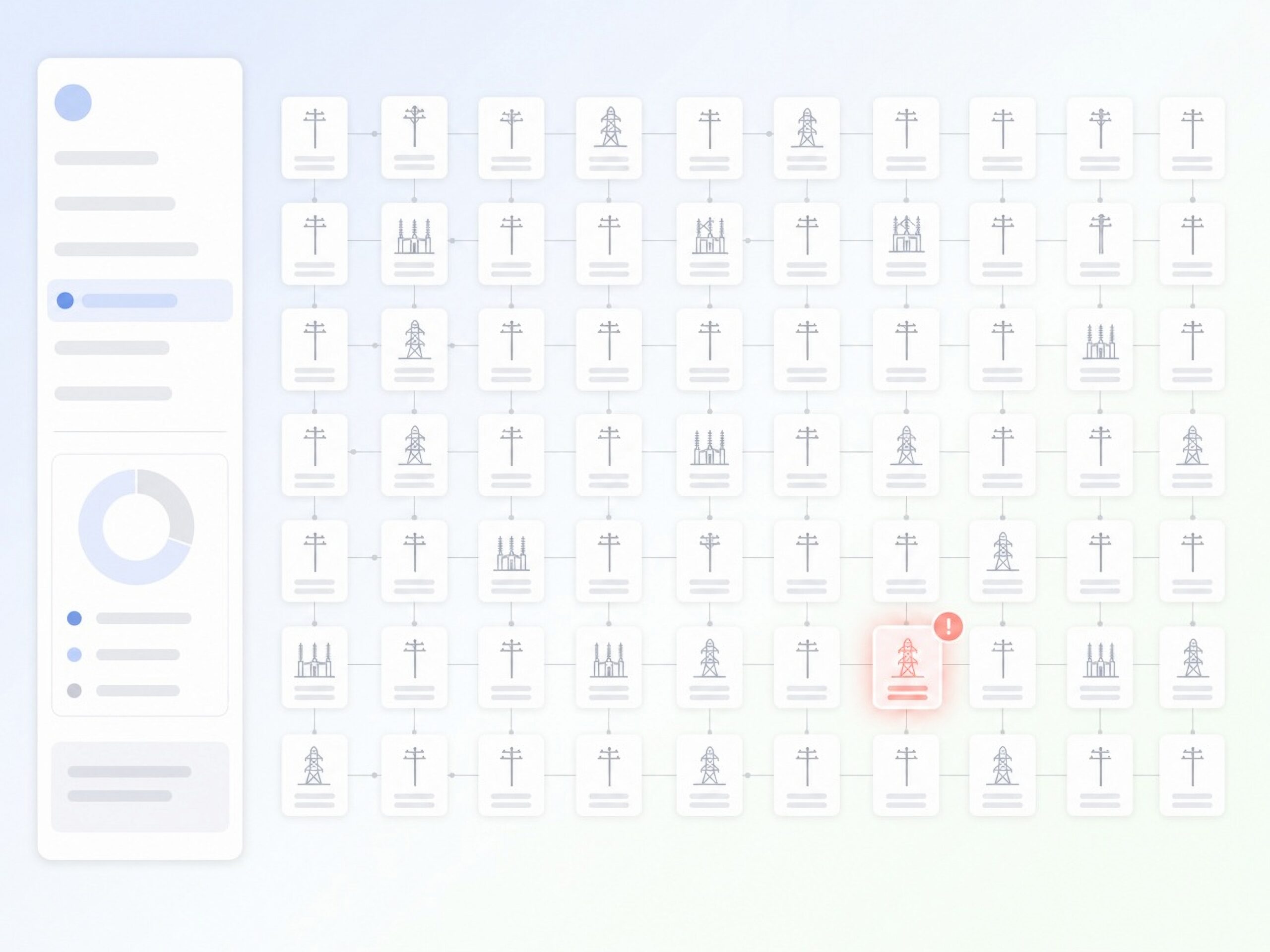
Monitors electrical poles, transformers, substations, and grid infrastructure for structural deterioration, corrosion, and anomaly signatures. Prioritizes inspection crews by risk score rather than geography, and surfaces wildfire-risk assets before they become incidents.
Operational Outcome: 70% reduction in field inspection time
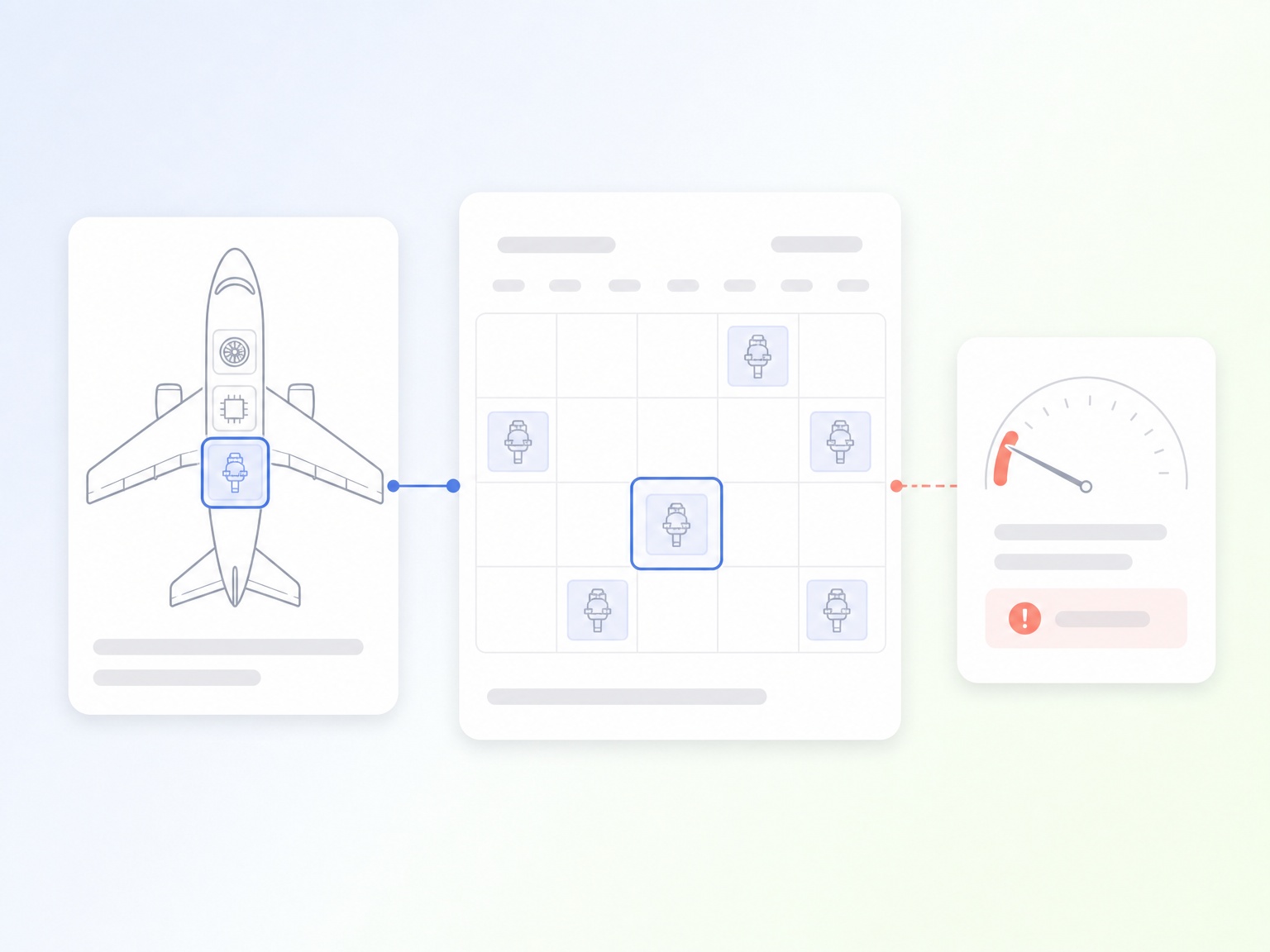
Tracks sensor data from flight-critical components to calculate Remaining Useful Life, predict failure modes, and optimize maintenance windows around operational schedule, eliminating unnecessary component replacements while improving safety margins.
Operational Outcome: Elimination of unnecessary MRO cycles, measurable cost reduction
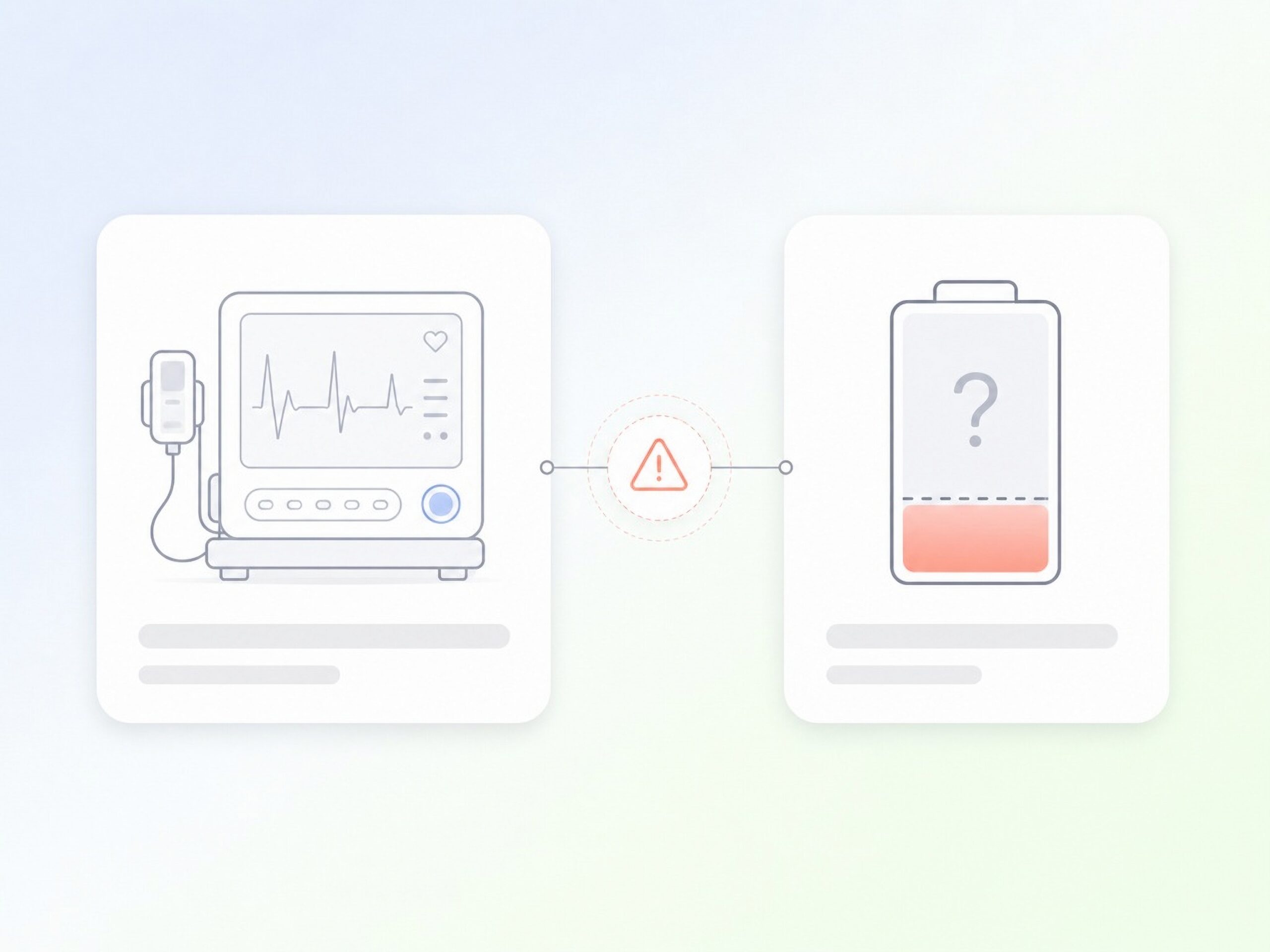
Predicts battery degradation curves and component wear in high-value surgical and diagnostic equipment using early lifecycle test data. Enables proactive device management before reliability is compromised in clinical settings, critical in regulated environments where equipment failure carries patient safety implications.
Operational Outcome: 90%+ prediction accuracy, reduced testing overhead
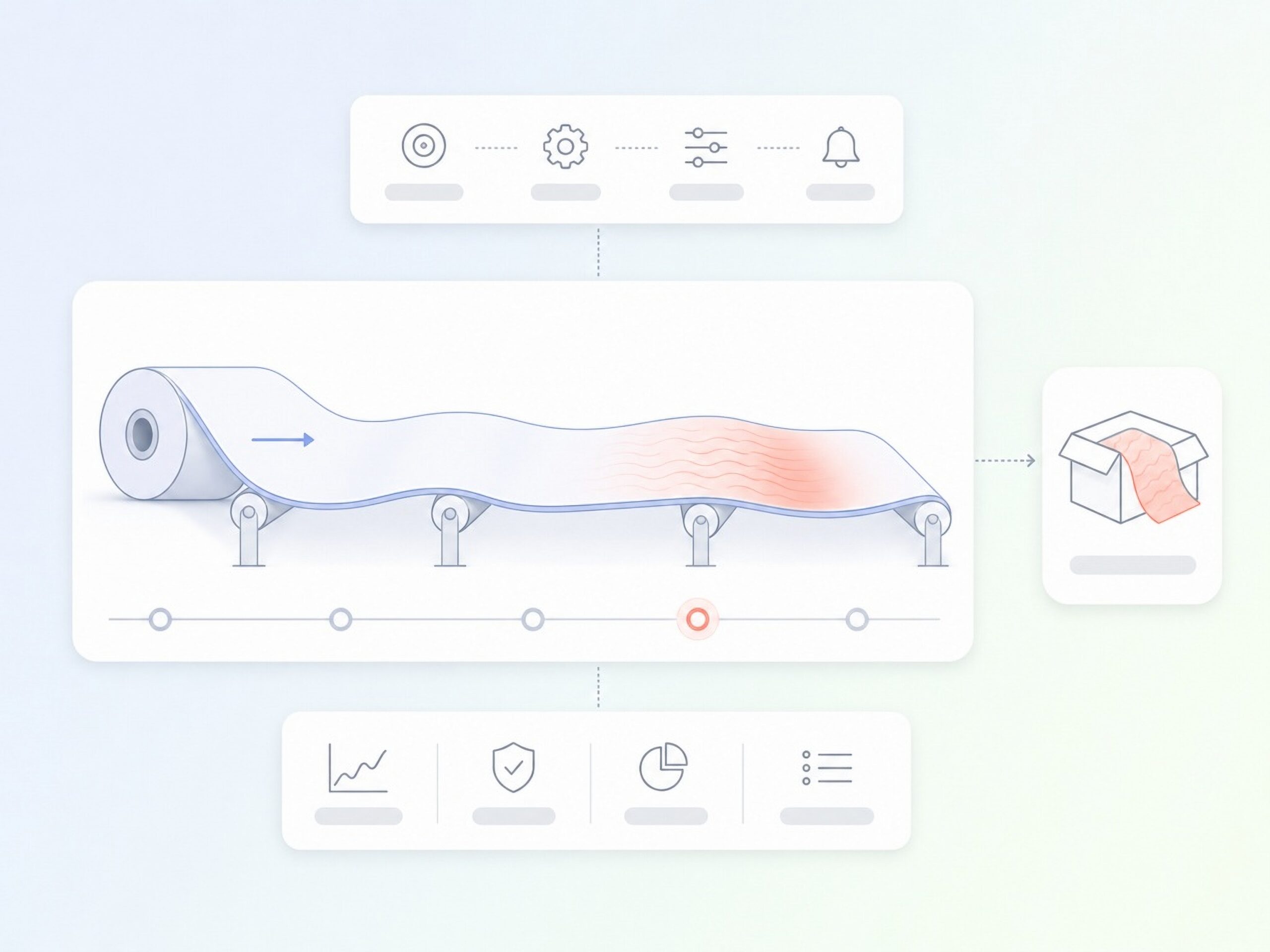
Monitors coating thickness, temperature, mixing ratios, and chemical concentrations in real time against learned process baselines. Detects process drift and machine degradation before they produce off-spec product, triggering corrective actions directly on the shop floor — reducing scrap and improving Overall Equipment Effectiveness.
Operational Outcome: Defect rate reduction, OEE improvement
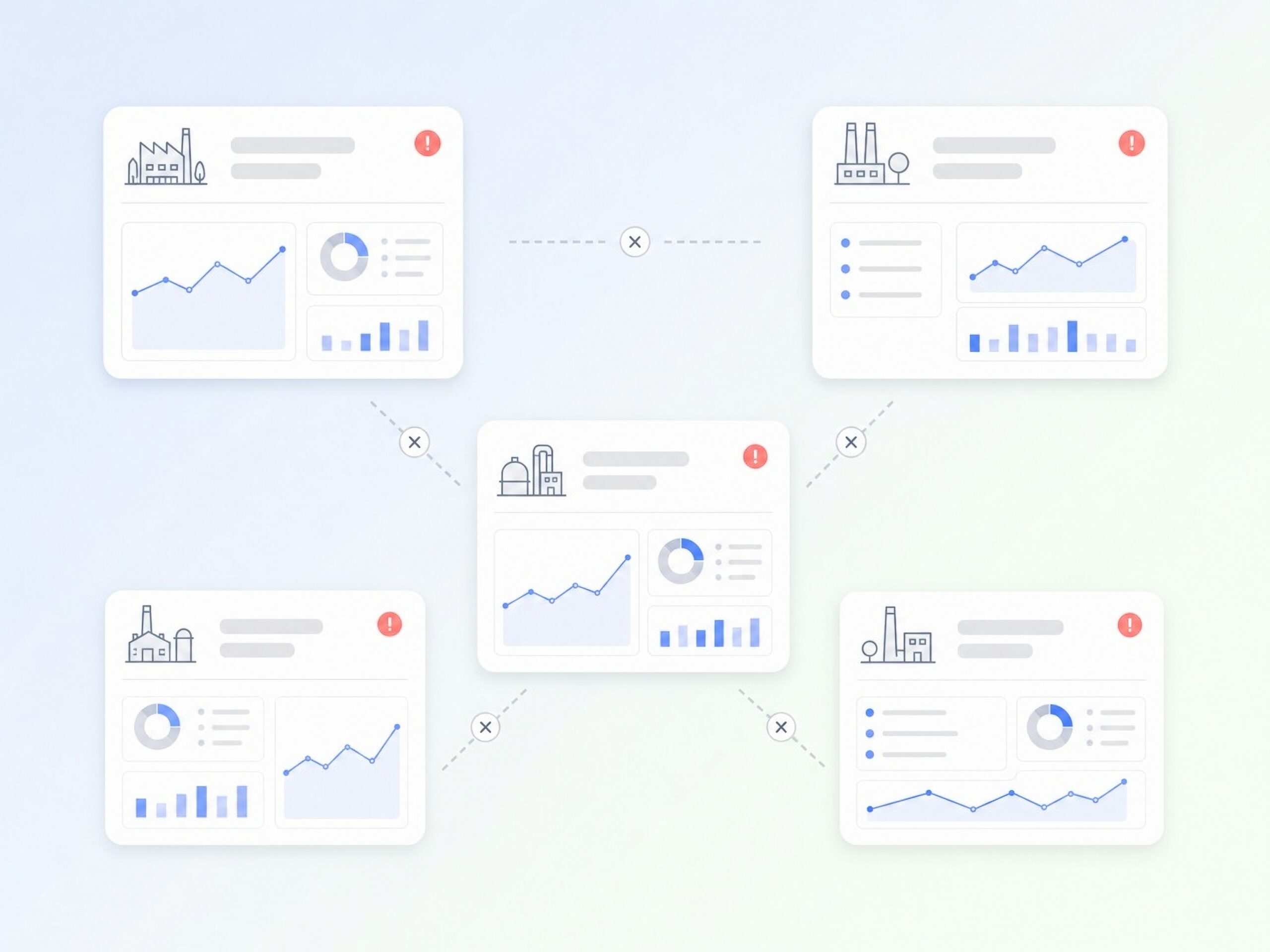
Unifies asset health data from multiple plants, depots, or field sites into a single intelligence layer. Standardizes failure detection models across site-specific variations and enables enterprise-wide maintenance benchmarking — giving leadership portfolio-level visibility, not site-by-site guesswork.
Operational outcome: Portfolio-level OEE visibility, cross-site benchmarking
Every module in this suite is built from predictive AI systems ThirdEye Data has already deployed in production environments. These are the case studies that prove they work.
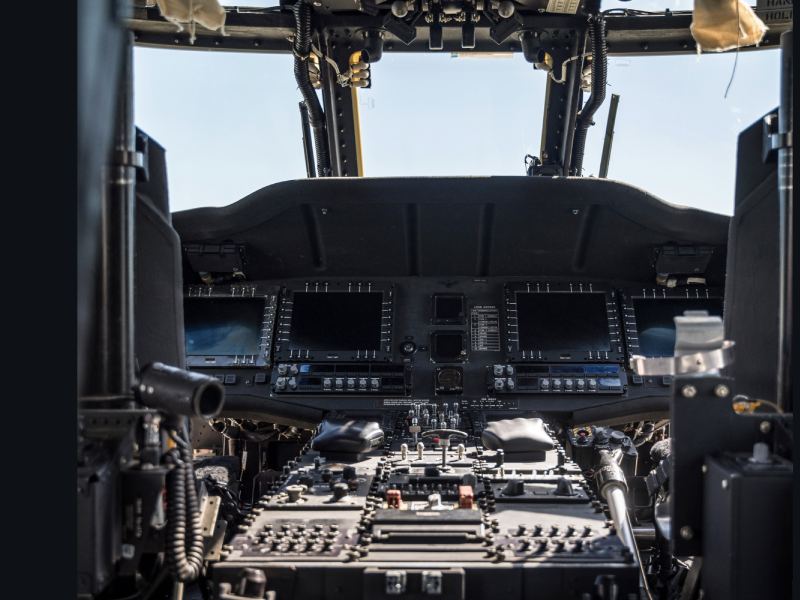
An aerospace organization operating helicopter fleets engaged us to move beyond time-based maintenance. We built Component Health Assessment models using sensor data, RUL prediction for critical flight components, and NLP-powered parsing of maintenance manuals to correlate logged symptoms with failure patterns.
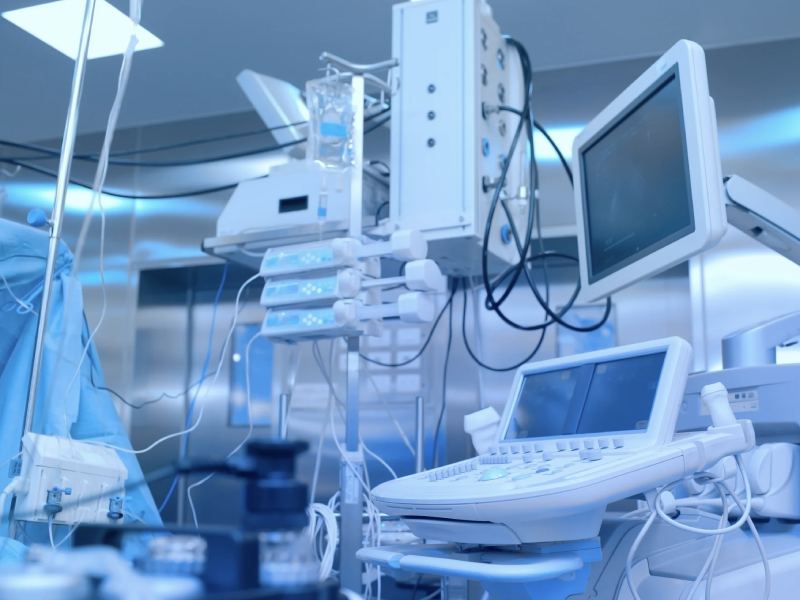
The customer engaged us to predict remaining battery life in high-value surgical equipment using ML models trained on early lifecycle test data. The solution targets 90%+ prediction accuracy using Reinforcement Learning and Active Learning, dramatically reducing costly full-cycle battery testing and enabling proactive device management at scale across global clinical operations.
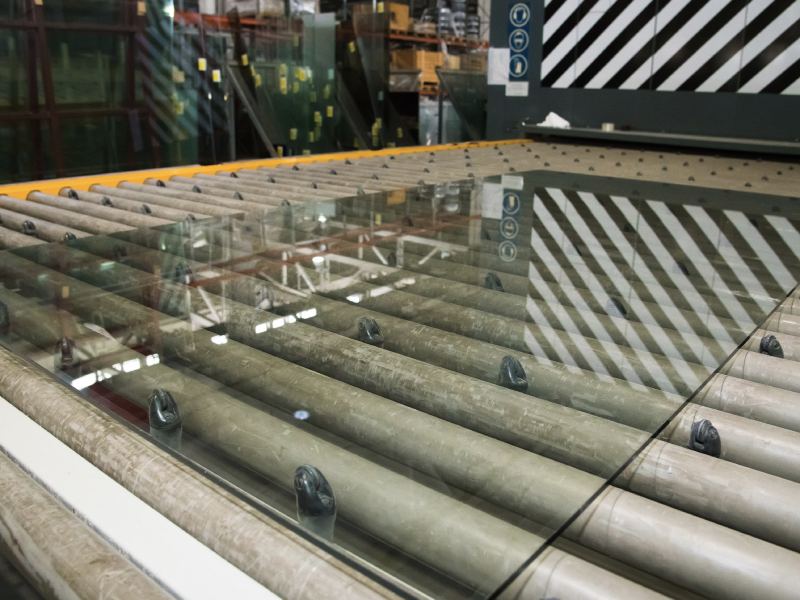
A Swiss precision glass manufacturer required a real-time predictive control system for its glass coating process. We built an open-loop predictive metrology layer on Azure that detects coating defects and machine failure signatures in real time, surfaces corrective action suggestions to shop floor operators, and has measurably reduced scrap rates and unplanned stoppages.

Managing the tension between aggressive production targets and the aging equipment reality. Running reactive maintenance cycles that erode margins and exhaust technicians. Needs a measurable shift with a clear ROI story and a realistic integration path into existing infrastructure, not a technology project that takes two years to show results.
"If you can give me 30 days advance warning on a compressor failure, you just paid for this platform in a single event."
Knows exactly where the gaps are. Has tried CMMS implementations and preventive schedules, but the calendar does not know the equipment, and the equipment does not know the calendar. Needs condition-based intelligence that matches the signal to the response, and a way to make that case up the chain with data, not instinct.
"I do not need more dashboards. I need the dashboard to tell me which three assets to touch this week, ranked by risk."

Maintenance cost creep is real and hard to audit. Approving emergency purchase orders for parts that should have been in stock, and budget overruns that trace back to a single unplanned failure two quarters ago. Needs intelligence that ties maintenance spend to asset risk, and a financial case for investing upstream rather than reacting downstream.
"If predictive intelligence reduces our emergency maintenance spend by 30%, that more than covers this deployment."
Your CMMS is a scheduling and record-keeping system; it manages what happened and what’s planned. This suite adds an intelligence layer that predicts what’s about to happen. It integrates with your CMMS rather than replacing it, feeding failure probability scores and risk-ranked work order priorities directly into your existing workflow. You keep your operational system of record; you gain the intelligence that tells you what to put in it.
You do not need a fully instrumented plant. We start with the sensors you already have, such as vibration, temperature, pressure, operational logs, and build baseline models from your existing data. If you have historical data, SCADA outputs, or maintenance event logs, those become the foundation. Expansion to additional sensor types can be phased in as the program matures and ROI is validated.
Most organizations see initial anomaly detection results within 8-12 weeks of deployment. RUL models and failure classification improve in accuracy over the first 60 days as the system builds behavioral baselines for your specific equipment. We scope the initial deployment around your highest-criticality assets so that early results are tied to the assets where failure cost is highest.
We start with a narrow, high-value use case, your top 5 failure-risk assets, rather than a fleet-wide deployment. You see demonstrable results in a contained scope before any expansion decision.
Our case studies reflect actual client outcomes from live deployments, not benchmarks from controlled environments. The engagement starts with a discovery phase where we assess your data and set realistic expectations, not a sales pitch built on industry averages.
The suite integrates with common CMMS platforms (SAP PM, IBM Maximo, ServiceMax), SCADA systems, Azure IoT Hub, OSIsoft PI, and historian databases. Most integration work takes 2-4 weeks for standard environments.
Custom integrations are scoped and time-bounded during the discovery phase, and you receive a clear integration architecture before any commitment is made.
Our short answer is “No”. The system is designed to be operated by your maintenance and operations teams, not data scientists. Dashboards surface failure probabilities and ranked recommendations in plain operational language. Model retraining is automated on new data. ThirdEye provides ongoing support and a shared responsibility model for model performance; you do not need to build an ML team to sustain this program.
We use transfer learning from similar equipment classes, physics-based constraints that encode known failure mechanics, and synthetic fault injection to build robust models even with sparse failure history. You do not need years of documented failures to get started. Operating data, maintenance logs, and manufacturer specs are often sufficient for initial model development.
Yes. The suite is available in cloud (Azure/AWS/GCP), on-premises, air-gapped industrial network, and edge deployment configurations. Data sovereignty requirements in regulated industries like defense, healthcare, and utilities are accommodated by design. Sensitive operational data does not need to leave your network perimeter for the intelligence layer to function.
The platform uses site-normalized models that account for local equipment variations, operating conditions, and historical maintenance practices. Enterprise dashboards aggregate health scores across sites using standardized risk metrics, so leadership sees a consistent portfolio view.
Local models capture site-specific failure signatures; what is normal for your Tier 1 plant may differ from what is normal for your Tier 2 depot.
Organizations targeting their highest-criticality assets typically recover deployment costs within 6-12 months through avoided emergency repairs, reduced parts waste, and recovered production hours. We provide a pre-engagement ROI model based on your asset inventory, current maintenance spend, and average cost of unplanned downtime, so you enter procurement with a financial case, not a hope.
From a specific use case to a full-scale modernization, share your requirements, and our engineers will take it from there. We typically respond within 24 hours with a transparent, detailed assessment of what's possible for your business.

We are a full-stack AI development company that helps enterprises make better decisions, reduce costs, and operate more efficiently.







333 West San Carlos Street, San Jose, CA 95110 USA
6000 Rome Blvd, Brossard, Quebec J4Y 0B6 Canada
Technopolis, Kolkata, India
CTIE, Hubli, India
We are a full-stack AI development company that helps enterprises make better decisions, reduce costs, and operate more efficiently.
333 West San Carlos Street, San Jose, CA 95110 USA
India: Kolkata, WB & Hubli, KA
Canada: Brossard, Quebec