The AI-based Vegetation Indices Solution leverages satellite imagery and machine learning to monitor crop health, detect stress, and generate actionable insights for precision farming. By analyzing multispectral bands (RGB, NIR, SWIR), it computes NDVI, EVI, NDWI, and other indices to provide farmers, agronomists, and agribusinesses with real-time visibility across large farmlands.
This solution enables data-driven decisions on irrigation, fertilization, and harvesting – improving yields, conserving resources, and supporting sustainable farming.

Manual field inspections are slow, labor-intensive, and unscalable.
Early crop stress is often missed, leading to 15–25% yield losses.
Inefficient water, fertilizer, and pesticide usage increases costs and harms the environment.
Fragmented datasets (soil, crop, weather) prevent holistic insights.
Lack of predictive analytics limits ability to anticipate disease or yield gaps.
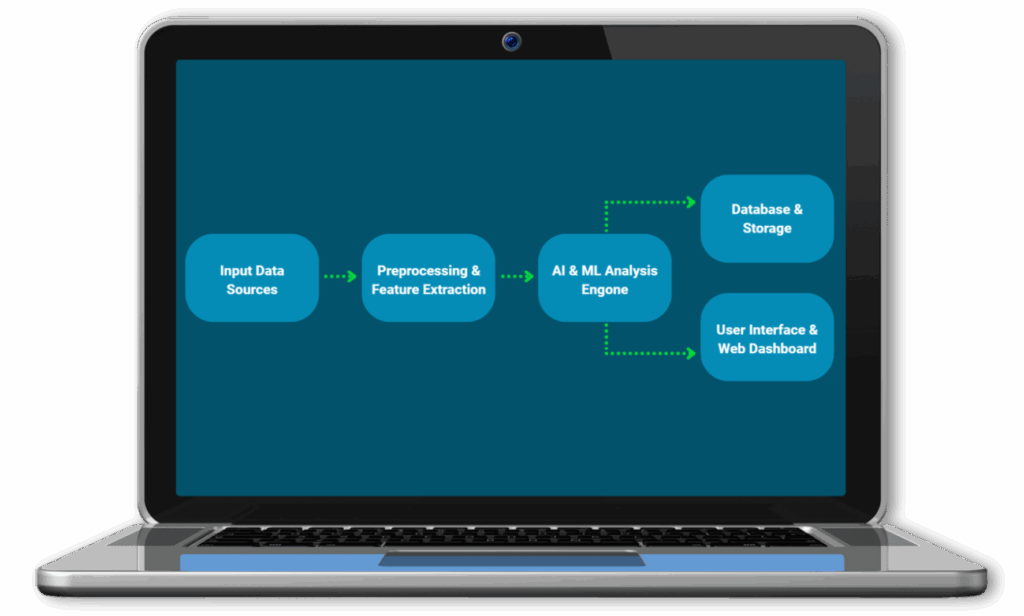
The system processes satellite images, extracts spectral bands, computes vegetation indices, and produces:
Crop health maps with NDVI, EVI, NDWI
Zoning maps highlighting healthy vs. stressed regions
Recommendations for irrigation, fertilization, and early disease prevention
The result: scalable, objective, and automated insights for smarter crop management.
Remote Sensing & Geospatial AI: Rasterio, GDAL, OpenCV
Machine Learning Models: Random Forest, SVM, K-Means, Regression, U-Net for segmentation
Data Sources: Sentinel-2, Landsat-8, MODIS, ISRIC SoilGrids, NASA POWER
Deployment: Streamlit UI, Docker containers, APIs for ERP/Farm Management integration

Supports RGB, NIR, and SWIR inputs to deliver a multi-dimensional view of crop health across large farmlands.
Generates NDVI, EVI, NDWI, and SAVI to detect stress, water deficits, or healthy growth patterns in crops.

Instant reports provide farmers with detailed health maps, reducing manual inspections by up to 80%.

Automatically segments fields into stressed vs. healthy zones for targeted intervention and resource efficiency.
Suggests irrigation, fertilization, and disease prevention steps to reduce losses and optimize yields.
Easily processes thousands of hectares using cloud infrastructure, suitable for individual farms or cooperatives.

Automates monitoring across wide farmland, reducing manual labor costs by up to 70%.

Improves decision-making with real-time insights, leading to more precise input usage.
Predicts yields early, helping agribusinesses plan procurement and logistics more effectively.

Supports crop insurance and financing with accurate, data-backed assessments of crop conditions.

Promotes water and fertilizer conservation, reducing waste and supporting ESG initiatives.

Provides reliable vegetation data for research, trials, and large-scale agricultural innovations.
Explore how our AI-powered crop health analysis works in real scenarios.
Reduced manual inspections by 70–80% in pilot deployments.
Prevented up to 20% yield loss by detecting early crop stress.
Optimized water and fertilizer usage, saving 15–25% in input costs.
Delivered reliable yield predictions with 85–90% accuracy.
It does not work like generic remote sensing tools; this system combines advanced AI with multispectral imagery to provide actionable, real-time recommendations rather than raw data.
Can this work with drones as well as satellites?
Yes, it supports both UAV/drone imagery and satellite data.
How accurate are the vegetation indices?
NDVI/EVI scores achieve 85–90% reliability when calibrated with ground truth data.
Can the solution integrate with irrigation systems?
Yes, APIs enable integration with irrigation controllers for automated action.
Does it require high technical expertise to use?
No, the interface is intuitive and farmer-friendly.
How frequently can crop data be updated?
As frequently as satellite passes occur (every 5–10 days with Sentinel-2).