
Most enterprises do not lose money on inventory because they lack a system of record. In fact, around 89% of supply chain businesses use WMS or ERP systems. They lose money on inaccurate inventory counts because the numbers in that system drift away from what is physically on the floor.
The cost shows up in places that rarely get traced back to counting. A truck waits at the dock while a supervisor recounts a pallet, and the detention clock keeps running. A customer claims a short delivery, and without visual proof of what left the building, finance issues a credit memo. A plant schedules a production run against raw material that the ERP says exists, then stops the line when the stack in the yard turns out to be smaller than recorded.
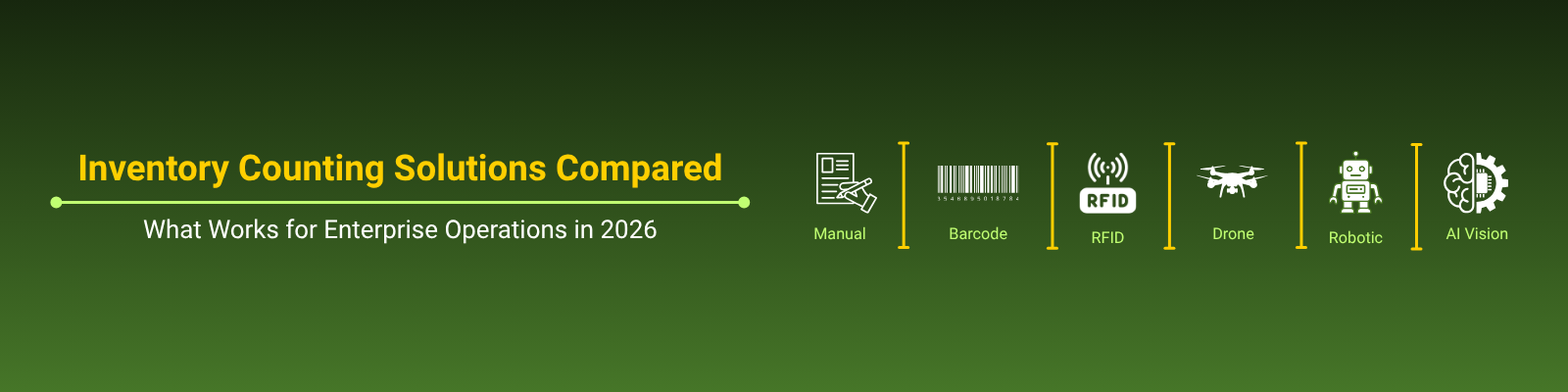
There are now several ways to count inventory, from clipboards and handheld scanners to RFID gates, drones, robots, and AI vision on cameras the site may already have. Each one makes a different trade-off between counting accuracy, upfront cost, running cost, and the kind of items it can handle. We have brought this guide that compares them side by side so operations and supply chain leaders can match the method to the problem they actually have.
A counting method that works well in an apparel distribution center can fail badly in a steel yard or on a food plant’s loading dock. Before comparing technologies, pin down what your operation needs from a count.
People walk the floor, count by eye, and write down the numbers. It needs no technology budget, which is why it is still the default in many plants and warehouses.
The problem is that accuracy depends on who is counting, how tired they are, and how the stock is stacked. Counts of tall stacks, dense pallets, or loose goods are often estimates. Full physical counts usually mean shutting down or slowing operations, and the labor cost repeats every cycle. There is no record of what the counter actually saw, so disputes come down to whose number to trust.
This Manual Method is Best Fit For: small sites, low SKU counts, and operations where counting is infrequent.
Workers scan barcodes on items, cases, or locations with a handheld machine or mobile app, and the scans post directly to the WMS or ERP. This removes transcription errors and is the backbone of cycle counting in most modern warehouses.
Scanning is still a line-of-sight, one-at-a-time task. It only works when every item carries a readable label, and it does not help with unlabeled bulk goods, high stacks the scanner cannot reach, or goods moving through a dock door. Labor remains the main running cost.
Barcode-based Counting Best Fit For: labeled cartons and pallets in racked locations with an established WMS.
Each item, case, or pallet carries an RFID tag, and readers capture many tags at once without line of sight. Fixed readers at dock doors can record goods as they pass, and handheld readers can sweep an aisle in minutes.
RFID is strong for high-value, serialized, and fast-moving goods, and it is well proven in apparel retail. But the cost model is the catch. Passive tags typically run $0.05 to $0.30 each, fixed readers $1,000 to $8,000 per unit, and a complete system anywhere from $10,000 to over $100,000 (KORONA POS). The per-tag cost repeats with every unit you tag, and metal and liquids can interfere with reads, which matters for steel, beverages, and many food products. Bulk goods like sacks of grain or stacked bars are rarely tagged at all.
RFID-based counting is Best Fit For: item-level tracking of high-value or serialized goods where per-unit tagging cost is small relative to item value.
Indoor drones fly racked aisles and scan barcodes or capture images of pallet positions, often during off-shift hours. They can reach high bays that are slow and risky to count by lift.
Drones work best in tall, well-organized racking with labeled pallets facing outward. They need clear flight paths, careful safety planning, and usually a vendor-managed program. They do not count goods inside a pallet, loose stock on the floor, or items moving through loading zones.
Drone-based Counting is Best Fit For: large high-bay distribution centers with standardized, labeled pallet storage.
Ground robots travel aisles with cameras or RFID readers and capture shelf or rack data on a schedule. Some are built for retail shelves, others for warehouse racking.
Robots give consistent, repeatable scans without adding counting labor. They also carry a high upfront cost, need mapped and navigable floors, and are built around structured storage. Outdoor yards, bulk stacks, and dock activity fall outside what most robots handle.
Robotic counting is best fit for: structured indoor environments where the same locations are scanned repeatedly.
Purpose-built camera rigs, often mounted over conveyors, workstations, or rack faces, count and identify items with machine vision. These systems can be very accurate in controlled positions with consistent lighting.
They are usually designed for one station or one product flow. Extending them across many locations means more custom hardware, more installation, and more cost per site.
A fixed CV counting system is best fit for: high-volume, fixed-position counting such as a single production line or packing station.
The newest category uses specialized AI models that count items from images or video captured on regular smartphones or from existing CCTV feeds. A supervisor photographs a stack, or a camera watches a dock door, and the model returns a count with the image attached as visual proof.
This approach handles goods that other methods struggle with: sacks, cartons, metal bars, sheets, bricks, dense or high stacks, large outdoor areas, and items moving during loading and unloading. Because it uses phones and cameras most sites already have, it scales across many locations without tagging items or installing readers. Its limits are real. Accuracy depends on how well the model is trained on the specific items; new item types need additional training, and sites without usable phone capture or with CCTV that does not support standard video streams (RTSP) may need new camera installs.
AI-based Counting Solution is Best Fit For: multi-site operations with bulk, unlabeled, stacked, or moving goods, and teams that need visual proof attached to every count.
|
Methods
|
Counting Accuracy
|
Upfront Cost
|
Running Cost
|
Result on Bulk Stacks or Moving Items
|
Visual Proof
|
Payback Drivers
|
|---|---|---|---|---|---|---|
|
Manual counting |
Varies by counter and stack |
Very low |
High, labor every cycle |
Estimates only, Hard on Moving Items |
None |
No upfront spend, but labor and recount cost repeat every cycle |
|
Barcode handhelds |
High for labeled items |
Low to moderate |
Moderate, labor every cycle |
Poor and Slow |
None |
Fewer transcription errors, while scanning labor remains |
|
RFID |
High for tagged items |
High (readers, setup) |
Per-tag cost on every unit |
Rarely tagged, but strong at fixed gates |
None |
Faster counts and fewer misses, offset by tag cost that grows with volume |
|
Drones |
High for labeled rack faces |
High |
Moderate to high |
Poor |
Yes, images of rack faces |
Lift time and labor saved in high bays, offset by program and safety costs |
|
Mobile robots |
High in mapped aisles |
High |
Moderate |
Poor |
Yes, images of shelves |
Repeat scans without added labor, offset by high upfront cost |
|
Fixed CCTV Systems |
Very high at its station |
Moderate |
Low |
Good at that station only |
Yes |
Labor and errors saved at one station, with hardware cost repeating per site |
|
AI vision on phones and existing CCTV |
Very high when trained properly |
Low to Moderate |
Low |
Strong |
Yes, timestamped |
Fewer recounts, disputes and credit memos on low hardware cost; 8 to 12 months payback in Vision Count deployments |
A practical way to decide is to pick one site and one recurring problem, such as yard stack variance or dock disputes, and measure the current count variance and the hours spent counting. Then test the candidate method on that same problem with your own items. The comparison will tell you more than any vendor claim.
Vision Count AI is ThirdEye Data’s AI counting solution in the smartphone and CCTV vision category. It runs in production across more than 2,200 warehouses and with more than five manufacturing and supply chain companies, where it counts goods that tagging and scanning methods were never designed for.
What it counts. The models are trained on sacks and bags, carton boxes, metal bars and steel sheets, and they extend to other items such as bricks or packaged food on a moving line. Spatial intelligence lets the system count stacks that are too high or too dense to count by eye, large outdoor storage areas, and goods moving during truck loading and unloading.
How it captures counts. Supervisors use the smartphones they already carry for periodic counts, and existing CCTV feeds handle continuous counting at docks and on production floors. Sites without usable phone capture or with cameras that do not support standard video streams may need a camera install, which is scoped at the start.
What it leaves behind. Every count carries a timestamp and the image or video it was based on. When a customer disputes a delivery or an auditor questions a number, the team can show exactly what was counted and when. Headquarters sees counts from every site in one view, and results can flow into the client’s ERP, Power BI, or a built-in dashboard.
Accuracy and how it improves. Customers report 95%+ counting accuracy in production. When a user flags an edge case, the model is retrained on it, so accuracy improves as the system sees more of your actual stock and conditions.
Hardware and cost. Vision Count is CPU-first and GPU optional. End-of-shift or recorded counting runs on standard CPU servers. A GPU is added only when the operation needs live, high-volume counting from video. Cost is driven by the number of cameras, live versus recorded counting, the reporting destination, and the variety of item types to train, not by how many units you move.
Beyond the count. The same system can run quality inspection on the items it counts, and an optional chat assistant lets audit managers ask questions about real-time counting and quality data in plain language.
Time to production. ThirdEye Data’s R&D team can build a custom demo on your own images within three to four business days, so you see counting results on your stock at no cost before any commitment. A full production deployment, including user acceptance testing, typically takes 8 to 12 weeks.
Payback. Clients typically recover their Vision Count investment within 8 to 12 months. The return comes from fewer recounts, fewer short-shipment disputes and credit memos, and less supervisor time spent counting by hand.
Where it is not the right tool. If you need item-level serial tracking of high-value goods, RFID is often the better choice. If your current count variance is already below 2 percent, the accuracy gain alone may not justify a change, and the case would rest on labor savings and visual proof instead.
It depends on the item. RFID and barcode scanning are highly accurate for tagged or labeled items. Dedicated machine vision stations are very accurate at a single controlled position. For bulk, stacked or unlabeled goods, AI vision trained on your specific items is usually the most accurate practical option, with production systems reaching 95% or higher.
RFID is better when you need to track individual high-value or serialized units. Computer vision is better when goods are untagged, stacked, metal-heavy or moving through docks, and when you want visual proof of each count. Vision also avoids the per-tag cost that grows with volume.
Yes, in most cases. AI counting systems can read standard CCTV video streams to count goods at docks and on production floors. Older cameras that do not support standard streaming, or areas with no coverage, may need new cameras.
Not always. Recorded or end-of-shift counting can run on standard CPU servers. GPUs are typically needed only for live, high-volume counting from video.
A demo on your own images can be ready in a few days. A production deployment across sites, including integration and user acceptance testing, typically takes 8 to 12 weeks.
Start with three numbers: your current count variance, the labor hours spent on counting each month, and the dollar value of disputes, credit memos and stoppages tied to count errors. A new method should reduce at least one of these by enough to cover its full running cost. In Vision Count deployments, clients typically reach payback within 8 to 12 months.
If bulk stacks, yard inventory or dock disputes are driving count errors in your operation, send us images from one site. ThirdEye Data’s team will run Vision Count AI on your own stock and show you the counting accuracy and the cost of the gap it closes, before you commit to anything. Book a 15-minute call with our team.
From a specific use case to a full-scale modernization, share your requirements, and our engineers will take it from there. We typically respond within 24 hours with a transparent, detailed assessment of what's possible for your business.

We are a full-stack AI development company that helps enterprises make better decisions, reduce costs, and operate more efficiently.








333 West San Carlos Street, San Jose, CA 95110 USA
6000 Rome Blvd, Brossard, Quebec J4Y 0B6 Canada
Technopolis, Kolkata, India
CTIE, Hubli, India
We are a full-stack AI development company that helps enterprises make better decisions, reduce costs, and operate more efficiently.
333 West San Carlos Street, San Jose, CA 95110 USA
India: Kolkata, WB & Hubli, KA
Canada: Brossard, Quebec