
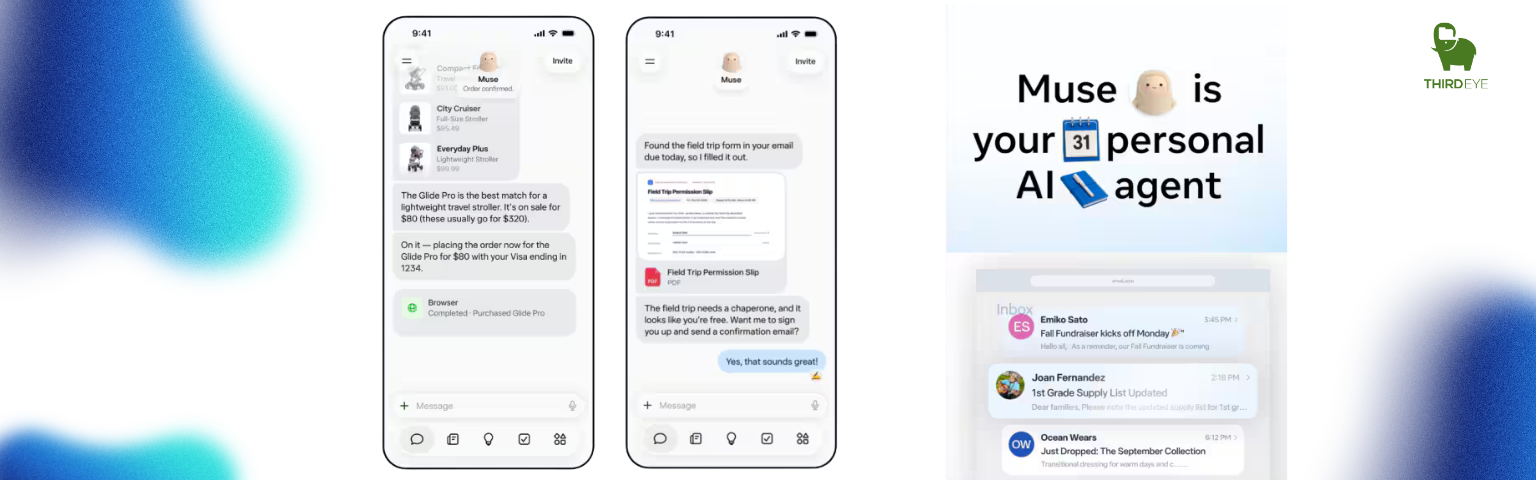
Meta launched Muse this week. It is a personal AI agent that can read your email, access payment information, book trips, and shop for you. Meta paired it with Muse Spark 1.3, a model built for coding and autonomous work, and with Muse Code, an agent aimed at large codebases that Meta quietly shipped back in August.
The headlines that followed were not about the model’s capability. They were about trust. “Can you trust it with your email and payments.” “Will it read your private data.” That is the story that stuck, not the feature list.
We think that’s the useful part of this news, and it’s worth a straight answer instead of a hot take.
To be clear, this isn’t a review of Muse and we’re not weighing in on whether Meta got it right. We build agents like this for a living, so we’re using the news as a chance to explain what’s actually happening under the hood, and where the real work is when you want to build or run one of these inside a business.
Muse needs broad access to be useful. To book a trip or send an email on your behalf, it has to read your inbox, see your calendar, and touch your payment methods. Meta is asking millions of consumers to grant one AI agent that much access, all at once, based on a promise that it will behave.
That is exactly the design question every enterprise already runs into the moment it tries to put an agent into production. Not “can the model reason well.” Not “can it hold a conversation.” The question is: what is this agent allowed to touch, what happens when it’s wrong, and can someone prove that after the fact.
Consumers are being asked to take that leap on trust. Enterprises don’t get to.
We build agentic AI for support ticket automation and operational workflows, and the pattern is consistent across every deployment: the model is rarely the hard part. The hard part is everything Muse’s coverage is now asking in public.
A production agent needs a defined scope: which systems it can read, which actions it can take on its own, and which ones require a person to approve first. It needs a full audit trail, so when it closes a ticket, updates a record, or triggers an action, there’s a record of what it did and why. It needs rollback and override built in from day one, not added after something goes wrong. And it needs a way to measure whether it’s actually reducing work, not just producing activity that looks like work.
None of that is a privacy feature bolted onto a chatbot. It’s the architecture. Skip it, and you get exactly the headlines Meta is getting right now, just aimed at your own systems instead of a consumer product.
Muse is a signal, not a template. It tells us two things worth acting on.
First, autonomous agents that touch real data and take real actions are now mainstream enough that a company the size of Meta is betting a product launch on them. The technology is ready. The expectation that AI should just handle things is spreading fast, and your customers and employees will start expecting it too.
Second, the trust question is not going away by ignoring it. If anything, Muse’s launch just made “how do you know your agent won’t misuse this access” a question every stakeholder in the room already knows to ask. Better to have the answer built into your architecture before someone asks, than to explain it after an incident.
Muse made the case, in public, for why AI agents that act on your behalf are coming to every business function, not just consumer apps. If you’re scoping one for support, operations, or security workflows and want a clear picture of what it actually takes to build and run one safely, we’ve done this in production. Happy to compare notes.
From a specific use case to a full-scale modernization, share your requirements, and our engineers will take it from there. We typically respond within 24 hours with a transparent, detailed assessment of what's possible for your business.

We are a full-stack AI development company that helps enterprises make better decisions, reduce costs, and operate more efficiently.



333 West San Carlos Street, San Jose, CA 95110 USA
6000 Rome Blvd, Brossard, Quebec J4Y 0B6 Canada
Technopolis, Kolkata, India
CTIE, Hubli, India
We are a full-stack AI development company that helps enterprises make better decisions, reduce costs, and operate more efficiently.
333 West San Carlos Street, San Jose, CA 95110 USA
India: Kolkata, WB & Hubli, KA
Canada: Brossard, Quebec