
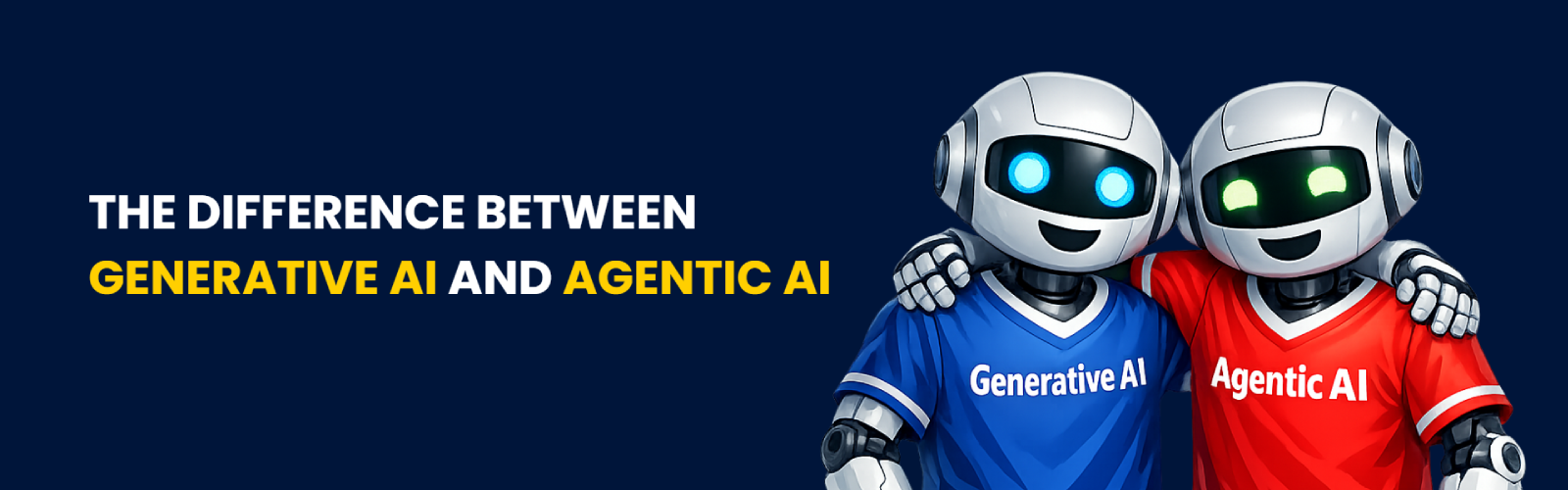
If you’ve been following the AI landscape over the past year, you’ve likely noticed a shift in the conversation. Boardrooms that were buzzing about “ChatGPT” and “Copilots” are now wrestling with terms like “AI agents,” “autonomous workflows,” and “multi-agent orchestration.” The two dominant paradigms — Generative AI and Agentic AI are frequently conflated, but understanding the distinction between them is one of the most strategically important things a technology leader or business executive can do right now.
This isn’t just academic. The gap between these two paradigms determines what you can build, how much automation you can achieve, what risks you’re taking on, and frankly, how much value you’ll extract from your AI investments. Getting this wrong means either undershooting your potential (deploying a chat interface when you need a full workflow engine) or overshooting your readiness (trying to run fully autonomous agents when your data infrastructure isn’t ready for it).
Let’s break it down: technically and commercially.
Generative AI refers to machine learning models that are trained to produce new content, like text, images, code, audio, video, or structured data, in response to a prompt. The output is “generated” rather than retrieved; the model creates something new based on patterns it internalized during training.
The dominant architecture underpinning modern Generative AI is the Transformer, introduced by Google researchers in 2017. Large Language Models (LLMs) like OpenAI’s GPT-4o, Anthropic’s Claude, Google’s Gemini, and Meta’s LLaMA are all transformer-based. For images, diffusion models (like Stable Diffusion or DALL-E 3) have become the standard.
At its core, a generative AI model is a sophisticated pattern-matching and pattern-completion engine. When you type a prompt, the model receives your text, processes it through billions of learned parameters, and predicts the most statistically coherent and useful response, token by token. It doesn’t “think.” It doesn’t “plan.” It generates.
Technically, the training pipeline involves:
The result is a model that can answer questions, write essays, summarize documents, translate languages, generate code, and engage in multi-turn conversations, all impressively, within a single inference call.
Here is the single most important technical truth about base Generative AI: it is stateless and bounded.
Every inference is isolated. The model has no persistent memory between conversations. It cannot access the internet on its own, cannot execute code autonomously, cannot send an email, cannot query your database, cannot monitor a file for changes, and cannot take a sequence of actions to accomplish a goal. It responds. It does not act.
This is not a flaw; it’s a design reality. For many tasks, you don’t want the AI to act autonomously. You want a high-quality, responsive generation capability that augments human work.
Despite its constraints, Generative AI has already delivered enormous value across industries:
McKinsey estimated that Generative AI could add $2.6 to $4.4 trillion annually across use cases, and most of what’s been deployed so far falls squarely in this passive-generation category.
Agentic AI refers to AI systems that can perceive their environment, make decisions, take actions, and pursue goals over multiple steps, and often autonomously. An agent doesn’t just respond to a prompt; it receives an objective, figures out how to accomplish it, calls upon tools and resources, tracks progress, handles failures, and iterates until the goal is met or it determines it cannot proceed.
The best analogy: if Generative AI is a brilliant consultant, you can ask questions; Agentic AI is an autonomous team member you can assign projects to.
A fully capable agentic system has four key components that distinguish it from a pure generative model:
1. Planning & Reasoning Engine: Rather than answering in a single pass, an agent uses techniques like Chain-of-Thought (CoT) reasoning, ReAct (Reasoning + Acting) loops, or Tree-of-Thought exploration to break a high-level goal into a sequence of sub-tasks. It asks: What do I need to do first? What information do I need? What’s the best path to the goal?
2. Tool Use & Action Capabilities: This is where things get real. Modern agents can be equipped with tools, callable functions that let the AI interact with the world:
This is what transforms a language model into an operator.
3. Memory Systems: Agents require memory to maintain context and state across multiple steps:
4. Perception & Environment: Agents don’t operate in a vacuum. They perceive inputs like user messages, tool outputs, error messages, database results, webpage content, and use that perception to update their plan and take the next action. This perception-action loop is the heartbeat of agentic behavior.
The most advanced deployments today aren’t single agents but multi-agent networks: architectures where multiple specialized AI agents collaborate, communicate, delegate sub-tasks, and coordinate to accomplish complex goals.
Think of it like a virtual department: an Orchestrator agent that manages the workflow, a Research agent that gathers information, a Code agent that writes and runs analysis scripts, a Communication agent that drafts outputs, and a Quality agent that reviews the final work. Each is specialized; together, they handle tasks that would overwhelm a single model.
Frameworks like LangGraph, CrewAI, AutoGen, and Anthropic’s Agent SDK are making these architectures increasingly accessible. Anthropic’s Model Context Protocol (MCP), released in late 2024, has become a major industry standard, providing a universal interface for agents to connect with external tools, data sources, and systems.
Let’s make the contrast explicit across the dimensions that matter most.
Dimension | Generative AI | Agentic AI |
|---|---|---|
Core action | Generate output from a prompt | Pursue a goal through multi-step actions |
Loop structure | Single inference: Prompt → Response | Perceive → Plan → Act → Observe → Loop |
Temporality | Stateless, moment-in-time | Stateful, time-extended |
Decision-making | Implicit in generation | Explicit: plan, decide, act, reflect |
Memory | Context window only | Short-term + long-term persistent memory |
Generative AI has zero autonomy by default. Every output requires a human input. The model is reactive, it has no initiative, no goals, and no capacity to self-direct.
Agentic AI operates on a spectrum of autonomy:
Most enterprise deployments in 2025–2026 sit in the supervised to semi-autonomous range, with full autonomy reserved for well-scoped, lower-stakes tasks like data transformation pipelines or report generation workflows.
This is the most visceral difference. A generative AI model (no matter how intelligent) cannot change anything in the world on its own. It can tell you how to send an email; it cannot send one. It can write a SQL query; it cannot run it against your database.
An agentic AI system, properly equipped, can execute real actions: call your Salesforce API, commit code to a GitHub repo, send a Slack message, run a Python script, schedule a meeting in Google Calendar, or provision a cloud resource. The boundary between AI as an advisor and AI as an operator is the boundary between Generative and Agentic.
Dimension | Generative AI | Agentic AI |
|---|---|---|
Integration Complexity | Low: API call, prompt in/out | High: tool integrations, state management |
Reliability Engineering | Moderate: output quality, prompt tuning | High: agent loops can fail, stall, or diverge |
Observability | Simple: log inputs and outputs | Complex: trace every step and tool call |
Security Surface | Prompt injection, output safety | All above + action authorization, scope control |
Cost Model | Per-inference pricing | Multi-inference per task, scales with complexity |
Neither paradigm is risk-free, but they have very different risk profiles.
Generative AI risks are largely about output quality: hallucination (factually incorrect content presented confidently), bias in generated content, intellectual property concerns, and sensitive data leakage in prompts.
Agentic AI adds an entirely new category: action risk. An agent that misunderstands its objective, encounters an unexpected edge case, or is manipulated through a prompt injection attack can take actions with real-world consequences – deleting files, sending incorrect communications, modifying database records, or spending money via API. This is why observability, sandboxing, least-privilege tool access, and human-in-the-loop gates are not optional in agentic architectures; they’re foundational.
It’s helpful to see these paradigms not as opposites but as an evolutionary progression. The AI industry has been moving along a clear trajectory:
The industry consensus is that we are in the early innings of the agentic era. Gartner placed agentic AI at the peak of the 2024 Hype Cycle, and by 2025, virtually every major AI provider, including Anthropic, OpenAI, Google, Microsoft, AWS, had pivoted their enterprise narrative to agents.
If you are building or evaluating AI systems today, the Generative vs. Agentic distinction should directly influence your architecture decisions:
The most pragmatic enterprise strategy right now is a hybrid stack: a foundation of reliable Generative AI for content and knowledge tasks, with carefully scoped Agentic AI layers for workflow automation and process orchestration.
The business question isn’t “which is better”, it’s “what problem are we actually solving?”
Generative AI excels at augmenting knowledge workers: making them faster, reducing cognitive load, and improving output quality. ROI shows up in productivity metrics, time saved per employee, content volume, and support ticket deflection rates.
Agentic AI excels at replacing entire workflows: eliminating the need for human coordination on routine, complex processes. ROI shows up in operational metrics: headcount avoided, process cycle times reduced, error rates dropped, and systems that now run 24/7 without human attention.
The strategic implication: Generative AI helps you do more with the same people. Agentic AI can fundamentally reshape how many people and what kind of people you need for certain functions. That’s a very different conversation, one that touches organizational design, change management, and job architecture.
Most organizations are moving through four stages of AI maturity:
Most large enterprises in 2026 are between Stages 2 and 3. The organizations moving fastest are those that built the data infrastructure, governance frameworks, and engineering capabilities during Stage 1–2 that let them safely deploy Stages 3–4 now.
No discussion of Agentic AI is complete without confronting the trust problem. Giving AI systems the power to take actions in the world introduces governance challenges that are qualitatively different from Generative AI.
Key principles for responsible agentic deployment:
Generative AI and Agentic AI are not competing technologies, rather, they are successive layers of the same transformation. Generative AI gave us the engine: a reasoning and language capability of unprecedented quality. Agentic AI gives us the steering wheel: the ability to direct that engine toward goals, connect it to the real world, and let it operate at scale over time.
For organizations navigating this landscape, the key is strategic clarity:
The organizations that will lead the next decade are not necessarily those with the most advanced AI models. They’re the ones that understand these distinctions deeply enough to make the right architectural choices — and have the execution discipline to operationalize AI safely and at scale.
That clarity starts with understanding the difference between a model that generates and a system that acts.
From a specific use case to a full-scale modernization, share your requirements, and our engineers will take it from there. We typically respond within 24 hours with a transparent, detailed assessment of what's possible for your business.

We are a full-stack AI development company that helps enterprises make better decisions, reduce costs, and operate more efficiently.






333 West San Carlos Street, San Jose, CA 95110 USA
6000 Rome Blvd, Brossard, Quebec J4Y 0B6 Canada
Technopolis, Kolkata, India
CTIE, Hubli, India
We are a full-stack AI development company that helps enterprises make better decisions, reduce costs, and operate more efficiently.
333 West San Carlos Street, San Jose, CA 95110 USA
India: Kolkata, WB & Hubli, KA
Canada: Brossard, Quebec