How We Use Neural Decision-Making Feedback Loops to Automate ITSM Ticket Triage
Most enterprise AI pilots in IT service management do not fail during the demo. They fail around week six of production, when someone in infrastructure opens the audit trail and finds the agent closed a P2 incident it never actually diagnosed. It guessed. The guess matched a runbook, the ticket cleared, and nobody caught it until the same incident came back a third time.
We hit a version of that on an agentic AI process automation project for ITSM and ticket triage. The fix was not a stronger model or a longer context window. It was giving the system a way to test whether its own assumption held up against the live environment before it was allowed to act on it.
That mechanism is a neural decision-making feedback loop. This is how we use it, stage by stage, and what it produced in a production ServiceNow instance.
What is a neural decision-making feedback loop?
The term neural decision-making feedback loop comes from neuroscience, and the part we borrowed is specific.
When you decide something under uncertainty, your brain does not run one forward pass and commit. The cortico-basal ganglia-thalamo-cortical circuit builds a hypothesis about the current state, gates the competing alternatives, runs a small exploratory action, then compares what happened against what it expected. That comparison produces a prediction error:
Delta = Outcome(observed) – Outcome(expected)
When Delta is large, the action does not go through. The circuit revises its state estimate and forms a new hypothesis.
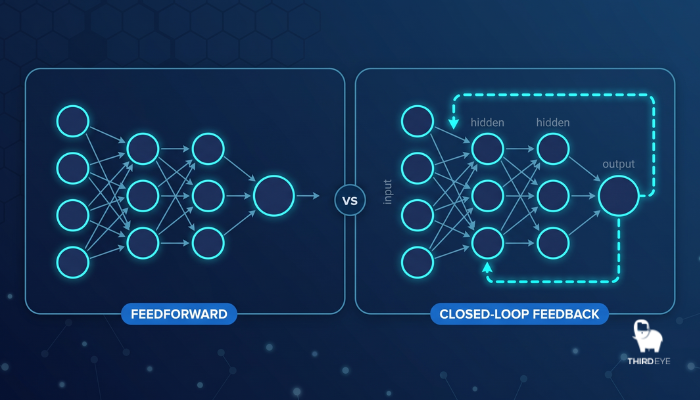
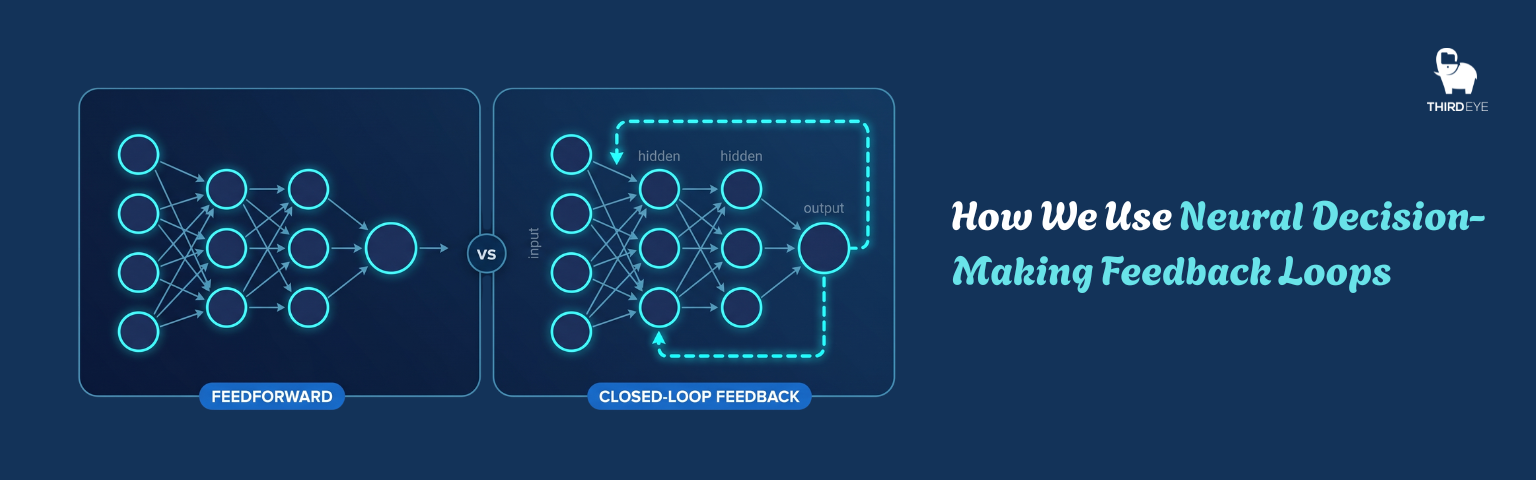
In software, the pattern reduces to a single structural difference. A standard LLM deployment is a one-way pipeline:
Ticket -> Model parameters -> Decision
A closed-loop agent adds a return path:
Ticket -> State -> Hypothesis -> Read-only probe -> Verify -> (converged? act : revise)
That single arrow back is the whole thing. It separates a system that produces an answer from one that knows whether it’s right.
Why does one-pass AI fail at ticket triage?
Enterprise ticket text is bad data. Not occasionally. Structurally.
Three real examples from the queue we worked on, lightly anonymized:
- “VPN handshake failure on Mac clients after the patch.”
- “Data pipeline worker timeout in staging, check if production billing is affected.”
- “Access dropped following identity directory sync.”
Each is a partial observation written by someone annoyed and in a hurry. None contains enough to determine root cause. A feedforward model still returns a confident classification, because returning a confident classification is the only thing it can do. It cannot answer “I need to check something first,” since checking is not a state the architecture has.
The cost lands in two places finance can see. Senior engineers lose a large share of the week re-triaging work the automation got wrong. And misrouted tickets sit in the wrong queue while the SLA clock runs, converting minor incidents into breaches with penalties attached.
Swapping in a frontier model does not change this. The failure is architectural, not a question of model quality. The system has no mechanism for doubt.
The loop we built, in four stages
Stage 1: State construction
A ticket description is an observation, not a state. When an incident arrives through the ServiceNow Table API, a perception agent enriches it before any reasoning happens. It pulls configuration item dependencies from the CMDB relationship graph (cmdb_rel_ci) so the agent knows what the affected asset actually talks to, recent change records and deployment tags in that infrastructure segment, IAM events, and open anomalies from the monitoring stack (Datadog, Dynatrace, and CloudWatch in this deployment).
The output is a grounded state vector. The reasoning layer never sees raw user prose on its own. That decision alone removed a large class of misclassification before we wrote a line of the verifier.
Stage 2: Hypothesis formulation
The orchestrator evaluates the state vector against an indexed knowledge graph of standard operating procedures and historical post-mortems, then produces a ranked candidate set rather than an answer.
For an authentication disruption, it does not pick a cause. It proposes:
- H1: Kerberos or Active Directory token expired after the overnight directory sync
- H2: Endpoint security profile or client certificate lapsed
- H3: Regional identity provider gateway latency
Three hypotheses, ranked by prior. Nothing decided yet.
Stage 3: Read-only diagnostic probe
The system tests H1 with a probe that cannot change anything. It queries Active Directory and Okta for exact token timestamps, pings the regional identity endpoints for response code distribution, and checks endpoint compliance state. No writes. No configuration changes.
We kept these probes as plain API calls rather than model-generated code. Determinism here is what makes the next stage mean anything. If the probe is itself probabilistic, you have not added verification; you have added a second guess.
Stage 4: The verifier loop
The verifier compares returned telemetry against the expected error signature of H1.
Convergence. The directory confirms an expired token above the confidence threshold. Execution gating lifts, the remediation workflow runs a controlled token refresh, work notes are written back to the ticket, and the incident closes.
Negative prediction error. The directory reports the token is valid. H1 is disproven.
A feedforward bot would have already acted on H1 and failed. Here the disconfirmation is a useful signal. The verifier writes it to working memory, prunes H1 from the candidate graph, and loops back to Stage 2 to test H2. The system is allowed to be wrong in a way that costs nothing, which is exactly what makes it safe to give it real authority.
Most tickets converge inside two or three iterations. We cap the loop, and the cap matters.
How we bounded the risk
The objection in every ITSM automation conversation is the same. What happens when the agent misreads context and takes down a production database?
The answer is not “our model is accurate.” Accuracy is a distribution, and you do not hand a distribution unrestricted write access to a production estate. We matched autonomy to consequence instead, with gating built into the loop.
Tier 1, read and diagnose. Zero mutation. APM traces, IAM logs, DNS records, CMDB verification. Full autonomy, continuously, during diagnostic loops. There is no reason to gate a read.
Tier 2, reversible mutation. Localized and low risk. Clearing a user cache, resetting an SSO session, reassigning a ticket. Autonomous execution permitted only above a 90 percent verifier confidence score. If it goes wrong, one user is briefly inconvenienced, and the action is undone.
Tier 3, mission critical. Restarting core production microservices, changing database pool configuration, updating firewall policy. Hard stop. Autonomous execution is disabled by design, not by configuration. No confidence score opens that path.
That last point is worth sitting with. Tier 3 is not a threshold set very high. It is an absent code path. A governance control that can be tuned upward under delivery pressure is not a governance control.
When a ticket reaches Tier 3, or telemetry stays ambiguous past the iteration cap, the agent compiles a structured dossier into the ServiceNow work_notes: incident signature, current root cause confidence, the full iteration history including every hypothesis it disproved, the recommended SOP, and the telemetry it already pulled. Then it routes straight to the named senior engineer for that domain, skipping tier-1 entirely.
The engineer opens a ticket with thirty minutes of investigation already done and documented. The automation did not replace their judgment. It stopped spending it on data collection.
What it delivered
Measured over [X months] of production operation against the [pre-deployment baseline period], in the incident domains in scope:
Around 70% end-to-end automation. Access requests, IAM issues, provisioning and recurring known-pattern incidents converge and close with no human intervention. This covers the domains we onboarded, not total enterprise ticket volume, and the distinction matters when you build your own case.
Median time to triage fell from about 45 minutes to roughly 12 seconds. Triage here means classification, CMDB reconciliation, and first diagnostic probe. The gap is that wide because the manual version was mostly queue latency, not human work.
MTTR compressed 62% on escalated incidents, from 4.2 hours to 1.6 hours. The pre-compiled dossier is doing most of that, not the autonomous resolution path.
Cross-team reassignment dropped sharply. Verifying telemetry against CMDB topology before routing removes the guesswork that causes ticket ping-pong. We would not claim it reaches zero across a full estate, and you should be skeptical of anyone who does.
What has to be true before this works
Four conditions predict whether closed-loop triage automation will hold up. We check all four before scoping.
CMDB accuracy. This is the one that kills projects. Verification reasons over real dependencies between configuration items. If your CMDB is 40 percent stale, the agent grounds itself in fiction and produces confident, well-structured, wrong conclusions.
API-reachable telemetry. Every hypothesis needs a deterministic way to be proven false. A diagnostic signal that lives only in a dashboard a human reads cannot close a loop.
SOP coverage with real depth. The knowledge graph is built from your procedures and post-mortems. Thin documentation means thin hypothesis generation.
An agreed risk tier map. Someone with authority has to sign off on what the system is never allowed to do alone. That happens before the build, not during UAT.
Three of those four you can assess internally this quarter without buying anything.
The advantage in enterprise AI is no longer access to the best model. It is how the model is orchestrated and governed. A feedback loop, a deterministic verification step and a hard ceiling on blast radius are what turn a generative model into something an infrastructure organization will actually approve for production.
Answering Some Commonly Asked Questions
What is a neural decision-making feedback loop in AI?
How is this different from a RAG chatbot connected to ServiceNow?
Can agentic AI safely make changes in a production ITSM environment?
What is realistic automation coverage for ITSM ticket triage?
Author Bio

Dj Das
Dj is the founder and CEO of ThirdEye Data, an enterprise AI and data engineering company headquartered in San Jose, California, with delivery teams across the US, Canada, India, and the Middle East. He writes about what separates AI projects that reach production from those that stall, with a focus on data readiness, delivery risk and industry-specific adoption.